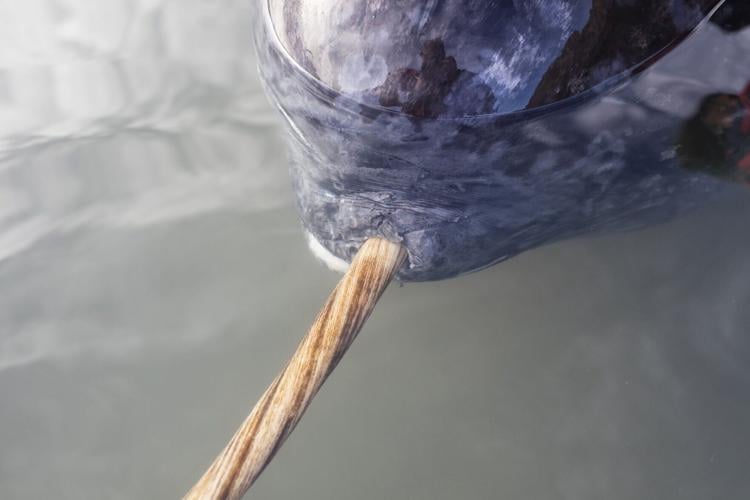
The narwhal’s tusk is the left canine tooth, which grows through the jaw and lip and can reach more than two meters in length. (Mads Peter Heide-Jørgensen, Greenland Institute of Natural Resources via SWNS)
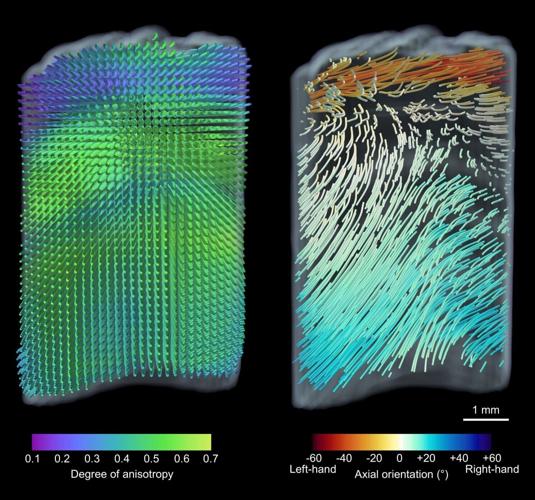
This 3D image shows how the mineralized collagen fibrils the microscopic building blocks that give the tooth its strength are arranged. It reveals their direction and how strongly they are aligned. The measurements were made using an advanced X-ray method, SAXS tensor tomography, which can map the internal organisation of the tusk in three dimensions. (Adrian Rodriguez Palomo / Nature Communications via SWNS)
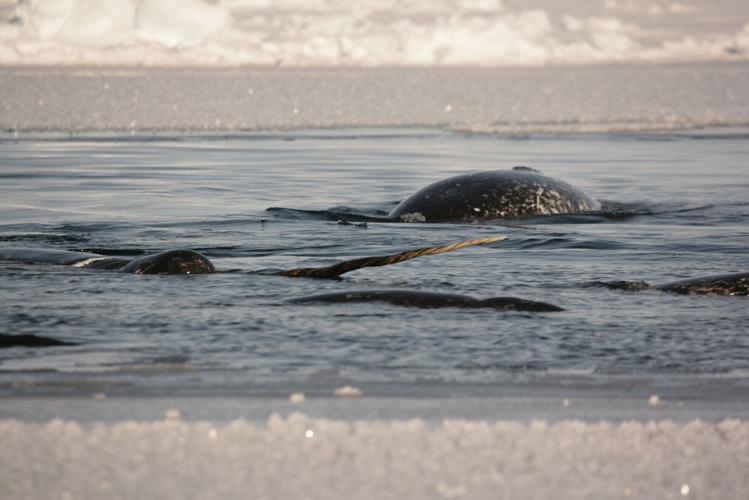
Narwhals in Northwest Greenland. (Carsten Egevang / Greenland Institute of Natural Resources via SWNS)
By Talker
By Stephen Beech
Hidden secrets of the narwhal's twisted tusk have been revealed using the latest X-ray technology.
Tusks of the species of whale native to the Arctic have long been the subject of myths — even being sold as "unicorn horns" believed to possess magical powers during the Middle Ages.
Now, an international research team has solved the mystery of how the tusk acquires its twisted structure.
But they are still not certain what the narwhal uses it for.
The narwhal’s tusk is the left canine tooth, which grows through the jaw and lip and can reach more than two meters in length. (Mads Peter Heide-Jørgensen, Greenland Institute of Natural Resources via SWNS)
Their findings, published in the journal Nature Communications, show that the tusk contains not just one spiral, but two.
On the outside, the structure twists to the left, while the interior structure twists in the opposite direction, forming a kind of "biological counterbalance" where two opposing forces meet at the interface between interior and exterior parts.
To see how mineralized collagen fibrils — the microscopic building blocks that give the tooth its strength — are oriented inside the tooth, researchers combined several X-ray imaging techniques, particularly a special 3D X-ray technique called tensor tomography.
The technique works by sending powerful X-rays through the tooth and analyzing how they scatter from the nanoscale mineralized collagen fibrils.
The team explained that the narwhal's tusk is in fact the left canine tooth, which grows through the jaw and lip and can reach more than two meters (6.5 ft) in length.
Unlike human teeth, it has no enamel but consists of dentin on the inside and cementum on the outside.
Most experts today believe that the narwhal's tusk — the only one in nature that is straight — primarily functions as a sexual signal, since it is typically males that possess one.
This 3D image shows how the mineralized collagen fibrils the microscopic building blocks that give the tooth its strength are arranged. It reveals their direction and how strongly they are aligned. The measurements were made using an advanced X-ray method, SAXS tensor tomography, which can map the internal organisation of the tusk in three dimensions. (Adrian Rodriguez Palomo / Nature Communications via SWNS)
By Talker
But the role of the tusk has been debated, in part because a very small proportion of females also develop tusks — and some males do not.
Some scientists have suggested that the tusk may be able to detect temperature, salinity and chemical changes in the water.
However, marine biologists in Greenland have found no evidence for that in the narwhal's behavior.
Due to the size and complex structure of the narwhal tusk, the research team had to deploy the biggest technological tools available.
They combined the capabilities of three enormous synchrotrons — particle accelerator X-ray sources — MAX IV in Sweden, Swiss Light Source in Switzerland and European Synchrotron Radiation Facility (ESRF) in France — to obtain enough resolution and power to map the entire interior of the tooth in three dimensions.
The analysis revealed that while the building blocks are primarily oriented along the tooth's longitudinal axis, they systematically deviate at small angles, creating a twisted structure.
Narwhals off the ice sheet of Greenland. (Mads Peter Heide-Jørgensen, Greenland Institute of Natural Resources via SWNS)
By Talker
In the outer cementum, the fibrils form a left-handed spiral, while in the inner dentin they form a right-handed spiral.
The two opposing structures meet at the transition between dentin and cementum — a complex biological boundary that now appears to be even more intricate than previously believed.
The researchers say the double-spiral structure gives the tusk favorable mechanical properties.
The structure is far more stable against bending and twisting than either a single spiral or a straight rod would be, according to the findings.
It is an architecture also found in other biological materials that must withstand large forces.
Study lead author Adrian Rodriguez-Palomo, of Aarhus University, Denmark, said: "No one has previously carried out such an advanced experiment of this type.
"We have only been able to do it by collaborating across several disciplines — namely chemistry, physics, materials science and biology.
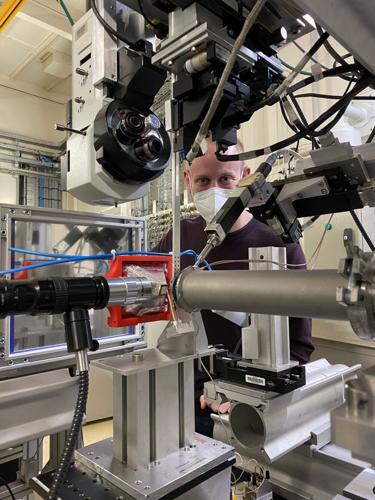
Adrian Rodriguez-Palomo, the study's lead author, at the ID13 beamline at ESRF. (Marianne Liebi via SWNS)
He said the study shows that the "double-spiral" structure is preserved across the tooth's annual growth layers — like tree rings, but with a constant twist.
Rodriguez-Palomo added: "This suggests that the left-handed growth pattern is genetically programmed and remains stable throughout the animal's life, which can extend to approximately 80 years.
"The discovery not only solves a centuries-old natural science mystery about one of the ocean's most iconic animals.
"It also provides new insight into how nature constructs advanced materials with extreme mechanical properties — knowledge that could eventually inspire the design of new composite materials for fields such as construction and medicine."
Project leader Henrik Birkedal, also from Aarhus University, added: "Since whales can live for up to 80 years, their teeth form a kind of historical record of changing environmental conditions throughout the animal's lifetime.
"And because the North Atlantic is currently undergoing very rapid changes, it is obvious to investigate whether we can trace these changes in the hard tissue of the narwhal tusk.




Commented