
The Fourth of July, 1924: Caesar Cardini’s kitchen was nearly bare, and Americans had been crossing the border from San Diego all weekend into a city where Prohibition held no power, and by nightfall, the pantry was stripped. What remained were romaine, olive oil, a coddled egg, Worcestershire, Parmesan and a heel of bread, and then Cardini carried them into the dining room, tossed them tableside and turned a depleted kitchen into a performance. Few diners thought of it as Italian; few thought of it as Mexican either.
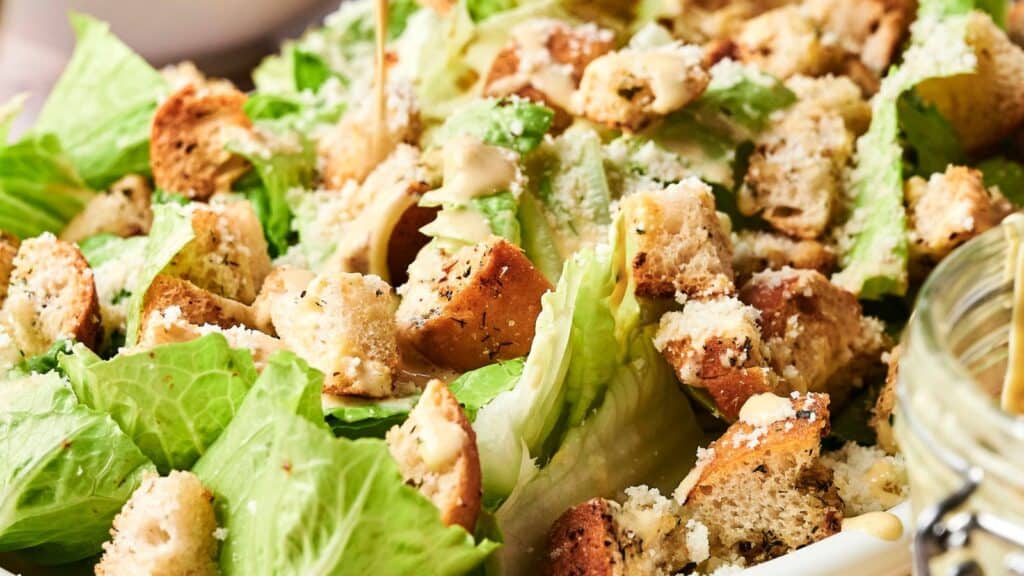
The name sounds Roman. The ingredients read like something from an Italian grandmother’s pantry: Parmesan, anchovies, olive oil, garlic. The man who created the dish was born in Piedmont, in northern Italy. So it is no surprise that for most of its first century on American menus, the Caesar has worn an Italian passport that was never issued.
The salad was created in Mexico by an Italian immigrant, making it one of North America’s most enduring culinary hybrids. It is the product of a specific collision: a Prohibition-era border town, a depleted pantry and an immigrant’s instincts. That combination is exactly what made it impossible to put down.
Today, more than a third of U.S. restaurants carry some version of it, from fine dining steakhouses to Thai kitchens to fast-casual salad chains, according to Technomic. That reach did not happen by accident. It happened because a salad born from scarcity turned out to be nearly infinitely adaptable, and because the people who carried it north from Tijuana knew exactly which rooms to walk it into first.
A Hollywood screenwriter took it national
The salad crossed the border quietly at first, passed hand to hand among the celebrities and studio executives who made regular runs south for a legal drink. The moment it broke wide came when a Paramount Pictures story editor named Manny Wolf circulated the recipe to Hollywood restaurants. New York food writers tracked its march east, and within a generation, it had arrived in New York’s finest dining rooms. The Italian-American fine dining circuit did the rest. The ingredients already lived in those kitchens, the tableside theater fit the room and nobody stopped to ask where it had actually come from.
It reads Italian, and that’s not entirely wrong
Cardini’s Piedmont roots showed up in every component. The egg yolk emulsified with olive oil into something creamy without cream: that is an Italian technique, even when the kitchen is in Baja California. The Parmesan, the anchovy umami, the garlic: mid-century American diners associated all of it with Italian cooking, which meant the Caesar slid naturally into that identity. The name finished the job. Caesar sounds Roman. Most people assumed Julius, not Cesare from Tijuana.
Culinary historian Jeffrey Pilcher, who studies Mexican foodways, does not hedge on the question. “This is an Italian salad,” Pilcher told NPR. “Caesar Cardini, the inventor of the salad, was an Italian immigrant, and there were many Italian immigrants to Mexico.” Pilcher also noted that Tijuana in 1924 was a cosmopolitan city built by Mexicans, Chinese immigrants, Californians and Europeans, a place with no single culinary identity of its own. Cardini’s Italian instincts met that environment and produced something the world would spend a century misreading.
Where the original spirit still lives
The tableside tradition that made the Caesar famous never entirely vanished. At Caesar’s on Avenida Revolución, the original location now more than a century old, the salad is still prepared the way Cardini’s staff first performed it, and the kitchen turns out up to 300 on busy days.
In the Pacific Northwest, El Gaucho has kept tableside Caesar as a signature for decades, with servers building the dressing from scratch at the table: anchovies, garlic, Dijon, Worcestershire, a fresh egg yolk, lemon and olive oil, assembled in a wooden bowl in full view of the dining room.
In Chicago, Beatrix has run a chef-driven version as its top-selling salad for more than 11 years. Chef and partner Andrew Ashmore builds it with yogurt-based dressing, little gem lettuce, capers and Grana Padano. “It’s our number one selling salad, and it has been since we opened 11 years ago,” Ashmore said. “I couldn’t try to take it off the menu if I wanted to.”
The salad and the bottle
The version most Americans know did not come from any of those kitchens. After Prohibition ended and Tijuana’s tourist trade thinned out, Cardini returned to San Diego and eventually settled in the Los Angeles area, where he began making his dressing in a kitchen behind a grocery store and eventually founded Caesar Cardini Foods. That bottled product introduced the Caesar to the American mainstream and altered it in the process.
Cardini reportedly disliked the heavy, creamy versions that came to dominate the market. The original was lighter: a quick emulsion of oil and egg, bright with citrus, built on technique rather than volume. Today, 43 million bottles of Caesar dressing worth $150 million are sold in the United States annually, according to Nielsen IQ. The bottle won. The recipe, in the hands of the restaurants still doing it right, did not lose.
The Caesar does not belong to Italy, Mexico, Hollywood or the American steakhouse. It belongs to a specific kind of moment: the one where you work with what you have, make it look intentional and somehow produce something that outlasts everything around it. More than a century on, it is still on the menu. The hotel kitchen in Tijuana just never made it onto the label.
Jennifer Allen is a retired professional chef and long-time writer. Her work appears in dozens of publications, including MSN, Yahoo, The Washington Post and The Seattle Times. These days, she’s busy in the kitchen developing recipes and traveling the world, and you can find all her best creations at Cook What You Love.
The post The Caesar looks Italian, tastes Italian and was born in a Mexican kitchen emergency appeared first on Food Drink Life.


Commented