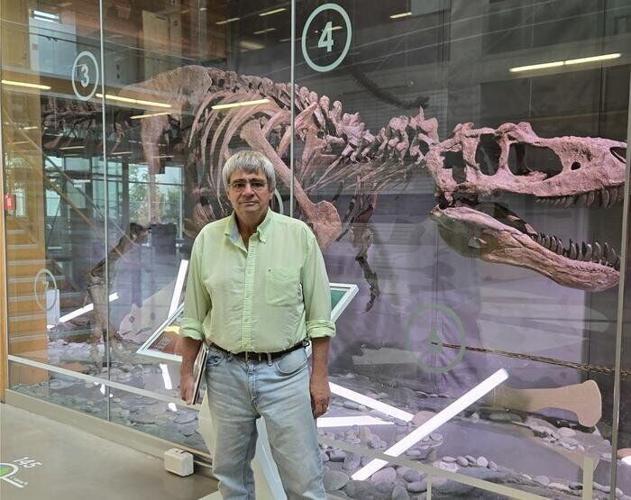
Dr. Philippe Claeys, a visiting professor at the University of British Columbia, in front of an exhibit at the Pacific Museum of Earth. (University of British Columbia via SWNS)
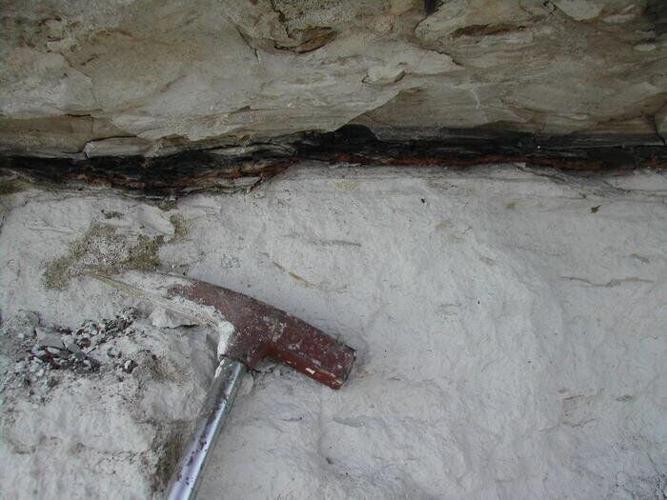
Residue of the Cretaceous-Paleogene impact. Dark clay-rich KT boundary layer in Stevn’s Klint, Denmark used in the study. (Dr. Philippe Claeys via SWNS)
Dr. Philippe Claeys, a visiting professor at the University of British Columbia, in front of an exhibit at the Pacific Museum of Earth. (University of British Columbia via SWNS)
By Talker
By Stephen Beech
Dinosaurs were unlucky to be wiped out by an "oddball" meteorite 66 million years ago, say scientists.
Fine debris thrown into the atmosphere by the space rock, rather than chemicals, was most likely responsible for killing off many of Earth's species — including the iconic reptiles, according to new research.
An international research team identified the class of meteorite responsible for the dinosaurs' extinction as a rare carbon monoxide chondrite.
Scientists in Canada, Belgium, France and Austria used advanced nickel isotope analysis of samples to narrow down the composition of the deadly Cretaceous-Paleogene meteorite.
They say the Cretaceous-Paleogene impactor was around six miles wide.
It slammed into the Earth's surface at an estimated 40,000 mph forming the massive Chicxulub crater.
The impact zone is buried underneath the Yucatan Peninsula in Mexico.
Philippe Claeys, who worked on the study as a visiting professor at the University of British Columbia in Canada, said: "Carbonaceous chondrites of the Ornans class are definitely not like the typical meteors you find in museum collections.
"It contains much less volatile elements — like carbon, zinc, water and particularly sulfur — than other classesof meteorites we've discovered so far on Earth.
"It doesn't alter our theory of what caused the extinction event — but it makes it less likely that sulfur contained in the impactor was the smoking gun.
Residue of the Cretaceous-Paleogene impact. Dark clay-rich KT boundary layer in Stevn’s Klint, Denmark used in the study. (Dr. Philippe Claeys via SWNS)
By Talker
"The fine debris thrown into the atmosphere would have the primary factor."
Researchers in France conducted high-precision nickel isotope measurements of samples collected over years from a thin layer of clay created across the globe by the impact.



Commented