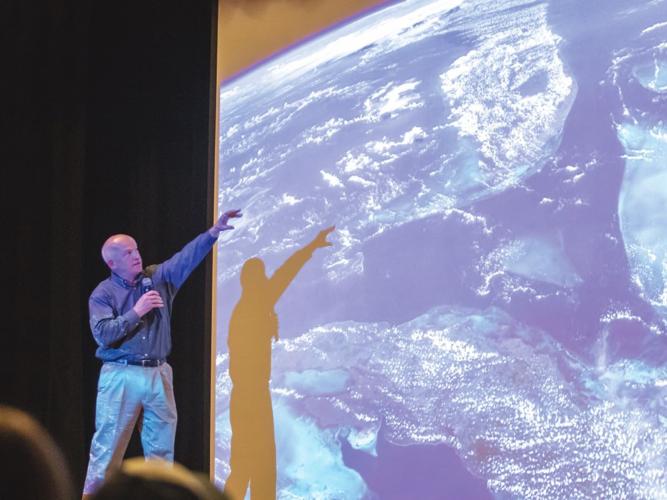
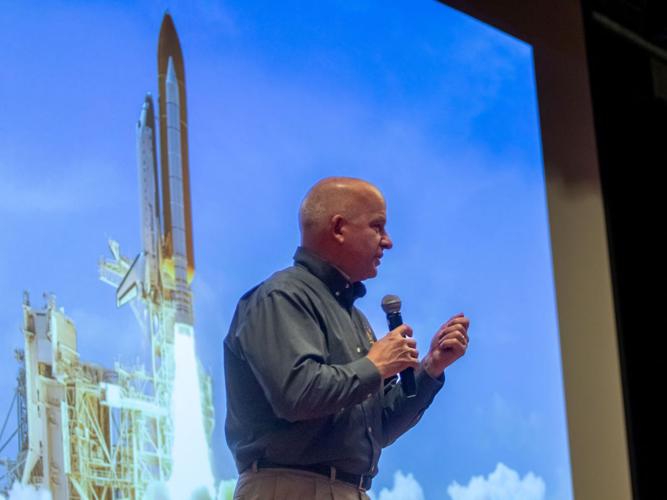
ASA Astronaut Jeffery Williams speaks to the audience at the Hood River Middle School Theater on March 21. Behind him is a photo of the International Space Station — which Williams made six trips to.
NASA Astronaut Jeffery Williams speaks to the audience at the Hood River Middle School Theater on March 21. Behind him is a photo of the International Space Station — which Williams made six trips to.
HOOD RIVER — On March 21, the Gorge Technology Alliance (GTA) hosted NASA Commander and retired U.S. Army Colonel Jeffery Williams at Hood River Middle School to talk about his experiences and answer questions about conducting research onboard the International Space Station (ISS). Williams played a key role in the design, construction and operations of the ISS.
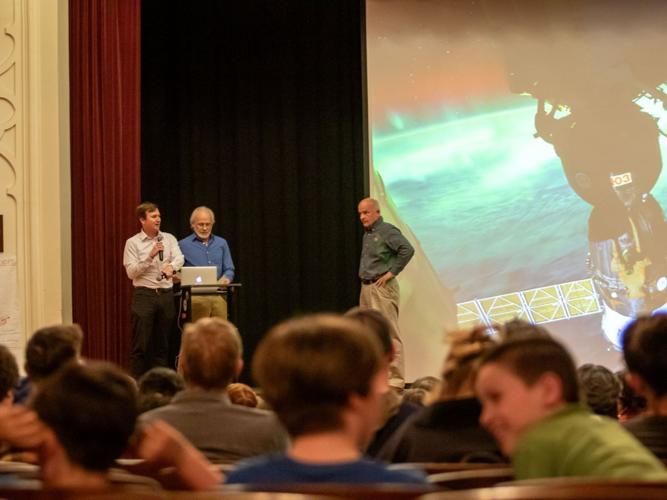
GTA Project Manager Jason Hartmann organized the event and introduced Williams.
“His remarkable journey spanning over six missions to the International Space Station, and countless hours of dedication to the pursuit of knowledge serves as a beacon of inspiration for us all,” Hartmann said. “As we gather here today, we’re not only privileged to hear from a distinguished astronaut, but also to celebrate the spirit of collaboration and curiosity that defines our community.”
ASA Astronaut Jeffery Williams speaks to the audience at the Hood River Middle School Theater on March 21. Behind him is a photo of the International Space Station — which Williams made six trips to.
Noah Noteboom photo
Williams explained that his stop at HRMS wasn’t his first visit of the day. Williams and his wife reside in Bend and made stops at Wy’east Middle School and Henkle Middle School in White Salmon.
“Great, great student bodies, both of them are very engaged, a lot of interaction,” Williams said.
Williams told Columbia Gorge News that he learned about the Gorge Tech Alliance during a conference in Vancouver last year. He declared his interest in coming to Hood River and it took a few months to find the right time, but eventually it all worked out.
“I just appreciate the support everywhere I go. People love space. They love to hear about space, and I feel a sense of obligation, if you will, to share it with the public,” Williams told Columbia Gorge News.
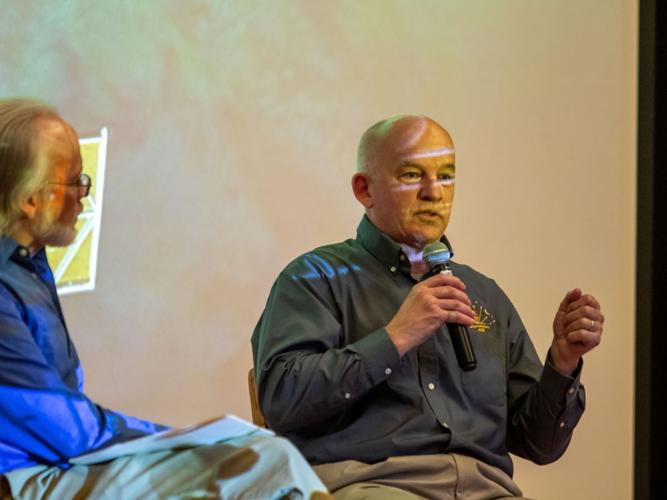
Jeffery Williams answers questions from the crowd at the Gorge Tech Alliance’s 3/21 Liftoff event on March 21 at the HRMS Theater.
Noah Noteboom photo
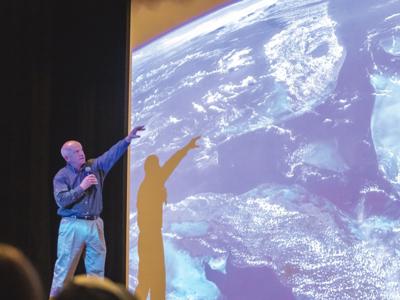
During his presentation Williams showed images and video he captured during his time on the ISS. He shared aerial photos of the Columbia River from space. He showed images from his spacewalks and missions outside of the ISS capsule.
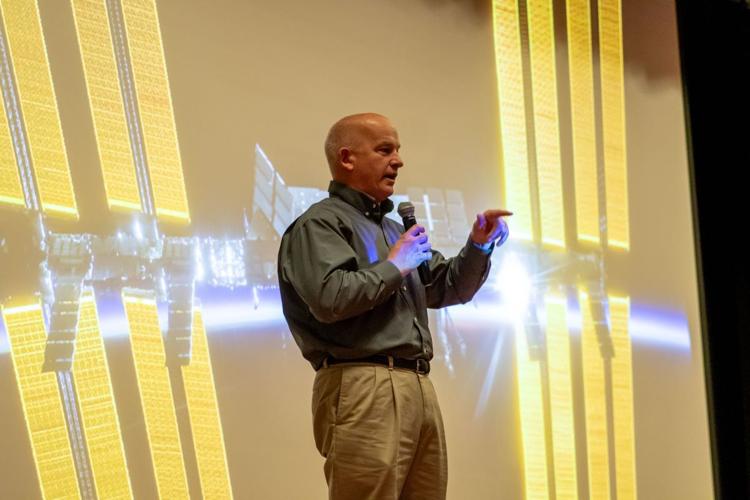
Williams said that the ISS has been inhabited by humans continuously since 2000. In conjunction with Russia, Japan and other countries included in the European Space Agency, astronauts routinely maintain the capsule and conduct research missions while on board of the ISS.
“When you get the force of gravity out of the laboratory, you can do a lot more science and we use it for technology development. Things work differently in terms of being in weightlessness than they do here on Earth. It’s a great platform to develop technologies that will be used in future space exploration,” Williams said.
He also addressed working with Russian astronauts amid the ongoing conflicts in Ukraine.
NASA Astronaut Jeffery Williams speaks to the audience at the Hood River Middle School Theater on March 21. Behind him is a photo of the International Space Station — which Williams made six trips to.
Noah Noteboom photo
“People are surprised we’re still working with the Russians, given what’s going on in the world. And particularly in the same station. Ironically, the program was designed where we are dependent upon the Russians, and they are dependent upon us,” Williams said. “It’s been frankly, a highlight of my experience.” By his estimates, he believes he is the only American who has flown on the Russian rocket, Soyuz, three times.
Williams went into detail about how astronauts return to Earth. He said once they reenter the atmosphere, the landing process takes about 10 minutes and they must carefully calculate their descent.
“To land in Kazakhstan, we would be flying backwards, fire the main engine of the spacecraft for a little over four minutes [while] over the southern tip of South America. ... [Now] we’re going to enter the atmosphere over northern Africa and get into the deeper part of the atmosphere at the eastern end of the Mediterranean Sea, carry across the Middle East into Kazakhstan,” Williams explained.
He added that the capsule will reach up to 4Gs of force and must withstand temperatures of over 3,000 degrees Fahrenheit upon reentry. The capsule takes over and utilizes thrusters and a specially designed Drogue parachute, which provides control and stability as they land.
Jeffery Williams answers questions from the crowd at the Gorge Tech Alliance’s 3/21 Liftoff event on March 21 at the HRMS Theater.
Noah Noteboom photo
“Let me tell you that was the longest 25 seconds of my life,” Williams said on the landing process.
Williams retired from active duty in the Army 2007 with more than 27 years of military service and 3,100 hours in more than 50 different aircraft. More recently in January, Williams retired from NASA.
To learn more about the Gorge Technology Alliance and their upcoming events visit their website at crgta.org.



Commented