
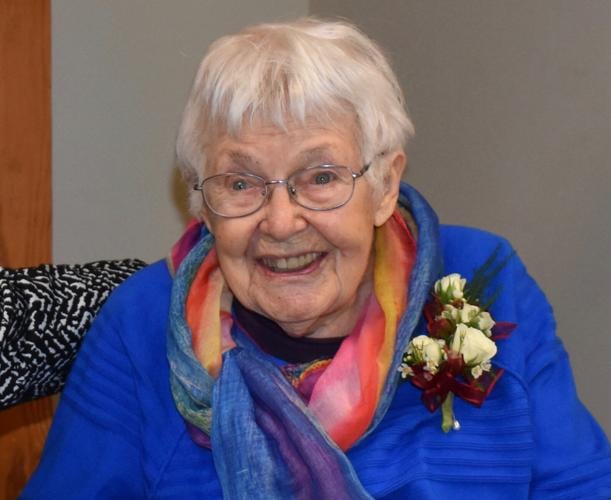
Linda Driscoll thought it would be fitting for her mom Bobbie Fallon, a 100-year-old World War II veteran, to join in the upcoming July 4 parade in The Dalles.
She enlisted friend Terry Armentrout to help make that happen, and now, not only is Fallon in the parade, she will be the grand marshal.
“Every veteran watching this parade ought to stand up to their best ability and salute as Bobbie goes by,” said Armentrout, who attended West Point. “Because she is just that kind of a lady. She stood up and served her country well and she’s still in the game.”
When Fallon, who turned 100 March 11, heard she’s be grand marshal, she quipped, “It won’t be hot will it?”
The parade is Monday, July 4, starting at 10 a.m. — hopefully early enough to beat the heat.
Fallon grew up on a dairy farm in Stanwood, north of Seattle — she attributes her longevity to eating right and drinking milk — and met her future husband there when her family invited local soldiers over for dinner while she was home from college.
She said her family was very patriotic, and noted her uncle Frank H. Hancock, was killed in the final months of World War I.
In December 1941, she was partway through sophomore year at Washington State College, as Washington State University was then known, pursuing a double major in English and journalism. She thought she’d become a teacher someday.
“And then came Pearl Harbor. I still remember that day at the dorm,” she said of the Dec. 7, 1941, attack that drew the United States into World War II. A friend “burst open” her door to say the Japanese had bombed Pearl Harbor. “Well, who knew about Pearl Harbor at that time? Nobody.”
She dropped out of school and joined the Women’s Army Corps.
A college friend was studying physical therapy so she knew about it, so when her group was asked if anyone wanted to study physical therapy, she volunteered.
She trained at the University of Wisconsin, where her roommate had a photographic memory. “Think what that did to me. I had to work hard to study Gray’s Anatomy, this thick book, and she just flipped the pages and had it memorized.”
She recounted heading off to war by boarding a ship in New Jersey. A band played as the troops boarded. “When it was the last two loaded, it was another physical therapist and myself, the band quit playing. We didn’t have the band. Terrible!”
Eventually, she was in England, stationed in the same building where General Dwight D. Eisenhower, supreme commander of the Allied Expeditionary Force, planned the June 1944 invasion at Normandy, France, which turned the tide of World War II.
She also had a picture of her “with” General Eisenhower. As he walked past a line of personnel, she’d poked her head out just as someone snapped his picture. In modern parlance, she photobombed him.
A few months after Normandy, Fallon was a part of Operation Dragoon, an Allied invasion in August 1944 that landed on the French Riviera and attacked the German Army from the south as the Germans were retreating from the north after the Normandy invasion.
After they landed in France, they boarded crowded trains on their continued journey. It was “cold, very cold,” that moonlit night, Fallon recounted. She started to hear what she thought was gunfire and figured they were nearing the front, but it was just soldiers in other train cars stomping their feet for warmth.
She never did hear bombing, but did hear Allied planes inbound from England on bombing runs. “You just lay awake, waiting for the planes to go back.”
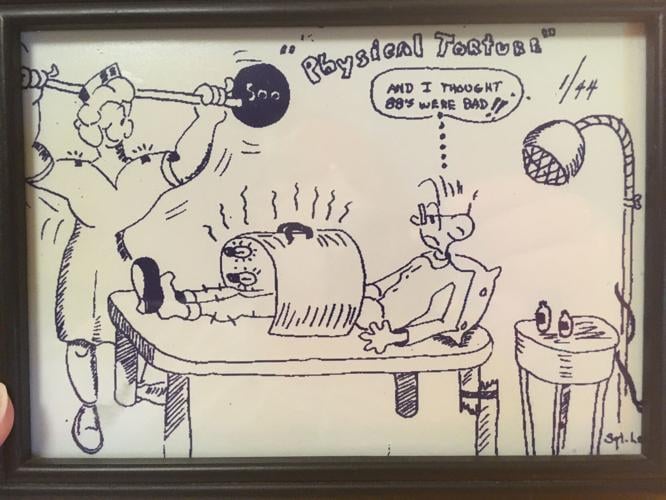
She treated wounded soldiers just days after they’d been injured. She still has a cartoon drawn for her by one of her patients. It labeled the treatment as “physical torture,” and the patient in the cartoon quips, “And I thought 88s were Bad!!”
Fallon explained, “88s are bombs.”
Fallon enjoyed her work with soldiers. She saw all types of injuries. “They were glad to get out of the fighting. They’d been fighting so long and they were happy to hear an American voice, and they responded well.”
Fallon’s future husband, Dale Fallon, was due to get out of the Army National Guard on Dec. 8, 1941. That, of course, didn’t happen. He ended up serving in the 41st Infantry Division as an infantry platoon leader in the jungles of New Guinea, where he served for three years, the longest tour of duty of any unit in the war, said Driscoll.
“Three years was a long time to serve in the jungle,” Fallon said.
Dale Fallon was awarded the Bronze Star for heroism and the Purple Heart, which is given to those who are wounded. He was part of an invasion force landing under heavy Japanese fire.
Soldiers were ordered not to go into a nearby shell hole, but did anyway, and were promptly bombed there. “He went over to the shell hole, to look at the carnage, and was leaning over, looking in, when he got the shrapnel to the butt,” Fallon said.
Dale Fallon, who, like his wife was a second lieutenant, died at age 98 four years ago.
Early in her deployment with Operation Dragoon, her group of WACs was walking in formation, and there was “a signal corps group that had been enduring extreme fighting conditions and one of the guys whistled at us, and one of the girls who was from the South, really told him off.”
She said it was “pretty likely” the admiring soldier was Black. “Having lived in the Northwest, I had not been exposed to that terrible alienation of the people in the South. You know, how they dismissed the negro. Where I was from, all was equal, but not the South.”
When they weren’t working, she and a friend rode bikes all around the French countryside, but Fallon didn’t actually see any of it too clearly, since “you know the adage, men don’t make passes at women who wear glasses.” She was nearsighted, so without her glasses, the beauty was a blur.
She recounted how a physical therapy friend’s husband led a charge up Omaha Beach on D-Day. “The water was pink,” Fallon said. He made it to the top of a hill and was briefly taken prisoner by a German. He told the German where he was from, and the German said, “’Oh, my wife and I went on our honeymoon there.’ It’s a small world,” Fallon said.
During her work in France, Fallon became good friends with a jolly, friendly chaplain who needed PT for an arm injury. “He got too close when they bombed Hitler’s headquarters and he was hit by a rock and it caused neurological damage to his arm.”
Bobbie and Dale married in 1946. They had three children by the time they moved to The Dalles some 70 years ago, and they would have three more. Driscoll, her oldest daughter, recounted that her mom kept the kids home from school to watch Celilo Falls get inundated in 1957.
Driscoll marvels at how her mom managed it all. She raised six kids, made dinner every night, and when her youngest started first grade, she started working from home as the first physical therapist in The Dalles.
Fallon said her husband converted a picnic table into her PT table, and she worked out of the basement.
Fallon said she did many house calls as well, and sometimes, she would see people in a three-county area in one day and put 300 miles on her car doing it.
She charged $3.50 per session back then. “I loved my work in therapy. When you like what you’re doing it helps. You do a good job.”


Commented