
CASCADE LOCKS — As the Bridge of the Gods enters its centennial year, its owner, the Port of Cascade Locks, is obtaining new information about the bridge’s condition gleaned from early findings of an ongoing study focused on pedestrian safety, bridge preservation, and seismic resilience.
The study, undertaken and managed by the port’s contract engineering firm Parsons Transportation Group, kicked off in early 2025 and is designed to assess existing conditions and identify key opportunities for safety and preservation enhancements.
Since opening in 1926, the Bridge of the Gods has served as a critical crossing of the Columbia River, linking the community of Cascade Locks, Oregon, with Skamania County, Washington. Originally built by the Wauna Toll Bridge Company, the bridge was purchased by the Port of Cascade Locks in 1961.
For over sixty years, the Port has overseen maintenance and targeted improvements to keep the bridge in service as the surrounding communities grew and modernized, and as tourism increased in this panoramic region of the Columbia River Gorge.
“The bridge was designed for a different era,” said Port President Brad Lorang. “Today, it serves heavier trucks, year-round traffic, and pedestrians in ways the original designers couldn’t have imagined. Now at the bridge’s 100th anniversary, we’re working to better understand how those modern demands affect this historic structure and how to preserve it responsibly while enhancing safety for future generations.”
The study is a multi-year effort focused on three objectives: improving pedestrian safety, extending the bridge’s usable life, and enhancing seismic resilience. The study was funded through a $6 million allocation from the Oregon Legislature, spearheaded by Representative Jeff Helfrich (District 52) during the 2024 short legislative session.
“The Bridge of the Gods is a lifeline for families, workers, and businesses on both sides of the river. Securing this investment was about protecting safety today while planning responsibly for the future,” said Representative Helfrich (R-Hood River). “I’m proud to have helped move this forward, and I’ll keep working with our local partners to make sure this bridge continues to serve our communities for generations. I appreciate the Port of Cascade Locks for their continued stewardship of the bridge.”
Initial findings
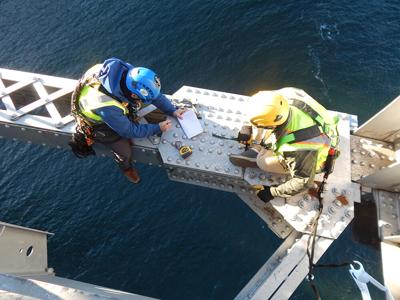
Early phases of the Bridge of the Gods study have included extensive technical fieldwork and analysis to better understand existing conditions. Work completed to date includes detailed surveying and mapping, over 200-foot-deep geotechnical borings of the below-ground soil layers, bathymetric analysis of the riverbed, underwater inspections of bridge piers, hands-on inspections of key structural elements, and the installation of structural health monitoring equipment that is now providing real-time data.
The work has produced several important early findings: Foundations and substructure are in better-than-expected condition. Underwater inspections performed by divers from AUS, Inc. show that key bridge foundation protection systems are holding up to swift river flows and do not appear to be severely affected by scour.
Seismic conditions are more favorable than expected. Preliminary evaluation by Parsons with geotechnical information supplied by Shannon & Wilson indicates the main bridge piers are likely founded in an old bedrock layer known as the Ohanapecosh Formation, which is deeper than deposits from the landslide debris composing much of both banks of the river.
Continuous data collection is helping the port understand real-time strains and stresses. Newly installed structural health monitoring systems by Move Solutions are operational and collecting data, allowing Parsons engineers to better understand how the bridge behaves under daily traffic and changing environmental conditions.
Critical information gaps have been filled. Hands-on inspections, drone scans, and field investigations have enabled close-up evaluation of structural elements that were previously inaccessible. Many of the original engineered blueprints, which had been destroyed in a fire, have now been recreated, improving understanding of the bridge’s composition.
What comes next
With a technical baseline now established, the study moves into its next phase of work. In early 2026, the Parsons team will conduct a vessel collision assessment to better understand navigation risks, continue monitoring structural health and performance data, and begin conceptual development of potential retrofit actions.
“This phase of work is about understanding the bridge as it exists today,” said David McCurry, PE, Project Manager and Lead Bridge Engineer. “The data we’re collecting and analysis of the bridge will guide future evaluations and help the Port plan thoughtful, phased investments that support safety, resilience, and long-term preservation.”
In collaboration with the port, teams will also begin advancing long-term preservation planning to extend the bridge’s service life through phased, manageable investments, while identifying initial safety actions that can be implemented in the near term. By the fall of 2026, the port plans to release a preliminary set of potential next steps for review and discussion, informed by ongoing study findings.
The information presented reflects preliminary findings based on work completed to date; further analysis and evaluation are ongoing, and final conclusions will be developed as the study progresses.


Commented