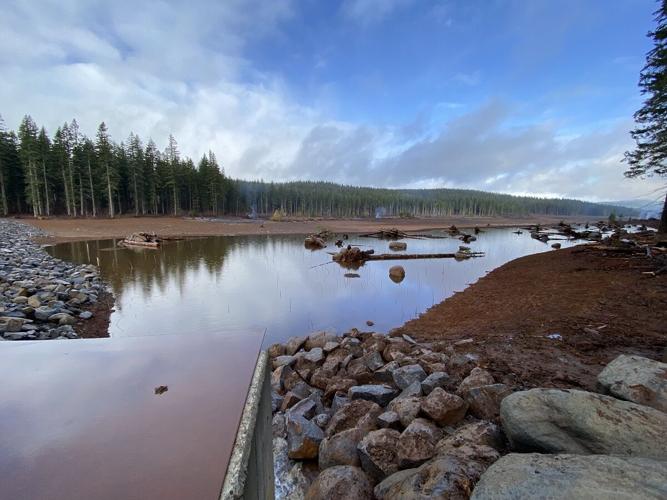
A new man-made wetland sits below the new dam, above. The existing wetland was disturbed to lay new piping, so the Farmers Irrigation District created a brand-new location for the wildlife.
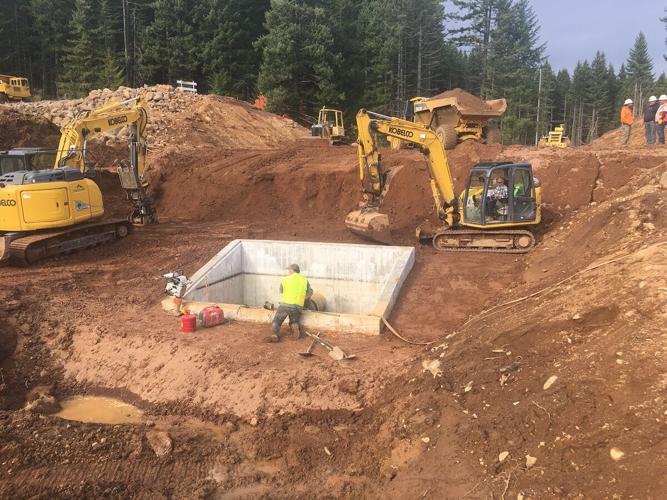
Workers configure the last sections of the updated outlet pipe at Kingsley Reservoir. The Farmers Irrigation District (FID) secured funding to replace the 80-year-old deteriorated pipe. FID Manager Les Perkins said they will never have to replace the piping again.
A new man-made wetland sits below the new dam, above. The existing wetland was disturbed to lay new piping, so the Farmers Irrigation District created a brand-new location for the wildlife.
Photo courtesy Farmers Irrigation District
HOOD RIVER — After years of delays due to poor weather conditions, threats of wildfire, holdups in permitting and supply chain issues, the Kingsley Reservoir expansion project is nearing completion. On April 14, Farmers Irrigation District (FID) Manager Les Perkins told Columbia Gorge News that the day use area will be available to the public in June. This follows extensive upgrades and improvements to infrastructure in order to combat climate change and a decline in snow pack on Mount Hood.
Perkins and the FID have been working to reopen the popular recreation area since it closed in 2017. Improvements include raising the height of the dam by 11 feet, replacing the existing 80-year-old outlet pipe and valve, relocating the campground to the opposite side of the reservoir and installing new flow monitoring systems.
Due to nearly doubling the amount of water capacity in the upper reservoir the existing campground has flooded, but the FID and the county has plans to create two overnight camping areas. Perkins estimates around 24 sites will be built by the FID on the southwest corner and available to the public in July. The county is currently seeking grant funding to complete the second camping area. Until the FID can put the finishing touches on the campground, workers are waiting for the weather to clear.
Workers configure the last sections of the updated outlet pipe at Kingsley Reservoir. The Farmers Irrigation District (FID) secured funding to replace the 80-year-old deteriorated pipe. FID Manager Les Perkins said they will never have to replace the piping again.
Photo courtesy Farmers Irrigation District
Perkins maintains that expansions of this magnitude don’t happen often, let alone receive the amount of funding they have. A basin study in November 2015 seriously initiated expansion talks, although it had been lightly discussed for 50 years prior.
“We (the FID) did a downscaled climate model where we looked at likely precipitation trends, glacial recession, all of those things,” said Perkins. “The modeling told us was that we were unlikely to be able to meet our in stream flow targets with just conservation alone.”
According to the FID website, they received $3 million in funding from the Oregon Water Resources Department to fund the expansion of the upper reservoir and replacement of a section of the Lowline Pipe along with another $3 million from the Clean Water State Revolving Loan Fund. Currently, Perkins estimates that, to date, project has cost $5.2 million.
Due to holdups in the permitting process and supply chain, this project has been slow to reopen back up to the public. For the FID to fill water to the desired capacity, new water storage rights requires and upgrades to upstream fish screens must be in place.
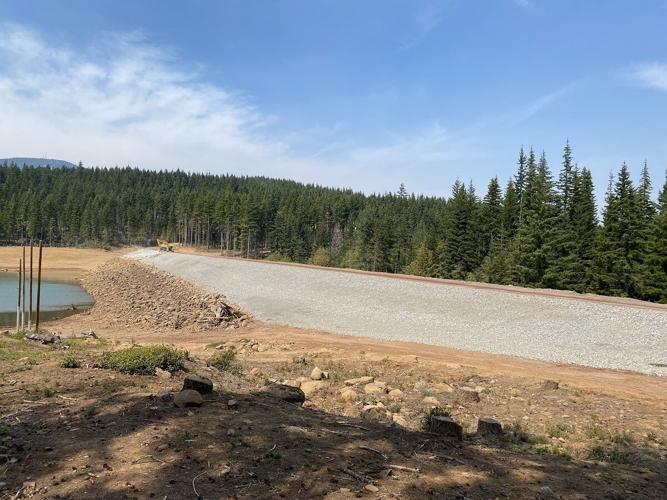
The new dam was raised by 11 feet to accommodate an increase in reserve water for the later months in the summer.
Photo courtesy Farmers Irrigation District
After deliberations with National Forest Service, the FID has to replace existing fish screens upstream from the reservoir. This added requirement complicates the process. According to Perkins, the fish screen is on Forestry land and demands additional permitting. The FID currently has an easement in place and is currently working with the screening division in the Oregon Dept. of Fish and Wildlife (ODFW). The irrigation department will work alongside the Division of State Lands and the Army Corps of Engineers to permit the replacement. All this must happen before the reservoir can be filled to the new storage capacity.



Commented