Beneath tents adorned with dozens of paper flags, each bearing the name, internment camp number and birthdate of a Hood River area resident of Japanese descent who was interned during World War II, the Japanese Heritage Garden celebrated its 10th anniversary on Friday, May 17, with a series of commemorative speeches, readings of letters written by Japanese children in internment camps to their teacher in Hood River, and a performance by Portland Taiko.
Japanese flower arrangements, prepared by the Odell Garden Club, and a video of the garden across several seasons were also on display inside the OSU Extension Office, alongside tea and cookies.
“I am filled with a sense of pride to see Japanese culture transferred to a new society and thriving in its new environment,” said Consul Hiro Sato of the Consular Office of Japan in Portland, reading from a letter written by Consul General Kojiro Uchiyama. “This garden is particularly significant, as it looks out upon lands which the past generation of Japanese settlers was instrumental in developing,” he said. “May the garden become more beautiful with each passing year and bring happiness to the people of Hood River.”
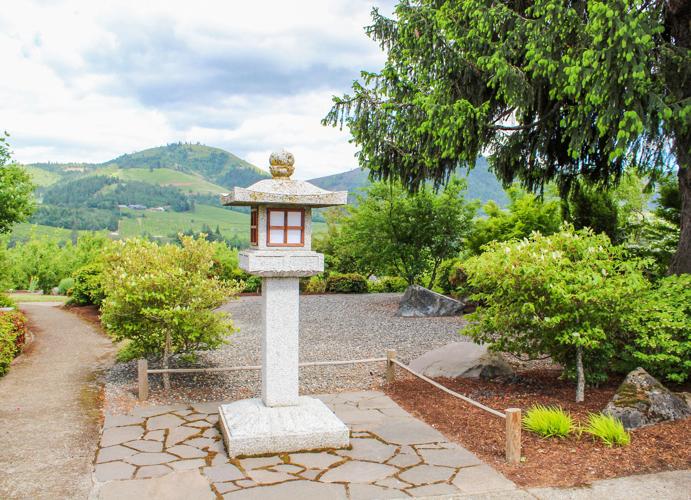
Tucked away between the OSU Extension Office and the Experiment Station at the Mid-Columbia Agricultural Research and Extension Center, the Japanese Heritage Garden was designed by Sadafumi Uchiyama — the curator of the Portland Japanese Garden — in 2007 and completed in 2009.
“As we researched the history of Japanese Gardens, we learned that, in the internment camps, the Japanese created their own gardens to have a place of peace by just using plants they could find and natural resources that they could find in the area,” said OSU Master Gardener Sandi Rousseau. “We hope that all the visitors to the Japanese Garden here will find a place of beauty that also provides you a sense of peace.”
One of the main focal points of the garden is a stone lantern — a rare replica of the lanterns found abundantly in the Kasuga Grand Shrine, one of the oldest Shinto shrines in the central Nara area of Japan. “I want to bring a little bit of that history from that shrine,” said Uchiyama. “It’s one of those things, the continuity and the history this particular piece actually brings that whole history to the Hood River. This is definitely a tribute to all Japanese descendants and the friendship between two countries.”
The creation of the heritage garden was first proposed by Master Gardener Rita Saling in 2007. “When we decided to build the garden here, in order to honor all those people who were sent away, I spent most of my time focusing on the internment itself and on the camps, what life was like in the camps, and the gardens that were built in the camps, because I thought that was a good way to make our garden fit in with the way the Japanese gardens are regarded,” Saling said at Friday’s anniversary celebration.
She spoke about her research into internment camps, and about how poorly those who returned to the Hood River Valley were treated. Hood River residents organized campaigns and used fear tactics to drive the returned Japanese residents out of the community, Saling said. She finished her speech by thanking those who returned and stayed for their perseverance and their contributions to the community. “Our garden is just a small recognition for what you have suffered and what you have contributed to this valley, and I believe our garden is truly a heritage garden.”
Three descendants of some of the interned children who wrote letters back to their teacher in Hood River were invited to read segments of those letters aloud. The letters primarily dealt with simple things like food, the hot weather, travel and housing conditions; one, read by LisaAnn Kawachi, included a postnote: “Please tell everybody there is no place like home. Everybody doesn’t think so.”
“I think you can see that these brief letters tell the story of a very industrious people who were well integrated into their community, who were hustled off to very inhospitable places based on totally unrealistic fears,” Rousseau said. “They’re very relevant to the world we live in today, and it’s very important to remember this history and underline these lessons learned in the Hood River Valley.”




Commented