
Cost would increase 25-cents per hour
HOOD RIVER — February and March Hood River City Council meetings have started off with intense periods of public comment and protest regarding the war and genocide be-tween Palestine and Israel. Many community members spoke in favor of the council approving a resolution for ceasefire, like ones adopted in Seattle and Multnomah County.
After about an hour of opinions from the public, Mayor Paul Blackburn explained that the council has several models of resolutions to review and adapt. Councilors expressed that, while the public can continue to voice concerns on this issue, it will take time and there are other matters in the city that fall within their elected duties.
“While we are struggling with the great moral issues of our time, there should be paved roads, and there should be police, and there should be planning, and there should be parks, and there should be snowplows,” Blackburn said. “That’s what we’re here for. And if you want somebody who believes something else you can vote for the other guy … There are other genocides that we should speak out on as moral people but that’s not what you elected me to do.”
Financial report
City Finance Director Chris Longinetti spoke to city council in March to review the financial performance report for July through December 2023. Overall, many items came in below the projected revenues, namely aspects that involve tourism and occupancy rates like hotels and lodging, parking receipts, and marijuana taxes.
Longinetti said that general fund revenue is 4.5% below budgeted expectations while other major revenue sources are within 2% of expectations and in-line with budgets. He charted 3.7% growth over the previous fiscal year and projects a very small surplus or at least a balanced budget for this fiscal year.
“For conservative purposes, we have assumed for projections that we are using the contingency fund. I think we will use some of it, I don’t know that we will use all of it,” said Longinetti. He told city council to be aware of what funds they are using and what projects they are prioritizing.
Longinetti also presented a Consolidated Schedule of Fees, Rates, and Charges for Hood River for 2024. Annual fee increases occur to cover city budgets for services like police and fire, street and water maintenance and building inspections. Proposed changes each year are based on general inflation adjustments, such as the 3.6% increase in 2023. A 2.7% increased has been proposed for Construction Price Indexes. Increases for 2024 mainly revolve around street and lot parking in the downtown area, as the last hourly parking rate increase was in 2016-2017, when it was increased from 75 cents to $1.
Longinetti said accessible options like the mobile Passport app and Cale pay-to-park stations were infrastructure investments that the city should cash in on. He also explained the “85% rule” which suggests that once an area reaches 85% occupancy, “more aggressive parking management strategies are called for.” Some streets or lots reach that occupancy on certain holidays or during special events, though not for a majority of days.
Proposed changes include:
• Increasing street parking rates from $1 to $1.25 per hour
• Increasing rates in Cascade, Front, and State Street lot from $55 to $60 per month
• Increasing “failure to pay” from $30 to $35
• Increasing the “28 day non-payment fee” from $10 to $15
Many of these new rates are still below other local fees like the Port of Hood River, and Longinetti said these increases keep Hood River more consistent with other regional providers.
Urban Renewal
Many city council meetings have included discussions and agendas from the Urban Renewal Agency (URA), with Urban Renewal Administrator Will Norris leading presentations. In early March, Norris proposed increasing the Waterfront District’s maximum indebtedness by $2.15 million, for a total maximum indebtedness of $7.9 million.
The previous limit was set in 2008 at $5.75 million and since then, infrastructure projects like streets and paths, parks, wastewater odor control, and utility upgrades have been successful. However, the stormwater line is in urgent need of an update and the URA does not yet know the total cost of the repair.
In the Waterfront District, the stormwater line is still the original drainage pipe from the 1960s. The city discovered its state of disrepair via sinkhole near Hood River Distillers in 2017. Phase two of four in repairing the stormwater drain has been completed but the cost to come will need to be funded.
In a split decision, city council approved the URAs funding but stated that any amount of the borrowed total not used for the stormwater replacement project must be returned to appropriate districts.
Norris also spoke about new URA Governing Board Membership possibilities, as the councilors want more input and consistent collaboration with other taxing districts and government organizations. Different groups were asked about their level of interest in involvement: Hood River Library, Parks and Recreation, the school district, board of commissioners and Columbia Area Transit.
Most groups wanted some sort of involvement on the board though required participation and voting seats were of less interest. Ultimately, due to time commitment and interest levels, the council passed a motion for the URA Governing Board to be made up by Hood River City Council alone, just like a majority of cities in the U.S.
Council Member Megan Saunders said they need to be more proactive in community engagement and include other group representatives in consistent discussion, rather than waiting for formal letters of request or required project approvals.
Keeping the city safe
Through a nonprofit program called the Trauma Invention Program Northwest, trained volunteers are available for emotional support following a crisis event. November 2023 marks 5 years of the program in Skamania County and 2 years in Hood River County.
TIP NW aims to ease the immediate suffering of those who experience loss and trauma. “A lot of research shows that… if people aren’t left alone immediately after something bad has happened… there wouldn’t be as much of a need for this long-term care later,” Director June Vining said.
Volunteers provide practical and emotional support either on-site or over the phone and can provide resource guides for community support options, funeral arrangements, and other challenges. As a free resource with 24/7 availability, Vining said the majority of their calls are in response to natural deaths, but other incidents include suicide prevention and drownings.
Volunteers must complete a 60-hour training academy followed by a 3-month field training program to receive certification in Emotional First Aid by TIP National Trainers. In the field, trainees are paired with veteran volunteers to gain experience. Gorge volunteers are spread between Hood River, Mosier, Carson, Skamania, and White Salmon.
Vining updated the council with statistics from the Columbia River Gorge area in 2023:
• 17 local area volunteers (3 are TIPTeens)
• 48 total requests
• 105 on-scene hours
• 210 people supported
Vining said the area has a good call volume for the community size, but knows some peo-ple are hesitate to call or feel unsure of accessibility. Though 911 can dispatch TIP NW, in-dividuals and businesses who feel at risk or are on-site of a traumatic event can also call. “Call if you ever want to,” Vining said.
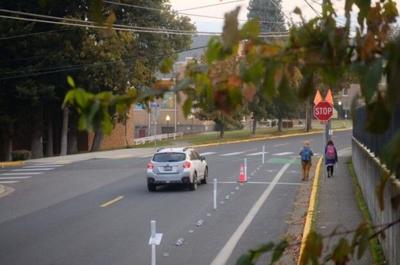
Another organization, Safe Routes to School, updated City Council on future plans and re-quested letters of commitment for upcoming grants opportunities. Megan Ramey, manager of the program, reported raising $11 million in 3 years for infrastructure and programming for childhood mobility in Hood River.
Through demonstrations, Safes Routes to School rearranged paths and brought awareness to environmental, physical, and mental health by encouraging walking and biking in the community. They collected data through public surveys and student interviews, considered input from police and Public Works, and started plans to better support mobility safety in Hood River.
Some survey responses described an aesthetic issue with the demonstrations, but Ramey explained that was due to efforts being a temporary measure, not a permanent installment. Levels of feasibility, implementation, and safety are still being developed too; twice an ambulance was called for accidents between walking and biking traffic. Maintenance in summer and winter is also complicated due to the size of plows and sweeps versus paths.
Overall, the work done by Safe Routes to School’s collective efforts has made parents and drivers feel safer. Ramey mentioned the possibility of a kiosk or other signage to explain future demonstrations to pedestrians, acknowledging that “behavior change takes time.”
Of the grants proposed by Ramey and Jackie Vanderpuye (Community Engagement Coordinator), one is a surface treatment grant for updates like thermoplastic strips, paint, and reflectors for shared paths; this grant would be handled by ODOT. The second is an education grant submitted by the school district for $150,000 to fund the Safe Routes to School Manager position for another two years.
Though Ramey had a third grant in mind, City Council deemed these two as the most feasible and approved the letters of commitment.
City reports
Updates from Abigail Elder (City Manager) included a reminder that budgeting meetings will take place throughout May. She also summarized a few new legislations that passed at the state level. Senate Bill 1537 detailed housing accountability, creating new provisions, land use adjustments and regulations, and more. The focus of the bill is to mandate more resi-dential growth in Oregon.
Senate Bill 1530 provided $2,438,595 for water, sewer, and stormwater site improvements in the 7.1 acre Rand Road housing project. Elder thanked Norris, Nilsen, Longinetti, and others for their cooperation in acquiring those funds and mentioned a request for infra-structure.
House Bill 4002 recriminalizes the possession of small amounts of hard drugs like cocaine and fentanyl, among other changes. It “prohibits insurers from requiring prior authorization or other utilization review for coverage of substance use disorder medications,” with the goal of changing laws to make it easier for those with substance use problems to get treatment.
Urban Renewal Agency Items
Many City Council meetings include discussions and agendas from the Urban Renewal Agency (URA), with Urban Renewal Administrator Will Norris leading presentations. In early March, Norris proposed increasing the Waterfront District’s maximum indebtedness by $2.15 million, for a total maximum indebtedness of $7.9 million.
The previous limit was set in 2008 at $5.75 million and since then, infrastructure projects like streets and paths, parks, wastewater odor control, and utility upgrades have been successful. However, the stormwater line is in urgent need of an update and the URA does not yet know the total cost of the repair.
In the Waterfront District, the stormwater line is still the original drainage pipe from the 1960s. The city discovered it’s state of disrepair via sinkhole near Hood River Distillers in 2017. Phase 2 of 4 in repairing the stormwater drain has been completed but the cost to come will need to be funded.
In a split decision, City Council approved the URA’s funding but stated that any amount of the borrowed total not used for the stormwater replacement project must be returned to appropriate districts.
Norris also spoke with City Council about new URA Governing Board Membership possibilities, as the councilors want more input and consistent collaboration with other taxing districts and government organizations. Different groups were asked about their level of interest in involvement: Hood River Library, Parks & Recreation, the School District, the Board of Commissioners, and CAT.
Most groups wanted some sort of involvement on the board though required participation and voting seats were of less interest. Ultimately, due to time commitment and interest levels, the council passed a motion for the URA Governing Board to be made up by Hood River City Council alone, just like a majority of cities in the US.
Saunders was cautious to mention that they need to be more proactive in community engagement and including other group representatives in consistent discussion, rather than waiting for formal letters of request or required project approvals.


Commented
Sorry, there are no recent results for popular commented articles.