
By Emma Renly
For Columbia Gorge News
HUSUM — During rainstorms and snowmelt, the White Salmon River’s flow is constantly changing. There’s always one question on river users’ mind:
“Does anyone know what the Husum Gauge is at?”
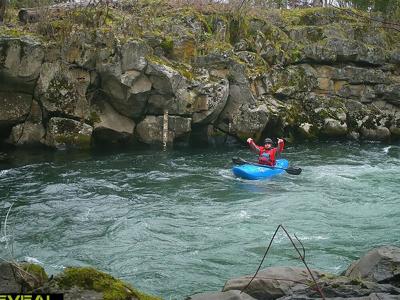
Visible from the Husum Bridge, the gauge is a wooden stick drilled into bedrock and marked in feet. The numbers give river users an accurate idea of how high or low the current levels on the White Salmon River are. Below one foot means it’s low, and above four means the water is moving fast. If the stick is underwater? Flood levels.
Historically, the only way to access the gauge’s levels is by taking a drive to Husum or asking a nearby resident for an update. Last November, Max Mills, a whitewater kayaker based in Hood River, installed a small hunting camera that faces the Husum Gauge to change the accessibility.
“I wanted to give back to the community,” Mills said. “I don’t even hunt … I just decided to build a website on a whim, on a random Tuesday night.”
The images from the camera are uploaded every couple of hours to GorgeGauge.com.
Since the hunting cameras are motion-activated, Mills said they often capture shots of people paddling down the river or adjusting the camera to get tree branches out of the way.
Mills noted that while there is an online U.S. Geological Survey (USGS) gauge that measures cubic feet per second (cfs) for the White Salmon River, the reading isn’t always accurate for the upper sections. That gauge sits at the confluence of the Columbia River, where tributaries, such as Buck Creek and other unnamed springs add flow to the river.
In addition, reported flows are calculated based on prior measurements of gauge height and cubic feet per second, graphed on a rating curve. During floods, such as last December’s atmospheric river event, those estimated flows become less accurate because it becomes dangerous to directly measure the river.
However, not even the camera could keep up during that event.
“It actually went underwater for a brief second. It’s tied to a tree right now, and it went above the tree,” Mills explained. He briefly took the camera down and put up the notice on the website: “Camera almost took a swim, so it is going to take a spa break. Happy 6-foot-plus White Salmon to all who celebrate.”
Going forward, Mills plans to continue making the project collaborative, and wants to hear from other river users about the website, and where to add additional cameras.
“There’s been some requests to put some on the Wind River,” Mills said. “[And] to have them on different spots on the White Salmon. People really want one at the Truss, because there’s a lot of variability in the flows.”


Commented