
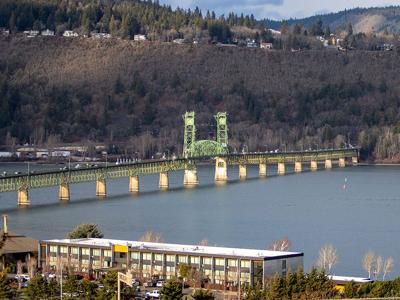
THE GORGE — As the Biden administration was replaced by President Trump and his staff — who promised cuts to many federal agencies — funding for the Hood River White Salmon Bridge Replacement Project (HRWSBA) became uncertain.
On March 17, bridge replacement project Executive Director Mike Shannon and HRWSBA Commissioner Marla Keethler sat down to discuss the bridge replacement team’s efforts to understand policies and priorities within the Trump-Vance Administration. In response to federal funding pauses and how that could affect financing for the bridge project, Shannon said, “We have not gotten any indication that it’s not going to [be dispersed]. We’re hopeful that it will, and confident that we have a good project and a strong application.”
In light of the new $1.12 billion cost estimation, the bridge project has increased their ask for federal money. They are hopeful to catch the attention of the Trump Administration and U.S. Transportation Department (USDOT) through their Bridge Investment Program (BIP) application. The project’s resume was strengthened in December when the Biden-Harris administration listed the Hood River-White Salmon Interstate Bridge as one of America’s most economically significant bridges. The project was grouped with 17 other bridges across America — including the I-5 Interstate Bridge in Portland and the Golden Gate Bridge in San Francisco. A lot has changed since then, and the bridge replacement team is focused on being flexible and adapting to trends throughout the heavy infrastructure industry.
As reported by the Columbia Gorge News in October, costs associated with construction of the new bridge have risen significantly, and staff estimated the price tag for a new bridge could be upwards of $1.12 billion — more than double the original $520 million.
Shannon pointed to the National Highway Construction Cost Index, which showed a 51.3% rise in heavy construction costs from October 2021 to April 2024. Despite the dramatic change, the project took another step forward when Kiewit Infrastructure West Co. completed 15% of the “base design” plans and underwent a Risk Assessment Workshop in conjunction with the Federal Highway Administration (FHWA).
One month later, Trump took office and issued an executive order that paused the disbursement of funds for two major federal grant programs: the Inflation Reduction Act [IRA] of 2022 and the Infrastructure Investment and Jobs Act [IIJA].
The bridge project had been awarded a $200 million grant from the Infrastructure for Rebuilding America (INFRA) program in January of 2024, and has an outstanding application in to the Bridge Investment Program (BIP), both programs authorized under the Biden-era IIJA.
“The executive orders and other signals from the new administration have slowed review on our INFRA grant agreement, but we’re not being treated any differently than any other project,” said Commissioner Keethler. “We are in regular and ongoing dialogue with the relevant federal agencies, making sure they get what they need to proceed, as well as our congressional delegation so they can help advocate for an executed agreement.”
Trump also restored and modified tariffs to steel and aluminum imports, which he originally set in 2018. Based on construction efficiencies and material cost projections, the project switched from using concrete to steel for the bridge’s building materials. Similar to many agencies that rely on federal funding, Shannon said there is no way to know yet how the recent tariffs could impact construction of the new bridge.
“We’re still looking at moving forward with the steel structure,” Shannon said. “Depending on what happens with steel prices, there may need to be a change. But we don’t know that yet, and you don’t want to prematurely react until you really know.
“If we see trends growing in a way that’s going to negatively affect the project, then we’re going to have to stop and make a decision and evaluate what the alternatives are,” Shannon said. “So, I think we have to kind of ride those waves and figure out what’s the best solution at the time we actually can go to construction.”
The Trump administration is no stranger to the bridge replacement project. In 2020, the administration awarded the project $5 million as part of the federal BUILD Transportation Discretionary Grant program. Shannon confirmed the project used that money for preliminary engineering but need another $532 million in federal investment to cover costs of building a new bridge.
Funding already secured
Currently, the bridge replacement team has secured funds from a combination of federal grants, state money, local contributions and has their eyes on federal loans.
The largest award came in January 2024 when the project was selected for $200 million from the INFRA grant program. Shannon said they have sent revisions to the FHWA, which is common, and are hoping to use $75 million up front for design and the remaining $125 million for construction. Additionally, the project received $3.6 million from the Rebuilding American Infrastructure with Sustainability and Equity (RAISE) program that will go towards pedestrian and bicycle access across the bridge.
The states of Oregon and Washington are also expected to foot some of the bill. The Move Ahead Washington funding package awarded the bridge replacement efforts with $75 million that will be spread over six years. According to Shannon, the HRWSBA has since received the first $15 million and will receive the next $30 million in July.
In April, the state of Oregon will sell lottery bonds, and the bridge replacement project expects to receive around $20 million from those funds, thanks to the efforts of Rep. Jeff Helfrich and Sen. Daniel Bonham during the 2023 legislative session. Shannon said they will collect that funding no later than June.
When the Port of Hood River raised toll rates to cross the bridge in September 2023, they did so based on a recommendation from the HRWSBA and with intent to build cash reserves, which will bolster their chances at receiving a loan through the federal Transportation Infrastructure Finance and Innovation Act (TIFIA). According to the Bridge Replacement website, the TIFIA loan is considered the local share of the project, since it will be paid back using toll revenue. The project is going after the maximum loan amount of $105 million.
In October, the HRWSBA authorized staff to resubmit their application to the Bridge Investment Program (BIP), which awarded over $2 billion in 2024 to bridge projects across the country.
Shannon said, in addition to securing funds for the bridge, Kiewit is working to reach 60% design over the course of the next 12 months. Another Risk Assessment Workshop will take place when that design milestone is completed. While engineers map out the new bridge, staff is doing everything in their power to advocate for the new bridge and community members.
Following a trip to Salem to meet with legislators in March, two HRWSBA commissioners and Shannon traveled to Washington, D.C., for meetings with USDOT representatives. Keethler, who has been on lobbying trips before, said they are looking for clarification on a number of aspects including how they score applications. She believes creating connections between priorities for the Trump administration could better their chances.
“We’ve spoken for years about the benefits, not only for the state and regional economies, but nationally. So emphasizing how this bridge supports forestry and agriculture has always been a point of importance, but I think even more so now it’s one that we want to make sure is a continuous theme, because we know that those are industries that they seem to be wanting to prioritize,” Keethler said.


Commented