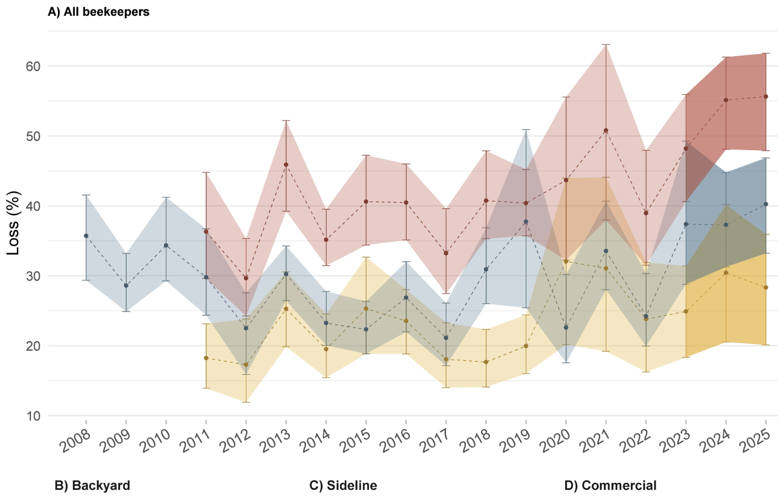
Honey bee colony losses are reported by several differing organizations both nationally and regionally. The USDA identifies the number of active colonies annually. The ‘over wintering’ hive losses for 2024/2025 were reported to be 62%.
On the surface this loss appears devastating! The number of active colonies in the United States on April 1, 2025, was 2.99 million colonies. This is up from October 2024 of 2.93 million.
Honey bee colonies swarm at least once annually. This is a division of the original colony into two. It does not matter if the bees are managed or feral. Approximately two million colonies travel from around the United States into northern California annually for the almond pollution around mid-February when the trees come into bloom.
The demand for the annual almond pollination is around 2.2 to 2.6 million colonies each year.
The pollen of the almond tree has one of the highest protein contents. The bee colony travels during winter months as the girls are clustered around the queen to keep her warm. Upon being exposed to the warmer climate of northern California the colony awakens to the delight of the robust pollen and nectar afforded by the surrounding almond orchards.
The transportation of bee hives entails a logistic operation. The hives are two deep boxes set on a wooden pallet along with three other hives. These pallets are stacked three high. Once they arrive in California, they are unloaded and placed into the orchards. The foraging bees bring in copious amounts of pollen and nectar.
Pollen is a source of protein. Protein has amino acids. It is the amino acids that are the “building blocks of life.” Every living thing on Earth is created from amino acids.
When it comes to honey bees, the amino acids form the basis to develop the bee’s wings, body, antenna, mouth parts, guts, and more. It is fed to the bee larvae once every two seconds. Due to the pollen and nectar arriving into the colony in copious amounts, this stimulates the queen to lay her eggs in greater quantities.
The input of grocery stores (nectar and pollen) expands the population beyond the confines of the two-box configuration. As part of venture into the almond orchards, the commercial bee operations must cull off the excess bees into new hives adding a purchased queen to create a new colony.
This shaking off of excess bee population from hives creates one to two new hives. These news colonies augment of the operations ‘over winter’ losses. They are also sold to other commercial operations and backyard beekeepers.
The number one cause of colony loss is the Varroa destructor mite. A pest that only affects the European honey bee. There are other stressors to the bees, but not nearly as devastating as the Varroa. The mite began its journey from Southeast Asia across Europe to finally arrive into Florida in 1987.
The bee community was not prepared for this intruder. Entomologists rapidly searched their shelves for miticides (pesticides) that would counter the infestation. Some of those initial products have fallen to the wayside as the mite became resistant to them.
Sadly, the percentage of losses annually has been creeping upward. Why? A complex issue, at best, to address. Varroa mites have developed resistance to some of these chemicals. Beekeepers, both commercial and backyard, have not created a robust management plan.
From the commercial operation side of beekeeping, it becomes a struggle to maintain their revenue sufficiently against the rising expenses of the operation. Net result comes down to shrinking profit. The cost of Varroa destructor treatments alone continue to increase.
This monetary struggle has caused some to use what is considered “off shelve” products. Miticides not approved by the EPA. Considering human medication, the relation between dose and affect against the medical issue is refined into a pill, capsule or liquid dose. When beekeepers engage in non-approved treatments they over or under dose. This has created resistance, which is the prominent cause of the high colony loss of 2024/2025.
On a personal side, tending to a few rose bushes some years back, I found myself at the local hardware store in search of a pesticide. The bottle with a nice label seemed to be the one chosen. Pour that into a spray container with a bit of water without reading the label or considering the necessary dosage.
The issue of the Varroa destructor mite has yet to develop a viable solution. This in spite of significant research. The bottom line is the number of colonies has not been affected. But the health of the bee is not as it should be.
The Columbia Gorge Beekeepers Association meets on the third Wednesday of each month, http://www.gorgebeekeepers.org/, at the Hood River Extension, 2990 Experiment Station at 6:00 PM. A different subject is presented by an Entomologists or experienced beekeeper. All are welcome. Visitors may attend in person or via Zoom. You may reach out to the club for login information — admin@gorgebeekeepers.org. You may also enjoy a visit to the Hood River Extension to view the three beehives maintained by the Columbia Gorge Beekeeping Club and financially by the Hood River Master Gardeners, Klahre House and the Columbia Gorge Beekeepers Association.



Commented