
This story is part 1 of a two-part series. Part 2 will be published in next week's edition of Columbia Gorge News.
Sharron Allen came home one day last month and was hanging up her coat when a strange man came down the stairs inside her home.
“He was standing there with a smile on his face. He had a can of sardines in one hand and a can of yogurt and fruit in the other,” she said. “You could tell he was high or disoriented.”
When he refused to leave, Allen and her husband Cameron Larsen quickly went outside and called 911, something they’ve done countless times regarding what they and others describe as a growing and increasingly aggressive homeless population in their neighborhood.
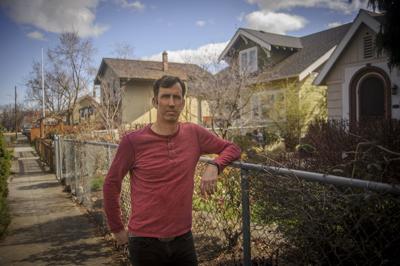
They live in the 200 block of Pentland Street in downtown The Dalles. Just west of them is the Original Wasco County Courthouse. A few doors east is the St. Vincent de Paul Society office and the Community Meals site.
Allen, Larsen and other neighbors are empathetic to the plight of the homeless, and believe society isn’t providing the services they need, such as mental health or addiction treatment. But they also feel the St. Vincent site is not a good fit for a residential neighborhood. Larsen said St. Vincent’s no-loitering policy just forces people into neighboring properties.
“The business around it struggle with the situation drastically and our neighborhood suffers from it horribly,” Allen said. She used to drive by the street she lives on as a kid, and loved it, describing it as a picturesque dead-end street with “historic, beautiful homes.” Now, she says, living there is more like a “nightmare.”
Allen said she is calm under stress, and she believes her long experience with the homeless was helpful on the day of the break-in because she has learned the vast majority of the time, they mean no harm.
She feels that if the man had broken into another home, he might have been shot.
Police quickly came and arrested the man. Allen learned he’d spent all day at their home, slopping sardine oil around, reading, showering and working out in the basement. He claimed to have lived there once. He had packed up some credit cards and house keys and other items to steal.
A few weeks later, the man broke into another home and was arrested again.
Pallet homes arrive
COVID-19 funding allowed the city of The Dalles to obtain some pallet homes for the homeless for the winter, because the Warming Place, the winter overnight warming shelter housed at St. Vincent’s, couldn’t open because of COVID restrictions. The pallet homes are on city property in the port industrial area.
The pallet home project has provided a noticeable reprieve for the neighborhood, with one neighbor saying the situation has been “immensely better.”
But the pallet homes are slated to close at the end of March. It’s been so successful, said Dave Lutgens, executive director of the St. Vincent de Paul Society, that he thinks it has spurred much more interest in seeking a solution to the homeless problem than even five months ago.
He knows the pallet homes “will most likely go away, at least for awhile. I’m sure once the pallets close, we’ll see more folks hanging out.”
Communication between Lutgens and the neighbors is essentially nonexistent. “The neighbors don’t talk to me,” Lutgens said. “They complain to the city. I don’t know what we’re supposed to do. We don’t own the people. We try to keep our place clean.”
Lutgens said, “I guess I’ve got a reputation that I don’t listen to ideas. I think I do.” He said he doesn’t want conflicts with the neighbors.
He said the only solution he hears from people is for St. Vincent’s “to move away. Well, that’s not gonna happen.”
Impact significant
The pallet homes have made a big difference in regards to the amount of folks hanging around, Lutgens said. He drives around the building every morning to be sure it is free of debris.
St. Vincent’s erected a fence to help protect a neighboring business from having people get on its roof.
St. Vincent’s has also recently added another service: Workers with the Mid-Columbia Center for Living, the regional mental health agency, will be at St. Vincent’s weekly to answer questions and help people get services.
St. Vincent’s has done cleanups along nearby Mill Creek, which is a haven for camping and becomes heavily littered.
Lutgens said of the neighbors, “We’ve been here longer than they have,” noting St. Vincent’s moved to its current location 25 years ago. “If you’re not smart enough to realize what you’re moving in next to, and who your neighbor is, it’s not on me, it’s on you. I don’t believe people should have to put up with that mess in their yard either, but I don’t know if they refuse to call the police, or they expect us to work some miracles.”
He said, “Someone’s in their back yard, or stealing cans off their porch, or pissing in their backyard, I don’t see what I can do.”
The situation is fluid, as people with problematic behaviors come and go.
Lutgens agrees it would be better if they weren’t in that location, “but we own the building.”
He calls it “an unresolved situation that both sides are trying to resolve but they don’t talk to each other. They’re going to the city and they’re saying, ‘City, you make those people conform.’”
Problems increase
Rian Beach did do research before he moved to the neighborhood in May 2019. He asked Larsen and Allen, who live next door, what the homeless situation was like.
Allen said they told Beach it wasn’t really that bad — and they themselves had asked around before they moved in back in 2016. But, the summer Beach’s family moved in, “it felt like it kicked up tenfold,” Allen said.
Beach is not disparaging the work St. Vincent’s does, and understands they don’t have control of people after business hours. But he feels St. Vincent’s “has never shown empathy to the safety and concerns of the neighborhood, so that’s been frustrating.”
When things are at their worst, feces, trash and needles litter the sidewalks. People sleep on the sidewalk or yell incoherently. “It’s like sketch-ville around here at night,” Beach said. “Any other business would never get away with this kind of thing,” he said of the St. Vincent building.
“It just feels like we’re living on an island and we have to fend for ourselves. The police are great, but there’s only so much they can do.”
Last summer, Beach called police more than 20 times. He described “constant trash, constant trespassing, constant feces and urine.”
He hasn’t had thefts, but both his neighbors have. One neighbor had a homeless person defecate in front of their front door, then put a cigarette in it. They’ve blocked the alley so the neighbor can’t pull their vehicle in to park.
Beach wears headphones when he walks, partially so he doesn’t have to listen to harassment. As to what he’ll encounter on walks, he said, “It depends on the day. It’s a potpourri of possibilities.”
He said of St. Vincent’s, “We do think it’s a necessary service, but St. Vincent’s helps with one-third of a problem and causes two-thirds more.”
He doesn’t like that he’s become more numb to his fellow human beings. “It sucks just not being able to have the sense of empathy with your fellow neighbor because you’re focused on the problems that are being caused by them.”
He calls the homeless his neighbors. “They, for all intents and purposes, live in the neighborhood, so they’re neighbors.”
He doesn’t want the police ticketing or jailing them. “That’s not doing anything for anybody. We’re dealing with mental health.”
He’s tired of hearing that St. Vincent’s owns the property, and that the location is close to services. “I get it, but again, where are the rights that we have as homeowners, or renters or businesses?
“We had a super scary guy park right in front of our house,” he said. The man was yelling nonsense, and it was the first time Beach was concerned a situation might escalate.
Beach said St. Vincent’s makes the neighbors feel like they are the ones being a nuisance.
He pays taxes, and while he doesn’t believe that entitles him to a gated community, “We should feel safe.”
Larsen, Beach’s neighbor, described “random verbal abuse — you just get yelled at for no reason.” There’s broken bottles and trash, he said, but the feces are the worst.
Three people have moved from the neighborhood because of the homeless situation, he said.
Larsen is a big guy who doesn’t intimidate easily, but “you just get the feeling it’s unsafe.” Some neighbors are scared to go for walks in their own neighborhood.
He had a guy come at him with a fire extinguisher once. He was soon arrested. Another guy whirled on Larsen from 50 feet away and theatrically pulled something from his pocket, but it turned out to be just a phone. “For a split second,” Larsen thought it was a weapon.
“Everyone’s solution” is to have St. Vincent’s move elsewhere, Larsen said, “but I just don’t know how feasible that is.”
He said St. Vincent’s is “just feeding them and enabling them, and we pay the price.”
Larsen feels the homeless crowd this past summer was rougher than ever. “You feel for them because they’re troubled, and I’m sure they don’t have anywhere else to go.
“I don’t know what the answer is, I don’t even know if there is one,” he said.
Allen hears people screaming at night like they’re being killed. She calls it in to police out of concern, but also noted, “You get hardened to it because you hear it so often.”
Larsen puts his pop cans out for the homeless to take. He’s given out cases of bottled water, and boots and clothes. He’s talked to people who are homeless and knows they get their stuff stolen too. “It’s tough.”
He has friendly interactions with the homeless too. “One guy, his dog and my dog were best of friends.” Another homeless man helped him rehang his gate.
Beach said he’d like to see St. Vincent’s allow people to stay on their property around the clock. Lutgens said it’s “always been a problem” of how to manage the St. Vincent property. When they’ve allowed people to stay after 7 p.m., “It’s proved to be a disaster in the long run, because you get more drinking.”
If you allow a blanket to stay on the property for one night, a tent crops up the next, he said. “It just builds up.”
In Lutgens’ estimation, “It’s a problem for the city. The city has not addressed it.”
His ideal solution is getting enough money to relocate outside the main corridor, where people could camp, or rent homes on a year-round basis. He’d like space for showers, laundry and food service, and space for visiting professionals like nurses, mental health counselors or lawyers.
He added, “I don’t see how feeding people is a problem. It’s frustrating. I’ve offered, ‘Let’s sit down and talk.’ We had one meeting a year and a half ago and we got broadsided. We thought we were there to discuss it, but it was like an inquisition.”
He said even if St. Vincent closed and didn’t exist anymore, “Those people are still going to be here. They’re just not going to be in one place, they’re going to be distributed more.”
Larsen said he’s talked and emailed with Lutgens, “but I don’t really care to do that anymore, that’s all I’ll say. He’s got a job to do, I get it, but I would like to see some smaller things we could do.” Portable toilets and garbage cans would be a start, he said.
As to the garbage in the area, Lutgens said people with St. Vincent’s walk down the streets every day to pick up litter. They have garbage cans onsite, which they empty up to twice a day.
As for portable toilets, Lutgens said they put one on their property once “and it was just trashed.”
Lutgens said the city offered to pay for a portable toilet on the St. Vincent’s property, but the property is closed from 7 p.m. to 7 a.m. He instead suggested putting one in the city-owned lot east of the St. Peter’s Landmark.
“We’re a non-profit, why should we be expected to provide portable toilets?” Lutgens said. “The city could step up and do that. They don’t want to put it on their property, they want to put it on our property. It’s the whole not in my backyard.”
The Dalles City Manager Julie Krueger said the city is working on a plan for a public restroom, with a location yet to be determined.


Commented