
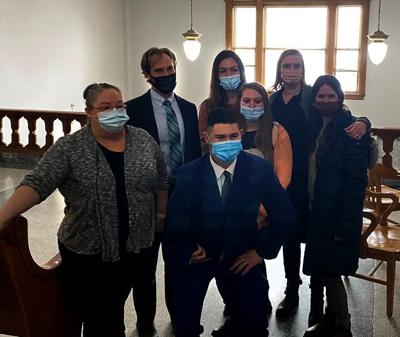
THE DALLES — On the third floor of the Wasco County Courthouse, five felons stood patiently awaiting their hearing time — 10 a.m., on Jan. 6 with a snow delay. Two hours later, they walked out free, having had their convictions vacated — the first in the state through a new process laid out in newly enacted legislation.
“This conviction no longer serves the interest of the justice system,” was repeatedly heard through the two-hour hearing, presided by Court Judge Janet Stauffer, as the five individuals — four women and one man — shed the label “felon” and exited the courtroom free of all the consequences that come along it.
Such an event would not have been possible in the state of Oregon without newly enacted legislation.
Oregon Senate Bill 819, which went into effect the first of this year, provides a process that allows a person convicted of most types of felony crimes to file a joint petition to reconsider a conviction or a sentence.
Wasco County Circuit Court was the first in the state to hold such hearings, District Attorney Matthew Ellis said, which culminated in five convictions overturned.
The five individuals had faced convictions for drug possession and property crimes between 2009 and 2016.
Inspiring stories of addiction and recovery were heard in the courtroom and met with expressions of hope and elation by Stauffer, Ellis, Chief Deputy DA Kara Davis, and the defense counselors.
For some, as Ellis explained, they would not have been made felonies as the law reads nowadays. Simple possession has been a misdemeanor in the state of Oregon since 2020.
For the five individuals — Joshua Aljaouni, Tiffany Greenslade, Ashlee Klaviter, Alyssa McNally, and Mitzi (Wickerham) Mason — a sentence vacation means a higher probability of acceptance for a mortgage, job interviews, and the ability to vote.
Each individual was invited to stand before the court and provide testimony on their journey towards overcoming their troubled pasts.
Aljaouni pled guilty to three felony counts related to methamphetamine possession and three counts of identity theft. When the court chose to postpone his prison sentence in 2018, he elected to enter the Portland Rescue Mission on the deal that the court would not send him to prison pending completion of the program. Shannon Tissot, Aljaouni’s defense counsel, noted that the program is “one of the most intensive inpatient treatment programs.”
Aljaouni testified that he has been sober since a day after his arrest, four years clean now. At first he said his goal in going to the program was to avoid jail. “I had no intentions of having the life that I have today,” he said.
By the time the court sentenced him to probation during his treatment, he had ended up having heart surgery and began to see a different perspective.
“Why not just graduate, and actually do something that’s going to benefit my life?” he asked himself. “When I did graduate, it was like, ‘Oh, wow, I actually did something. Imagine what else I can do.’”
Today he rents a house and has held a job for more than two years. Currently he is taking courses to earn a bachelor’s degree in order to become a pastor.
“This whole journey has not only impacted my life, but it has impacted the lives that come in contact with me,” he said. Since his recovery, he has been involved with others in the recovery community, many of them who joined him in having their convictions overturned.
“I’ve been able to watch some of us that are sitting in this room get married,” he said. “It’s been an honor to prove that it is possible for one to go from one lifestyle and completely change.”
He came before the court with letters of support from his sponsor, his growth manager at the rescue mission, and from him wife, Kelly.
Stauffer ruled his conviction vacated.
“You should be really proud of yourself for the work that you’ve done, the progress you made,” Stauffer said.
Like Aljaouni, others who stood before the court that day noted how interconnected their lives had become. Greenslade told Stauffer that “all these people on the docket… I was part of their journeys. I was in treatment with them. I was helping assist them in their recovery and recovery communities. Like , this is just a really amazing honor to be here in first place.”
Greenslade credited The Dalles Police Officer (now Captain) Jamie Carrico with instigating the first step to her recovery. Carrico arrested her in 2012 on possession of heroin, which prompted her first steps toward sobriety.
Ellis said Greenslade’s conviction would not be a crime under today’s laws.
Stauffer awarded Greenslade a reversal of the former judgment, vacating her conviction.
Greenslade, a full-time mother and volunteer with her church, thanked Carrico for saving her life.
Mason (Wickerham at the time of her conviction) was found in possession of methamphetamine in 2014 and 2015. She told the court that following her arrest, she would fail to show for court hearings. “I would abscond and run,” she said.
After her final arrest in 2016, she found herself at a treatment center in Portland where she graduated and accepted into another program. Upon her graduation, she was offered a job, and went to school, where she is set to graduate with a near-perfect GPA. She currently works at the Mid-Columbia Community Action Council and volunteers with the WINGS program, which provides support to women of birthing-age live safely and raise their children while on supervision.
Her attorney, Louis Grossman, told the court that she has an “exemplary record.”
Stauffer awarded her with a vacation of her convictions.
Klaviter had convictions of methamphetamine possession and theft between 2009 and 2014.
She told the court that, through her own recovery process, she was able to see another perspective on her upbringing with a mother that was using.
“I always thought mom did not want us,” she said. “She did want us, but did not know how to get to us.”
When she gave birth to her own child, she told the court that was the day she decided she wanted to be clean, and to be a part of her child’s life.
Since her conviction, she entered Family Dependency Court, which cares for mothers while they maintain sobriety, and began to create bonds with others in the program. Since her recovery, she has found work with Mid-Columbia Center for Living and works with Oregon’s Department of Human Services. She is five years sober, taking classes, and works hard at her job, said her attorney, Jerrett Glass.
“I look forward to seeing what she can accomplish within DHS, “ Davis said.
Stauffer announced her convictions will be vacated.
McNally was convicted of three drug possession crimes in 2015 and 2016, then a felony. She worked through her substance use issues with the Family Dependency Court and participated in the WINGS program. This allowed her to raise her four-year-old child.
Stauffer ruled her convictions will be overturned.
Four of the five people were represented by students from the Lewis and Clark School of Law Criminal Justice Reform Clinic, headed by Aliza Kaplan.
The judgments made on the five individuals will just be the start of this new process in Wasco County Circuit Court.
Ellis said the legislation gives each county DA the discretion to set up a process to review applications.
In Wasco County, individuals can apply to the District Attorney’s office. Requests can come from the person seeking reconsideration, a friend, coworker, supervisor, mentor, or family member. Law enforcement agents are also encouraged to send a recommendation.
A committee, currently made up of four members, will review all requests. Those belonging to the committee include: Dan Nelson, a former law enforcement officer; Shannon Tissot, a former defense attorney; Chris Sorenson, a former probation officer, and Kasey Buckles, a graduate of the county drug court.
“It removes a lot of barriers for people,” Buckles, who works with Mid-Columbia Community Action Council, said about having a conviction overturned. “It will be very life-changing.”
Most felonies, aside from aggravated murder and those eligible for expungement, will be considered. Ultimately, the DA and the judge will need to agree on the terms of the petition to complete the request.
A more complete guide to submitting a request can be found on the District Attorney’s website.


Commented