Oregonians are coming to grips with the need to prepare for wildfire, even in the relatively moist forests of the Columbia Gorge and Cascades.
In response to increasing concerns about wildfire, Oregon State University (OSU) Extension is ramping up outreach and education to help residents and communities prepare for wildfire. The first step is to recognize that there is much we can do to reduce both the risk of wildfire and the damage done when fire comes.
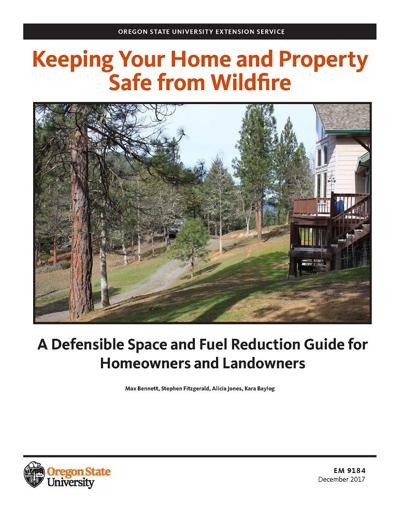
Basic steps for assessing and reducing risk are illustrated in “Keeping Your Home and Property Safe from Wildfire: A Defensible Space and Fuel Reduction Guide for Homeowners and Landowners .”
This publication shows how to reduce vulnerability of buildings to fire and how to manage vegetation to make an area “less inviting to fire and more inviting to firefighters.”
Reducing fire hazards where we live is a good start. However, to be effective in preparing whole communities for wildfire, we have to manage fire hazards across the larger landscape, across both private and public landowner boundaries.
In the face of the horrific wildfire scenes from California and elsewhere, we might think there is nothing we can do to prepare for fires that start on a hot and windy day. But it is important to know that large-scale planning and treatment of the landscape can make a difference in fire behavior and reduce fire damage.
A nationwide push for wildfire protection planning helps identify the next steps needed to reduce risk for communities. Most counties in Oregon have developed Community Wildfire Protection Plans. Further effort is needed to map forest and fuel conditions, predict fire behavior under extreme weather and identify priority actions for communities at risk. OSU Extension can help communities do this by facilitating partnerships and projects across ownerships.
A great example is provided by the Klamath-Lake Forest Health Partnership in southeastern Oregon. Their work provides a model that can be applied in Hood River County and beyond, as illustrated in the publication Planning and Implementing Cross-boundary, Landscape-scale Restoration and Wildfire Risk Reduction Projects. To expand this kind of effort across Oregon, OSU Extension is undertaking a Statewide Fire Program initiative. Goals include:
Establish an OSU Extension Fire Program Leader/Coordinator and secure the funding to support them.
Develop new curriculum and education programs to help communities prepare for and adapt to wildfire.
Provide leadership in fire science and education to help people take the next steps in Community Wildfire Protection, across ownerships.
If you are interested in getting involved with the OSU Extension fire education program, please contact Glenn Ahrens at 503-655-8631 or glenn.ahrens@oregonstate.edu
May 30 workshop
To learn more, attend the upcoming workshop for landowners and residents “Keeping Your Home and Property Safe from Wildfire”, May 30, 2019, 6 to 8 p.m., Ty Taylor Fire Station, Community Room, 1785 Meyer Parkway, Hood River, next to Hood River Aquatic Center.



Commented
Sorry, there are no recent results for popular commented articles.