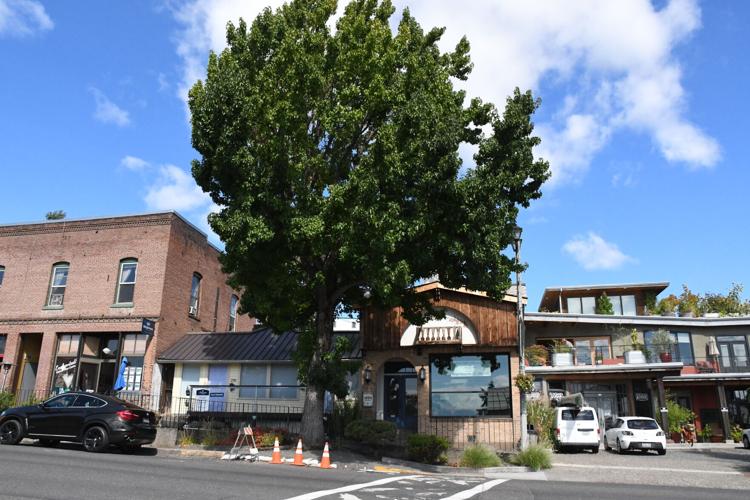
This American sweetgum tree in downtown White Salmon provides ample shade to passersby along the north side of the street, at the cost of destroying city sidewalks.
This American sweetgum tree in downtown White Salmon provides ample shade to passersby along the north side of the street, at the cost of destroying city sidewalks.
This American sweetgum tree in downtown White Salmon provides ample shade to passersby along the north side of the street, at the cost of destroying city sidewalks.
Jacob Bertram photo
This American sweetgum tree in downtown White Salmon provides ample shade to passersby along the north side of the street, at the cost of destroying city sidewalks.
WHITE SALMON — One of the more prominent trees in downtown White Salmon has been spared the axe pending an engineer’s inspection of the tree’s surroundings.
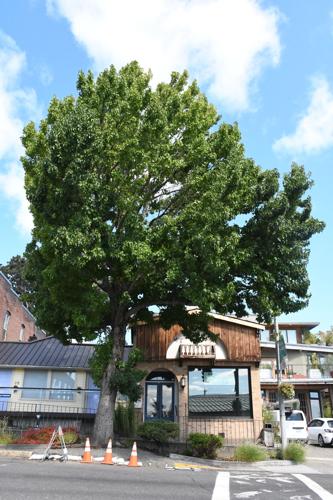
The tree is a 64-foot tall American sweetgum, which is located in front of the former White Salmon Enterprise building at 218 E. Jewett Blvd. Its 40-foot wide canopy provides plenty of shade to the north side of the street.
However, given its stature, the site is an awkward fit for its current location. Nestled between an upper and lower sidewalk (now gravel patch, following a public works project), an arborist who studied the tree noted in a May 2022 report that the site is not ideal for the tree, due to its large stature at maturity, as well as its aggressive root system.
According to the arborist, Ruth Williams with Treecology Consulting Group, an ideal planter width for a mature American sweetgum tree should be 8-feet wide, when actually, the tree has 1- to 2-feet of room. This caused the lower sidewalk to lift unevenly, creating a safety hazard and potentially taking the sidewalk out of compliance with ADA (American Disability Act) standards.
Williams also noted in her report that the tree is in fair condition with two documented instances of limb failures. She said in the report that removal and replacement of the tree may be considered, and that it may take up to 40 years to grow a tree with a comparable size.
Despite removal of the sidewalk panels that were jutting up unevenly, the tree still put the upper sidewalk at risk of a similar fate. The upper sidewalk is privately owned, and with the lower sidewalk removed, the root system is now exposed.
At the Sept. 7 city council meeting, councilors approved a $6,000 work order with engineering firm Gray & Osborne to craft three to five engineering solutions to preserve the tree and install a permanent sidewalk and curb system that would not interfere with the tree.
Explaining the issue during the meeting, Councilor David Lindley, who chairs the city’s Tree Board, said public comment regarding the tree has generally been in favor of preserving it.
Councilor Jim Ransier questioned the amount the city would be spending on the basis that $6,000 could buy many new trees, and that spending the money would not solve the problem but instead be another step to getting towards a solution.
“This consulting contract would really get us to a place of really considering what can we feasibly do with the sidewalk,” Lindley responded, adding that the key question is whether the cost is worth pursuing any of the engineering designs that Gray & Osborne creates.
If the council chooses to keep the tree, the city would be looking at an annual bill of about $5,000 for maintenance of the tree, which would include pruning and other various treatments, Lindley said.



Commented