
Sept. 30 marks the end of burn bans across Klickitat County, and as private individuals begin to prepare their slash piles, so too will Mt. Adams Resource Stewards prepare for prescribed open burns in state forests.
For the first time in nearly 18 years, the State of Washington is endorsing prescribed burns on state forest land through a new program administered by the Department of Natural Resources.
Trout Lake’s Lucas King was the first to receive certification through the state-led program.
King, who works with Mt. Adams Resource Stewards as supervisor to its stewardship crew, oversaw his first prescribed burn as a certified burn manager this spring.
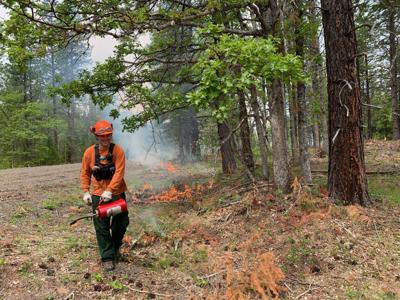
Leading a team of stewards through the Mt. Adam’s Resource Stewards community forest in Glenwood, King lit up 38 acres of natural fuels and vegetation in the spring in a demonstration of how effective this new tool can be for land managers. He later oversaw another prescribed burn in June near Klickitat Canyon. But before that, King had to go through a three-day long course, where DNR Program Manager Kyle Lapham evaluated King on burns and how to keep one under control, test for natural conditions and how suitable they are for a prescribed burn. After the course, King was required to start a controlled burn and was evaluated for how safe and effective it was.
The program was borne out of the state agency’s 20-year strategic plan that identified prescribed burns as a critical tool for keeping forests healthy.
But why burn anyway?
Mt. Adams Resource Stewards Executive Director Jay McLaughlin said controlled burns have been occurring throughout human history. Indigenous people, for example, used controlled burns to maintain travel routes, to enhance their first foods and hunting grounds, he said.
As Americans arrived and populated the west, use of fire in that way was outlawed.
“Burning, or fire in our forests, has been regarded as a blight on the landscape, as something that was a destructive force … And it really wasn’t until kind of the mid-1900s where some debate began to emerge around (prescribed burns),” McLaughlin said.
He noted that the U.S. Forest Service has historically had a policy that called for extinguishing blazes in the forests. There are times of the year, he said, when it’s true that fires must be put out immediately due to weather conditions. But other times are ripe for a burn, such as “when fires would burn in a very subdued fashion and really just kind of clean up the understory and thin out some forest, and we really need to differentiate our policy or recognize the complexity around those different considerations when we think about fire and how fire works naturally in an ecosystem.”
King said prescribed burns are not the sole solution to preventing dangerous wildfire. Prescribed burns are only viable during certain times of the year, when the wind does not blow as hard and the ground is damp.
“In conjunction with mechanical removal of fuels, whether it be with masticators, or using hand crews to do ladder fuel reduction or thinning of trees, and reintroducing prescribed fire, I would say it’s a tool in the toolbox,” he said.
Sometimes it can be better to pull out weeds mechanically or by hand rather than to start a fire, he said. But prescribed burns are growing in importance to Lucas given that “we have a relatively finite amount of time to reduce the risk of catastrophic fires in these communities. So we need to be able to apply all these tools.”
Ultimately, a burn will be more effective at reducing fuels that any mechanical or manual weed-pulling and trimming can do, McLaughlin said.
As land managers, Mt. Adams Resource Stewards works to identify the forest systems that they are working in, and how “departed” a forest might be from their natural fire regime. In other words, land managers seek to understand what tools for management would be best for the system they are working in.
“Understanding how departed they are often gives us a pretty good idea as to what we need to do to get back to where that forest system can sustain itself, can be healthy, and cannot be consumed in what we might call a natural fire event that is not only going to pose a risk to that forest itself, but also a lot of the human values, (such as) the homes, the recreational assets, and the communities or towns that surround or are intermixed with those forests,” McLaughlin said.
In a lot of the drier forests seen in the Gorge and the south of Mount Adams where Mt. Adams Resource Stewards works, McLaughlin said he is seeing departure from a healthy ecosystem. He said having the burn certification will open more opportunities to perform prescribed burns around their managed lands as the organization engages with landowners and offers this new tool to serve the community.
Some feel hesitant towards prescribed burning because of the potential for things to go wrong. King said that his team of 10 works diligently to prepare a forest for burning. They start by mechanically removing fuels, such as brush and vegetation, around the perimeter so that there is a lower intensity burn around the edge of the blaze. “As if you were constructing a line on a wildfire, we’ve done that preemptively,” he said.
They also set up water sources around the area and dig handlines to stop the burn where they want it to stop. Before any work is done, the team has measured the level of moisture, wind direction, and other important factors.
By having the certification on hand, the organization hopes it can employ prescribed burns more commonly during the prime time for burning. It not only works to educate those professionals seeking to employ the tool for more effective land management, it also raises the threshold for certified individuals to be liable for any damages caused by a prescribed burn.
“There’s a lot of planning that goes into these prescribed burns,” King said. The 10-person crew is made up of locals, he added, who know the trails and lay of the land and can respond more effectively because of their background knowledge of the area.
“We’ve burned in these conditions; we’ve burned on these landscapes before. And so we know what to expect, and that really sets us up for success,” he said.
The organization has plans to do controlled burns on their property every fall and spring when they have appropriate weather conditions, King said. “We want to think of what’s the best benefit for our communities, whether its fire risk reduction, or watershed conservation or recreation, and how do we use these management strategies to best manage for community interest,” he said. “By having a little controlled smoke in the spring, in the fall, will hopefully reduce us having to breathe smoke for weeks due to wildfire.”


Commented