

HOOD RIVER — Back in 1913, small growers in the Hood River Valley decided to join ranks, forming one of the nation’s oldest agricultural cooperatives. A few years later, below-freezing temperatures swept across the valley, causing apple trees to split — but the pear trees held firm and have since dominated hillsides.
Transitions continued for Diamond Fruit Growers, collectively owned and managed. In 1971, Diamond opened its cavernous Odell packing house and, as preferences shifted in the early 1980s, closed its cannery in downtown Hood River. Today, Diamond must contend with demands from behemoth grocers, rising costs and an aging labor force that’s only getting smaller.
“Our greatest strength is the growers. The growers are the owners. Our greatest weakness? The growers are the owners,” joked Scott Halliday, an orchardist and Diamond board member.
“My job is to run the business. Their job is to oversee me, to make sure that I’m doing it properly,” said Bob Wymore, Diamond’s CEO. “That’s unique in a way because the growers are actually involved in the business.”
Diamond packs and markets pears from about 60 orchardists in the valley, who all have representation in the co-op. If they choose, growers can also be elected to the board of directors, serving three-year terms a maximum of three times. Other packing houses, by contrast, are family-owned or more vertically integrated, meaning they have less turnover in leadership or own their packing house along with the orchards.
“There’s a little more movement of people, ideas and philosophies in a co-op,” said Wymore. “That can be challenging, but it can also be really rewarding.”
And it has. Diamond’s co-op structure makes the company adaptable, like all farmers must be toiling at the mercy of Mother Nature, especially navigating labor shortages in recent years. According to the United States Department of Agriculture (USDA), the average farmer is 58 years old and the average foreign-born farmworker is 42 years old, the latter rising seven years between 2006-2022.
Hood River’s high cost of living only compounds that problem. Out of all American towns with a population ranging from 10,000 to 50,000, Hood River is the seventh most expensive with a median home value of $492,500, according to the New York Times. As a result, Diamond has struggled to fill its packing house with workers.
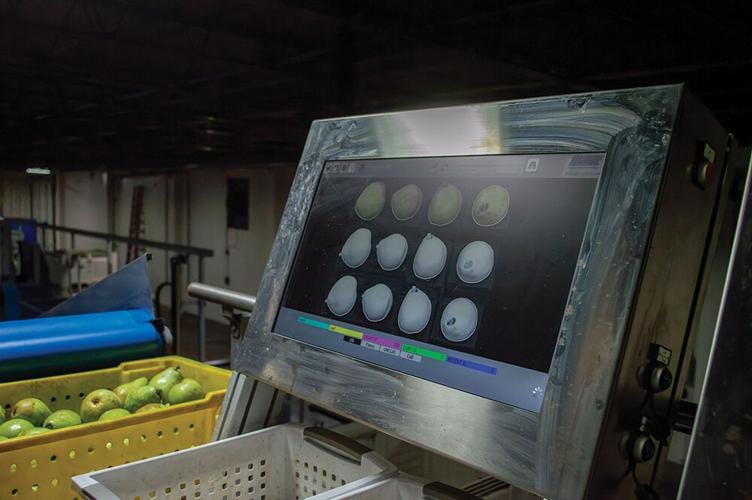
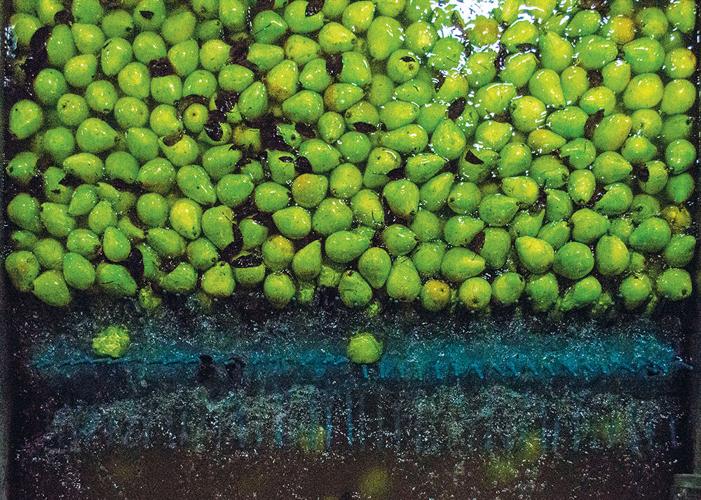
In 2013, Diamond began collaborating with Unitec, an Italian company, to develop a machine that would automatically sort pears by size and grade. Similar technology already existed for apples, but pears are very different: While round apples can roll down a sorting line, pears scuff and turn black, making them unmarketable.
“Automation was the only way we could see how, long term, we could survive, and it’s not done,” said Wymore. “We got people out there who are in their 70s. We’re losing those folks and nobody’s replacing them.”
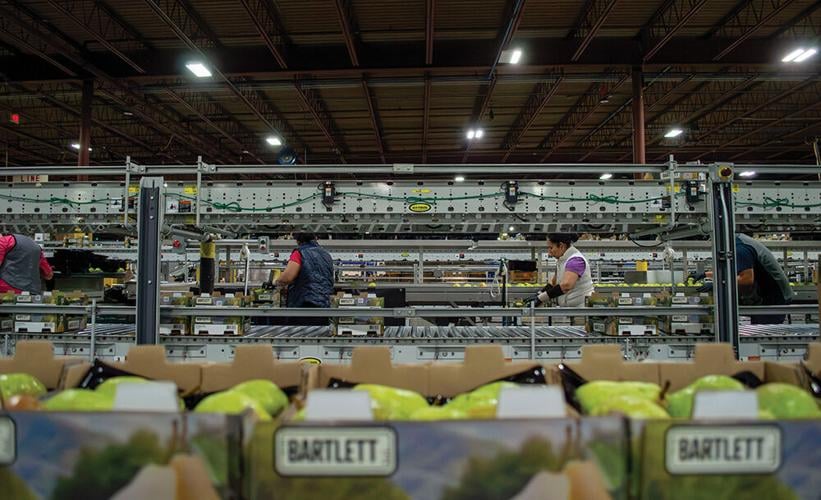
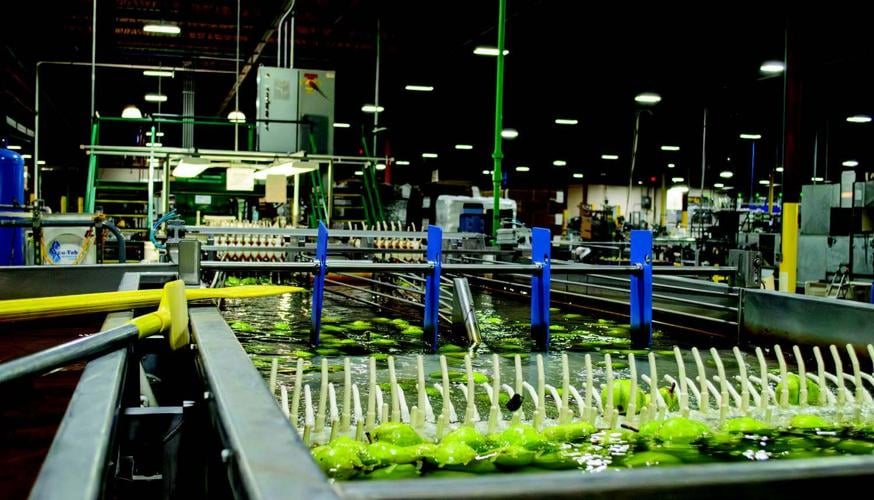
After five years of rigorous tweaking and testing, Diamond unveiled its automated line in 2018. Now, pears zip along in specially designed, pear-shaped rubber cups; pass under cameras that meticulously document any deformities; and then travel along a frenzy of conveyor belts, eventually dumped in a box full of identical pears. Unionized workers still physically pack all of Diamond’s pears, earning from $30 to $35 an hour.
Since automation, Diamond hasn’t laid off any workers. They’re also able to pack more efficiently. Diamond unloads and processes anywhere from 600 to 700 bins of pears per shift, each of which weighs half a ton, instead of just 400. The co-op moves through 100,000 bins annually.
According to Jennifer Euwer, orchardist, Diamond board member and Hood River County commission chair, the valley usually produces about one-third of the country’s pears, but this year’s percentage is much larger. A prolonged cold snap struck Washington’s Wenatchee River Valley in January, another major pear-producing region, leading to the smallest harvest in 40 years.
“You have to play to win every single time you go out there, even though Mother Nature and market forces can vaporize your profit by harvest time," said Euwer. “There’s a price for pears and it’s dependent pretty directly on the size of the crop, so we’re price takers … If we try and charge more, the only thing that happens is the store finds something to buy in a different country.”
The Wenatchee freeze likely means a more profitable year for Diamond, but that’s highly variable, and growers are consistently squeezed from other directions as well. On average, expenses for Oregon farmers, everything from pesticides and diesel to labor and maintenance, jumped 44% between 2017 and 2022, which far outpaced inflation according to USDA data.
“You pay everybody first. Everybody gets their money — the chemical people, the workers on the orchard, these guys [Diamond] — and then what’s left over is us,” said Halliday. He won’t even know how much this year’s crop is worth until next September after the pears are marketed and sold.
Excluding operational and sales costs, however, Diamond gives all profits back to the dirt, which plays a critical role in the valley: It keeps the returns that local packing houses provide to independent growers competitive.
Diamond used to have its own marketing department, but as grocery chains have gotten larger, they've become a less attractive supplier. Walmart (30%), Kroger (10%), Costco (9%), Albertsons (6%) and Amazon (6%) consumed 61% of the U.S. market in 2023, according to the Washington Post.
“They demanded more out of their sales partners,” said Wymore. “All we could do is supply them with pears. They wanted to be able to call us for apples, cherries and pears, maybe some potatoes, onions and other things.” Now, Diamond markets though CMI Orchards, a Wenatchee company that sells a wider variety of fruit.
Between rising costs, monopolization and Diamond’s arguably more equitable composition, growers simply must make more money in the orchards. Euwer mentioned how she’s planting trees closer together, trying to irrigate more efficiently and using other strategies that get more yield per acre with fewer inputs.
As she learned from her dad, Euwer always knew she wasn’t going to “get rich” from growing pears. It was about producing healthy food from the land while still making a living. She and Halliday both have kids who hope to continue their business, but they worry about the next generation of farmers and the future of small farms.
“There are a lot of young people that want to get into farming, but it’s difficult,” said Euwer. “When your production exceeds what's absorbed into a small or niche market, it's very difficult to transition to selling into a U.S. food landscape that's dominated by a few huge grocery chains.”
“It’s a lot of work and very risky — a lot of capital,” said Halliday. “In some ways, you almost have to be born into it because it’s mind-boggling from the outside.”
More challenges await Diamond, the biggest being labor, both inside the packing house and between the trees. Operating under the heel of market forces and the weather, Euwer, Halliday and Wymore turn toward Diamond’s legacy. They’ve adapted in the past — readily swam against the tide of corporate farming — and know that nothing beats a Hood River Valley pear.


Commented