THE GORGE — After 20 years of population decline, monitoring efforts are intensifying for a tiny, early-blooming endangered buttercup that grows only in the Gorge.
The Dalles Mountain buttercup (Ranunculus triternatus) is endemic to the Gorge, meaning it survives nowhere else on earth, said Ethan Coggins, a natural areas specialist with the Washington Department of Natural Resources (DNR).
Also called the obscure buttercup, it’s known from just four populations within a fifty-square-mile area, with an estimated 8,000-12,000 individual plants, he said. A federal species of concern, the flower is listed as endangered in Washington.
Why the buttercup is limited to this small area is unknown.
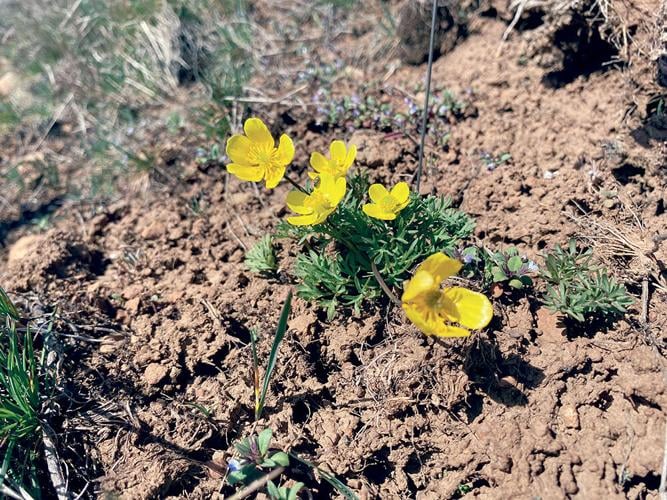
Blooming February through April, the penny-sized, shiny yellow flowers tilt to follow the sun across the sky like sunflowers, perhaps keeping themselves warm to attract their cold-blooded pollinators — thought to be one-centimeter-long beetles, Coggin said. The leaves are deeply dissected and lacy-looking, the whole plant about the size of your palm.
The largest population grows in Columbia Hills Natural Area Preserve, managed by DNR, and adjacent lands at Columbia Hills State Park. Here about 75% of all Dalles Mountain Buttercups grow on just 6,000 acres. Just two very small populations are known in Oregon, but Coggins said the buttercup could occur on private lands where no one has looked.
In December, when pollinating bees and flies are scarce, beetles seem to be doing the job. “But we’re more plant people here,” Coggins said. “So I can’t necessarily say it’s only pollinated by one species of beetle, or one species of anything. That ’s just what we’ve seen.”
A buttercup in full bloom, found during a 2024 survey. The tiny, early-blooming endangered buttercup grows only in the Gorge.
Photo courtesy Ethan Coggins
He doesn’t know why Dalles Mountain Buttercup grows deeply-dissected leaves, but speculates they conserve water in the windy Gorge.
“The environmental conditions in the Gorge are rather unique,” Coggins said. “It ’s in what would be the transition zone between east and west,” between the Cascades' rainshadow and their wetter western slopes. There's a big east-west precipiation gradient, and really high winds. "And it’s just kind of an unusual area environmentally, and that tends to result in the evolution of more distinct plant species.”
Every year, helped by volunteers and a community of self-taught botanists, DNR surveys the fading populations. “Unfortunately, we’ve seen quite a decline in this species over time,” Coggins said. The number varies between different long-term monitoring plots — between 42% and 87%, over 20 years of surveys. Most vanished between 2006 and 2012.
Although decline has slowed, populations have not recovered. Reasons for the loss aren’t fully understood, but DNR staff have speculated the invasion of nonnative grasses might play a part.
That’s led to more intense monitoring recently, Coggins said, aimed at learning what drives the buttercup’s decline.
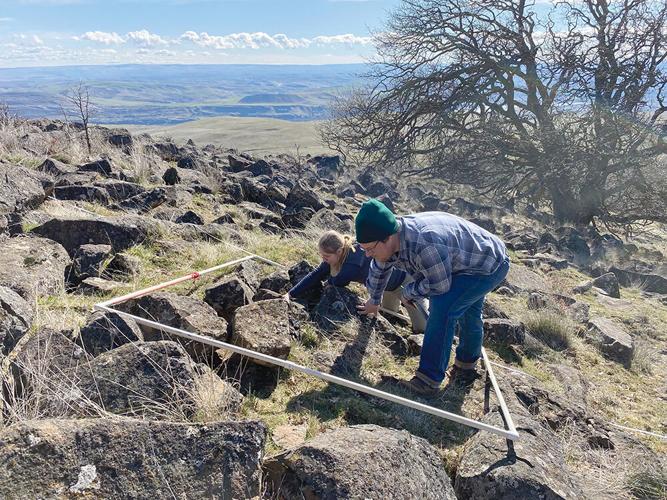
For this, 11 larger plots were mapped within the Natural Area Preserve. Within them are smaller, circular plots. It takes three years of surveys to count every buttercup in the circles. Without the volunteers who brave February’s windy cold to count buttercups, this effort would be almost impossible, Coggins said.
For now, conservation efforts focus on getting more data. “We ’re trying to find out why they’re decreasing. Whether that’s invasive species, or maybe it’s climate change, or maybe fire hasn’t been on the landscape as much as it would have been historically, we don’t really know right now,” Coggins said.
Surveys became more complex, including data on what other plants are present and in what numbers, Coggins said. “ ... If we start to see the buttercups declining — hopefully increasing — and we noticed that the same time we’re getting changes and other plants around them, hopefully we can see what kind of things are benefiting the buttercup and what kind of this might be hurting the buttercup. And that will hopefully guide our management going forward, to try and keep the buttercup, happy and present on the landscape.”
And if the buttercup vanishes from its tiny range? Seeds are banked at University of Washington Botanic Gardens at the Miller Seed Vault, a seed bank at Washington State University holds seeds, to propagate as a last resort. Volunteers with the RareCare program contribute seeds to this bank.
“We ’re doing everything that we can to keep this really special plant around and on the landscape for years to come,” Coggins said.
The little endemic means something different to everyone, he guessed. “It ’s just worthy of appreciation. No matter what it is, every single unique species is a unique story, a story of evolution, and persistence over time.”
The buttercup’s place within its ecosystem could use more study, Coggins said. “And it’s this kind of great natural puzzle. I think there’s individual pollinators that might be depending on buttercups, there’s microbes, there’s all sorts of members of this community, and there’s still so much to learn, and so much mystery.”
Those interested in volunteering, or learning more, can contact Keyna Bugner, DNR's Southeast Region Natural Areas Manager, at 509-607-1851 or keyna.bugner@dnr.wa.gov.



Commented