
By Michelle Klampe
Oregon State University
CORVALLIS — Crews will start installing the power and data cables needed to complete a new wave energy testing facility off the Oregon Coast later this month.
The cables will support Oregon State University (OSU)’s PacWave South. The facility will cost over $100 million, and is the first in the U.S.
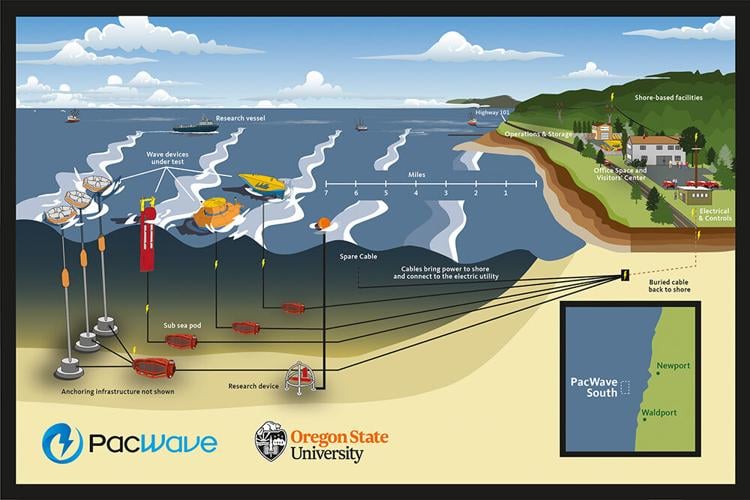
When it’s complete, wave energy developers can test different technologies for harnessing the power of ocean waves and sending that energy to the local electrical grid.
“Transmitting power from wave-energy generators to shore in a form compatible with the regional power grid is a huge challenge, and cabled connection from PacWave South provides the capability to test power-delivery technologies,” said Burke Hales, PacWave’s chief scientist and a professor in OSU’s College of Earth, Ocean, and Atmospheric Sciences. “These cables are highly specialized and their installation and burial is a keystone of wave energy development in the U.S.”
Four power and data cables, ranging in length from about 10 to 13 continuous miles, will be installed from a vault under the parking lot of Driftwood Beach State Park south of Newport, and stretch to the offshore test site.
The work will be done by crews on three vessels, probably visible to beachgoers and visitors for the whole six- or seven-week process, said Dan Hellin, deputy director of PacWave. Louisiana-based subsea cable services contractor R.T. Casey is overseeing the installation of the cables.
Anchored in the underground vault at Driftwood, the cables will run through conduits from the shore, under the beach, then come out of the seafloor about one mile offshore. From there to the test site, the cable will be buried about three feet under the seafloor.
The subsea cables, manufactured in Norway by the Paris-based firm Nexans, were transported via freighter to Louisiana and transferred to Offshore Support Vessel (OSV) HOS Innovator, which took them to Oregon and will be used to lay the cables.
A second vessel, the OSV Nautilus, will follow the Innovator to bury the cable with a remotely-operated vehicle. These two vessels are expected to work around the clock during installation and their lights may be visible at night, when they are close to shore, Hellin said.
“We are asking all mariners in the area to maintain a minimum distance of 500 yards from any vessel involved in the cable installation process,” Hellin said. “While these vessels will be moving very slowly, they will be laying cables and have equipment operating on the seafloor, so they will be unable to stop operations or deviate from their planned route.”
A third vessel, the M/V Liberty, will support diving operations and assist. It will go back and forth to Newport during the work, Hellin said.
On land, another group will put cables from the vault to a shoreside utility connection and monitoring facility east of Highway 101, just south of Driftwood. Two of three buildings are almost done and third is a couple of months behind them, Hellin said.
Parts of Driftwood Beach State Recreation Site parking lot will closed starting July 16. Beach access and park restrooms will stay open, possibly with limited parking through mid-September. Recreational and other large vehicles may not be able to turn around. Alternative parking and beach access is Governor Patterson Memorial State Recreation Site, three miles south.
“We will maintain some parking and access to the restrooms, beach trail and the viewing platform at the park so people can watch the action if they are interested,” Hellin said.
The test site will be marked with buoys to alert mariners, Hellin said. The first wave energy developer is expected at PacWave South in 2025 and the first cable-connected test is expected in 2026. Updates online at pacwaveenergy.org/constructionupdates.
The site is a sandy-bottomed spot, away from popular commercial and recreational fishing reefs, about seven miles south of Newport. Four test berths can accommodate up to 20 wave energy devices.
Wave energy could provide clean, reliable electricity to help meet the world’s rising energy demands. Oregon has pursued development of a wave energy test facility for more than a decade. There is no U.S. facility for developers to test the electrical and environmental performance of their devices at this scale yet.
PacWave South is supported by grants from the U.S. Department of Energy, Oregon State and other public and private entities. OSU’s College of Earth, Ocean, and Atmospheric Sciences is managing construction and operation.


Commented