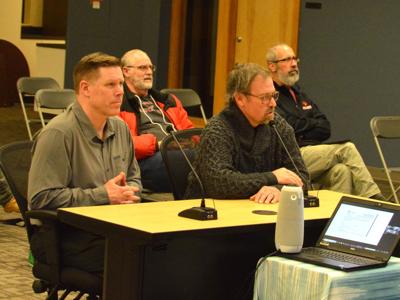
Columbia High School Principal Craig McKee and Career and Technical Education Teacher Del Medenbach share schematics of a tiny house build that will begin in the spring as part of wood shop.
Columbia High School Principal Craig McKee and Career and Technical Education Teacher Del Medenbach share schematics of a tiny house build that will begin in the spring as part of wood shop.
WHITE SALMON — Columbia High School (CHS) was a reoccurring focus on the Feb. 27 White Salmon Valley School District (WSVSD) board meeting agenda.
As its previous quarters in the Park Center Building now houses the Washington Gorge Area Programs (WAGAP) Community Youth Center, the meeting was held in the new boardroom.
“It’s been really great having [the youth center] here,” said Superintendent Rich Polkinghorn. “The building is filled with the noises of children playing, and that is really wonderful.”
Polkinghorn went on to thank Facilities and Maintenance Director Jesse Bryan and Edwardo Ornelas and Taylor Wiley, maintenance team, for their work in setting up the new space in the Park Center Building. He also thanked Technology Director Rhonda Hardisty and Network Administrator Jeff Augustus for making sure the room’s tech needs were met. “As a team effort for a community project, that really turned out great,” he added.
CHS Principal Craig McKee and Career and Technical Education (CTE) Teacher Del Medenbach gave board members an update on the school’s first ever construction of a tiny home during the meeting’s regular “Recognition and Good News” segment. The new class, Construction Technology — with its 23 students — will begin construction this spring. The project is funded by a $10,000 Green Diamond Resource Company grant, facilitated by the White Salmon Valley Education Foundation.
Medenbach said students will learn a variety of skills on the project, from reading blueprints to finishing work on the interior. “We’ll see how far we can get with $10,000,” he said. “We will at least get a shell built.” The plan, he added, is to sell the tiny home and reinvest that money into constructing another. The board expressed excitement for the project, noting the benefit of real-world work experience.
Later, CTE Director Emily Gehrig shared the program’s five-year plan. There are four CTE pathways — agriculture, business and marketing, digital imaging, and wood shop — and each include a number of classes students can take within that pathway. Worksite learning is also part of the program.
The board was equally enthusiastic about the CTE program at the high school, again citing industry experience.
“We try to focus on industries local to our area,” she said. “… I only have 15-16 this year, but I do visits to the sites to check upon students and make sure they’re reaching their goals. It’s a great opportunity to build those connections — and we’re going to get a lot more connections that way.”



Commented