
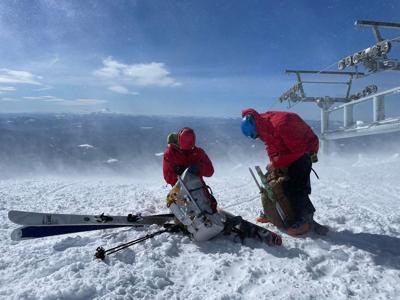
Two climbers fell while climbing on Mount Hood Sunday, March 6. One climber died and a second was seriously injured.
One climber was injured and a second died after the pair fell approximately 200 feet while climbing on Mount Hood Sunday, March 6, according to a press release from the Clackamas County Sheriff’s Office.
The two climbers fell approximately in the Leuthold Couloir area shortly after 5 p.m. Sunday and the Clackamas County Sheriff’s Office led a multi-team search-and-rescue mission in “challenging conditions” over Sunday and Monday (March 6-7), the release stated. One climber was transported off the mountain with critical injuries; the other climber was pronounced deceased.
Leuthold Couloir is a long steep chute on the west side of Mount Hood, visible from Portland. Both climbers suffered injuries in the fall. One of the injured climbers was able to call 911 by cell phone, and also used a Garmin in Reach device to notify an emergency contact.
Clackamas County Sheriff’s Office Search & Rescue coordinators activated in response and deployed to Mount Hood, setting up a command center at Timberline Lodge. Volunteer searchers also deployed to the mountain from teams, including Portland Mountain Rescue (PMR), the Hood River Crag Rats and Mountain Wave Emergency Communications. The Oregon Office of Emergency Management (OEM) was also notified.
According to Deputy John Wildhaber, climbing conditions on Mount Hood were extremely challenging. Rescuers faced deep snow and other treacherous conditions, including avalanche conditions, with winds blowing between 50-70 mph. There were at least two natural-release avalanche events on Mount Hood on March 7, the second day of the search, underscoring the concern for rescuer safety.
During the night, rescuers attempted unsuccessfully to reach the subjects by crossing the upper Reid Glacier and climbing the couloir. Rescuers encountered strong winds with repeated gusts up to 50 mph that knocked rescuers off their feet. The high winds were concentrated in the couloir and were blowing heavy sheets of snow down the couloir that created dangerous avalanche risk and extreme climbing conditions. The snow was deep and heavily wind-loaded, so with every upward step, rescuers sunk to their upper thighs. The difficult and dangerous climb was accomplished at night, with limited visibility due to the blowing snow and dim moonlight, said the press release.
By approximately 11:40 p.m. on March 6, the first climbing team — made up of personnel from PMR and the Crag Rats — made it to within approximately 700 feet elevation below the two subjects, but were unable to reach them due to conditions.
Rescuers were then forced to turn back due to heightened avalanche danger in the area.
OEM also advised they would be unable to deploy a military helicopter to assist with the rescue that night, due to altitude and weather conditions. Rescuers regrouped and prepared for a second attempt to reach the subjects at first light.
By daybreak on March 7, the operation had expanded to include personnel from PMR, the Crag Rats, Mountain Wave, AMR’s Reach and Treat Team, the 304th Rescue Squadron, the Hood River County Sheriff’s Office (which also provided an airplane to aid searchers), Clackamas County Search & Rescue (CSAR), Corvallis Mountain Rescue and the Oregon Army National Guard (providing a helicopter and crew).
As the day began, two rescue teams headed up to the top of Palmer Lift in a snowcat to make a second attempt to reach the fallen climbers.
Although the winds continued into the day, improved visibility at daylight allowed a third team of rescuers to reach the two subjects by summiting the mountain and descending the west side to the fallen climbers’ position above the Hourglass bottleneck at the top of the Leuthold Couloir. Conditions continued to be extremely difficult and dangerous for rescuers and limited what they were able to accomplish. A fourth team hauling rescue equipment over the mountain was forced back by severe winds and ultimately provided support lower on the Reid Glacier.
Once the fallen climbers were reached, rescuers were unable to obtain vital signs from Climber No. 1. Climber No. 2 was in critical condition.
Dr. Christopher Van Tilburg — medical director for Clackamas County Search and Rescue, Hood River Crag Rats and Portland Mountain Rescue — concurred Climber No. 1 was deceased, based on direct communication with the medically trained rescuers on scene.
Weighing the hazardous conditions and danger to rescuers, the decision was made to evacuate Climber No. 2, whose condition was critical but ambulatory. Mission priority shifted to stabilizing Climber No. 2 and getting the injured subject off the mountain.
Due to the severe avalanche hazard and poor conditions, rescuers made the tough decision to leave the deceased climber on the mountain, with plans to mount a recovery mission when conditions improve, said the press release.
An Army National Guard helicopter launched from Timberline in an attempt to airlift the subjects from their location above the Hourglass. However, challenging conditions persisted, and winds proved too strong to allow for a chopper hoist at their location.
Late Monday, rescuers evacuated climber No. 2 down the couloir and then carried the subject in a litter across the Reid Glacier. Using ropes, they raised the subject in the litter over Illumination Saddle and across the Zig Zag Glacier to a snow cat near the top of the Palmer lift. The snow cat transported Climber No. 2 to medical personnel staged at Timberline Lodge.
Climber No. 2 arrived at Timberline at approximately 6:50 p.m. on March 7, and was transported by AMR to an area hospital for treatment.
Four teams (32 rescuers) were involved in Monday’s rescue effort, with numerous other volunteers providing support.
The names of the two climbers had not been released as of March 8.


Commented