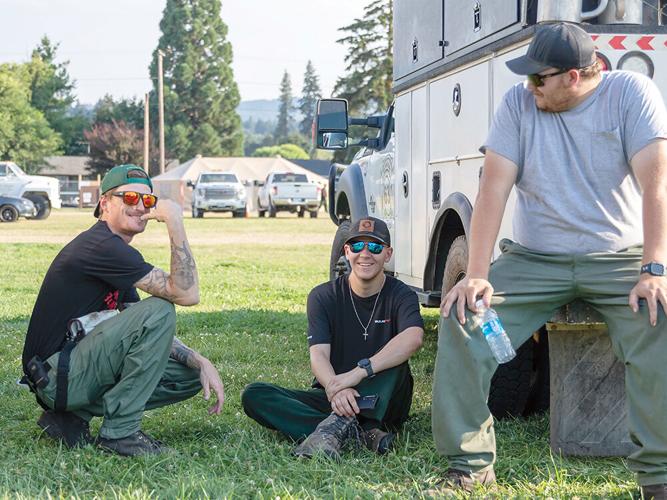
Firefighters from Canyon City, Colorado, Josiah Gould, Noah Scoby and Matthew Minchow pass the time before they head out to the fire lines. After a meal of rice, jambalaya and corn, the trio spent their 14-hour night shift mopping up stray flames and monitoring hotspots.
The Hood River County Fairgrounds served as headquarters for the Microwave Tower and Whisky Creek fires in the Columbia River Gorge. Hundreds of firefighters and personnel will come and go during the duration of fire season.
HOOD RIVER — Every year in July and August, wildland firefighters, medic teams and forestry technicians disperse across the country to battle wildfires. These men and women are continuously on the job building fire lines, cutting through brush, mapping the fire line and organizing information to keep the public updated, but what do they do and where do they go when their “work day” is done?
If you are working the Microwave Tower Fire or Whisky Creek Fires you are most likely stationed at the Hood River County Fairgrounds. That is, if you are lucky. Forestry Technician and Lead Public Information Officer Carissa Silvis said some firefighters may sleep in a “spike camp.”
These small camps are set up in the wooded areas and provide the necessities for firefighters close to the fire. Silvis said that a spike camp is currently set up near Kingsley Reservoir and added that at times it is safer and more convenient for travel.
“Even though it closed down, we do have folks camped around there and that just helps so they don’t have to drive so far every day,” she said. “Not only is it great for timing to get folks on the fire line, it also reduces exposure to driving, which is the most dangerous thing we do.”
The Hood River County Fairgrounds served as headquarters for the Microwave Tower and Whisky Creek fires in the Columbia River Gorge. Hundreds of firefighters and personnel will come and go during the duration of fire season.
Noah Noteboom photo
Further away from the fire line, there is far more access to water, food and shelter at the county fairgrounds — and the people who provide these services are firefighters, too. Chris Green, Austin Candela and Tyrone Stone help with logistics at Fire Camp — as it is called by the firefighters. Green makes supply runs back and forth from the fairgrounds to the spike camps bringing water, food and other equipment, while Green and Candela create signage and do the little things to turn the fairgrounds into a mini city.
On-site paramedic Jared Grissom said that when you have so many people in one area doing one job, there are a lot of moving parts.
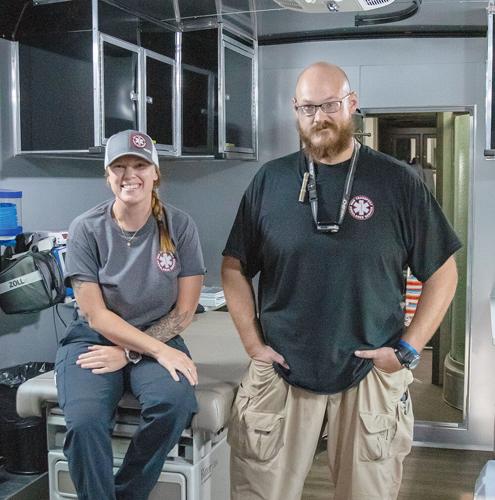
“It’s a city that crops up overnight. I’ve been on some fires in California where they have 8,000 people split up in two camps,” said Grissom, who is from San Antonio, Texas. He and Makenzie Tiegs are paramedics who treat minor injuries for firefighters who show up to Fire Camp. Tiegs, from Boise, Idaho, who earned her stripes as a rookie EMT on a fire engine and has now been in the fire service for 10 years. Tiegs said she is grateful to sleep in the living space of the medical trailer, because she has slept in tents while firefighting before. As an EMT, Tiegs deals with physical ailments of all kinds, but she believes mental health in firefighting is not talked about enough.
“I think one of the misconceptions that the public just doesn’t quite see is the emotional toll that this career takes on our firefighters... These are your brothers and sisters out on the line, these are your family members out on the line,” she said.
There are also medical teams in the group ready to respond in the case a firefighter gets hurt or needs medical assistance.
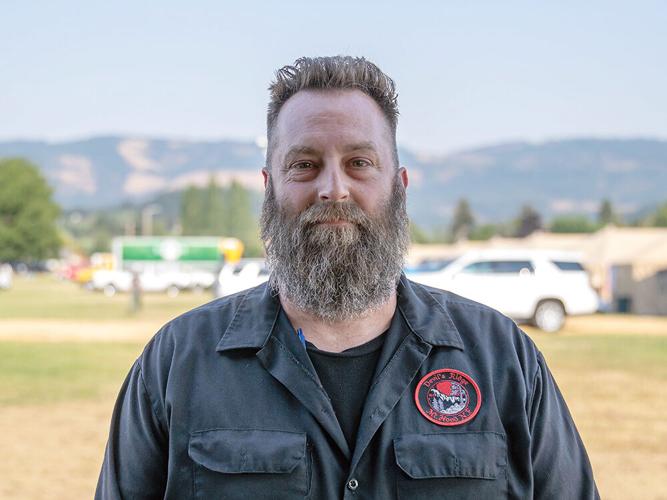
Jon Blackburn is a Type 3 Incident Commander in training and spoke to the living conditions at Fire Camp.
Noah Noteboom photo
Type 3 Incident Commander in training, Jon Blackburn, has been wildland firefighting for 29 years and says there are three to four different medical resource teams available depending on the request.
“There are line EMTs and line medics who are actually out there with the firefighters. We also have something that’s called a [Rapid Extraction Module Support] REMS team,” Blackburn said. “They’re mobile. They’re able to do some low angle rescue. They’re able to hoist and move patients around and load them on an [off-road vehicle] in order to get them out to a road system.” They are called low angle rescues when the terrain is between 15 and 29 degrees.
Fire Camp medics Makenzie Tiegs and Jared Grissom tend to firefighters who may experience a minor injury within the camp.
Noah Noteboom photo
Away from the fire at camp, a typical day starts at 7 a.m. with breakfast and a briefing meeting. Silvis provides important information such as weather patterns, fire behavior, terrain and more. The meeting will break and each group of firefighters will have specific assignments from their division supervisor.
“Those assignments vary from moving fire hose to and from the fire line, doing structure assessment and triage, working with the community and providing community awareness, depending on what the need is,” Blackburn said.
Firefighters are divided into night and day shifts, but Josiah Gould says he’s just happy to be here helping out. Gould and his companions drove out from Canyon City, Colorado to assist with the fire season in the Gorge.
“I love the landscape. I love that there’s fruit growing everywhere. We can just go out and pick chokecherries up the line for a snack,” Gould, a first-year wildland firefighter, said. “What we’re doing is every time they do a burn, we’ll provide backup. Keep the trees from catching and then we’ll do a mop up. And we basically make sure that there’s no hanging around heat sources and checking stump holes.” In firefighting, mop up basically means a follow up on the fire. Firefighters will go around where the fire has burned and totally put out smoldering tree trunks or holes.
Gould will start his 14-hour shift around 6 p.m. with dinner before heading out to the front lines. As Gould hits the road, other firefighters are preparing to settle in for the night. Some will eat dinner prepared by Chris Costello and the rest of his team. Costello says chocolate milk is the popular drink of choice by firefighters.
Chris Costello restocks the chocolate milk — a favorite among firefighters.
Noah Noteboom photo
Showers and laundry services are also available. Some will seek shelter in the shade or inside the “ice truck” which houses the cold water and, well, ice. You may find Kait Crossguns sitting on top of a dozen pallets of packaged bottled water and Gatorade. “I just wanted to chill out,” she said, while scrolling through social media and chatting with friends or family over the phone. Crossguns is from Brown, Montana.
When it’s time to get some rest, firefighters will return to their tents. At the fairgrounds, upwards of 30-40 makeshift beds are located in the “Tent City.” Most said it is not difficult falling asleep but the summer heat can make it less comfortable. A few firefighters were able to book hotel rooms in The Dalles, like Missouri residents Miles Huff and Hailey Sterkis.
“It would suck being in these tents during the day, but I can’t complain. I’ve done worse,” Huff said. He and Sterkis are also on the night shift and said they aren’t scared of firefighting but have had a couple close calls.
“We had a big log fall about 20 feet away that would’ve killed us if it hit us,” he said. When asked if he’s worried about anything he provided a blunt outlook: “I ain’t worried about nothin’. When you worry about something it happens to you.”
Firefighters from Canyon City, Colorado, Josiah Gould, Noah Scoby and Matthew Minchow pass the time before they head out to the fire lines. After a meal of rice, jambalaya and corn, the trio spent their 14-hour night shift mopping up stray flames and monitoring hotspots.
Noah Noteboom photo
Wildland firefighters make many sacrifices to protect residents and the environment from wildfires. They travel far away from home to work grueling hours in treacherous conditions. Wildland firefighters have their own reasons for becoming a firefighter, but most of them want to protect.
The Wildland Firefighter Foundation is an organization that provides assistance — emotional and financial — to families of fallen and injured wildland firefighters. If you are interested in volunteering or donating money visit wffoundation.org. The American Red Cross is also a crucial organization that helps the communities affected by wildfires. They are in need of volunteers to help staff shelters. To find a Red Cross chapter near you visit redcross.org/find-your-local-chapter.html.




Commented