
THE GORGE — When the Hood River-White Salmon Bridge shut down to traffic on June 27 due to a truck collision with the bridge’s lift span, residents and businesses in Hood River, White Salmon and Bingen were forced to adjust their routines.
For many residents, the bridge is more than just a bridge. It is the one connection between two communities that rely on one in another in many ways. White Salmon and Bingen residents work in Hood River, health providers use the bridge when relocating patients and agriculture and fruit companies use the bridge to transport their product to packing plants.
The incident occurred with a truck from Bingen trucking company, IV Riley Materials, Inc. A statement by the company said: “At the time of the incident, the truck and trailer were leased out to a separate company. The driver of the truck was employed by the lessee, and was not an employee of IV Riley Materials, Inc.”
Staff from the Port of Hood River sent photos of the extensive damage to engineers at Henningson, Durham and Richardson, Inc. (HDR) and the advised the bridge be shut down “until further notice until additional field investigations could take place,” according to an executive summary published on June 30. The closure lasted from 10:15 a.m. Thursday, June 27 through 2 p.m. Sunday, June 30.
Following an emergency meeting with the port board of commissioners, the commission approved reopening the bridge on the condition that no semi-trucks be allowed across until permanent repairs can be made. On July 2, the port announced additional 12-hour daily closures beginning at 7 p.m. on July 8. Port Executive Director Kevin Greenwood said he understands that the closures will not be an easy adjustment for residents and that the 7 p.m. to 7 a.m. window would be the “least bothersome.”
“I do know the contractor needed 12-hour chunks in order to get the work done efficiently,” Greenwood said. He thanked his team of engineers and port staff for quickly coordinating the logistics during the June 27 collision.
But, the approximately 76-hour shutdown has shown long-term effects on both the Hood River and White Salmon communities.
Food service industry reports losses
In Hood River, TreeBird Market owners Michael Kelly and Lauren Heumann reported financial losses of 20% over the three-day closure.
“I would say on top of that 90% of our staff live in Washington,” Heumann said. “I think because it’s such an expensive place to live, and we’re in a low wage, low salary type of industry that the reality is our employees can’t live close in, which means that they’re dependent on the bridge.”
At the time it was unclear how long it would continue to remain closed, and Kelly said they began creating long-term backup plans.
“We looked at all of our contingencies, I reached out to our point-of-sale operator, and we’re actually going to get into beta testing on new e-commerce platform,” he said. “For us, this is also a lesson. This probably isn’t the last time this happens. So, we want to be better prepared next time that happens to have online ordering.”
Some businesses in White Salmon experienced loss of busines, but, being the only full scale grocer in White Salmon and Bingen, the Harvest Market reported an increase in sales. General Manager Kevin Harris said the store was “very busy.” He added some deliveries of products were delayed because the trucks had to take alternative routes, but for the most part it was business as usual.
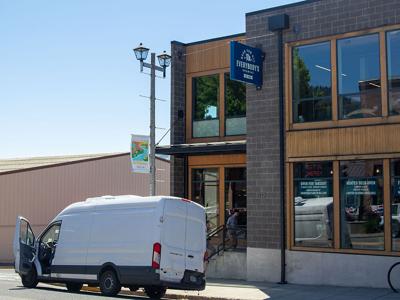
General Manager Kyle Bray at Everybody’s Brewing in White Salmon reported loss of revenue due to the bridge closure and said employees living in Hood River are faced with additional travel to get to work.
“I really feel like it hit some of our employees and just their ability to get to and from work. So, we’ve had to adjust schedules and things like that,” Bray said, who has been living in the Snowden area for four years. In response to the 12-hour closures starting at 7 p.m., Bray said he anticipates further impacts to his employees.
“Again, it’s going to hit our staff. [If] somebody works here till they get off at 11:30 at night and they can’t just jump the bridge, [they] have to go all the way around,” Bray said. “That’s really exhausting for them.”
Emergency services plan ahead
At Skyline Health in White Salmon, Emergency Room Medical Director Alia Breon said that the hospital saw an increase in the travel times for nurses and patient transports. Critical staff such as CNAs, nurses and hospital maintenance workers had to add upwards of 80 miles to their daily commute. According to Breon, Skyline health has been discussing different scenarios that could divert from usual transportation routes to and from the hospital.
“We work closely with our EMS agencies and EMS has a very large service area that they provide care to. So, having to do prolonged transports into the Portland area puts a lot of stress onto our system,” Breon said. She added that when faced with challenges to their normal routes, they will have an increased reliance on Lifeflight.
“A lot of it is kind of route to planning and resource planning. “Kind of trying to figure out how we can best use our resources to take care of our county.
“As we’re looking at the closures coming up over the next couple of weeks, we’re thinking about how we can really make sure that we’re here for everybody in the community that needs us,” she said.
Breon said there are concerns surrounding pregnant patients getting adequate care in a timely fashion.
“I think the OB care [Obstetrical care] is the biggest population that we want to be prepared to serve if we need to be able to take care of them,” Breon said. “Because for a woman in labor, having to drive, especially in a private vehicle, an extra half hour is a pretty long drive.”
Fruit companies monitor repairs
The Hood River-White Salmon Bridge serves as a convenient avenue for growers to transport the large bins of fruit across state lines. July marks the beginning of cherry harvest season but Columbia Gorge Fruit Growers Association Executive Director Mike Doke said he does not believe the closures “will adversely affect this year’s crop.”
He said that majority of cherry harvest will be transported to the Dallesport and thus trucks will use the toll-free The Dalles bridge.
Semi-trucks have not been allowed the cross the Hood River-White Salmon Bridge since June 27, but Doke said he is confident that the port will be able to complete repairs in time for pear harvest.
“Pear harvest doesn’t really get into earnest until August,” Doke said. “But we want to see how the next two weeks for construction goes to make sure that everything’s good to go for hauling freight across that bridge again.”
Greenwood said that as of Friday, port staff have had to turn away “five or six” semis. He believes the 12-hour intermittent closures are a better option than a full week closure.
“Timber, fruit, agriculture, I mean, those are all major businesses in this area and as an economic development agency, we have to take those interests into consideration,” Greenwood said. “I feel very good that we’re able to keep the bridge open for 12 hours a day during this repair period. We appreciate the public’s understanding as we try to get this bridge open and safe as quick as possible.”
Greenwood stated that the port is battling misinformation on social media in regard to the bridge and port operations.
“I think that there’s something that I learned a long time ago that being in this position, it’s impossible to go and try to tamp out [all the] misinformation and every conspiracy theory,” Greenwood said. “Our policy has been to not engage every little comment on social media and really direct people to our web page as the source for the latest information.”
To learn more about the Port of Hood River and the bridge replacement project visit PortofHoodRiver.com and HoodRiverBridge.org.


Commented