
By Nathan Wilson
Columbia Gorge News
THE GORGE — After the Supplemental Food Assistance Program (SNAP) saw several changes take effect last year, another one is coming in November, while more than 1,000 people in Hood River and Wasco counties have lost access to food stamps since.
That’s what Neil Freidrich, regional eligibility manager for Oregon’s Department of Human Services, told the Columbia Gorge Food Security Coalition Oct. 29.
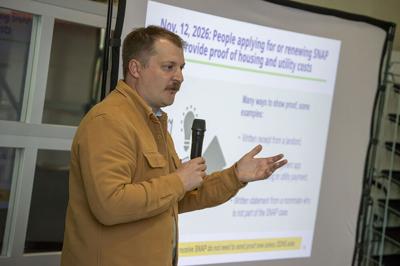
Beginning on Nov. 12, those applying or renewing their SNAP benefits in Oregon must provide proof of housing and utility costs. Additionally, as required by the “One Big Beautiful Bill Act,” a wider range of able-bodied adults have been required to work at least 80 hours a month since last October, including previously exempt veterans, young adults aging out of foster care and people experiencing houselessness.
Refugees, asylum seekers and other lawfully present noncitizens are no longer eligible for SNAP as well, and households relying on federal energy assistance programs in tandem with SNAP got their allowance reduced, too.
According to data from Freidrich’s department, 1,285 fewer people in Hood River and Wasco counties received SNAP payments in September compared to the same time last year because of the changes. Wasco County’s 16.5% decline in residents served was slightly greater than Hood River County’s 14.9%, and the difference in benefits distributed those months was nearly $230,000.
Statewide, 77,000 individuals lost access to SNAP and $112 million worth of payments weren’t processed between October 2025 and June 2026.
“One of the areas where I think we can really help folks is understanding some of the exemptions,” Freidrich told the coalition, made up of representatives from local nonprofits, health organizations, counties and other groups.
Those who are pregnant, enrolled in school, receive unemployment benefits, provide care for someone unable to do so independently, have a range of health conditions or are participating drug treatment program don’t need to meet the work requirements.
Freidrich also noted that bringing in a lease or mortgage statement isn’t necessary to prove housing and utility costs; verification can be less formal, like a note from a roommate.
Oregon may eventually, however, have to cover a roughly $250 million gap in SNAP funding it usually receives from the federal government. The same legislation that implemented work requirements also created a system to penalize states where SNAP recipients are either overpaid or underpaid at a high rate.
Oregon’s error rate was 14.14% in fiscal year 2025, and the threshold to avoid any penalty is 6%. If Oregon’s rate stays above 13.34% this year, it could incidentally delay the cost sharing mandate until fiscal year 2030, but other states will have to start paying anywhere from 5-15% of SNAP benefit costs in October 2027.
“When people think about inaccurate benefits administration, it can sound like there’s a bunch of fraud happening, which is actually incredibly low,” Freidrich said. “We’re often meeting with people at the most stressful time in their lives.”
He pointed to seasonal workers, who have incredibly variable pay. If Oregon’s Department of Human Services can’t anticipate how that changes, it’s still a strike from the federal government’s viewpoint, but the error rate has dropped nine points since fiscal year 2022.
“A lot of the steps you can take to improve accuracy restrict access — it’s more frequent reporting, increased verification,” Freidrich said.
•••
Our journalism needs your support. Subscribe at columbiagorgenews.com.


Commented