September is already is here, the month we have the autumnal equinox and the beginning of fall. September is a great stargazing month; skies are often clear, and darkness comes earlier. Sunset comes at about 7:45 p.m. on Sept. 1, and drops back to about 6:45 p.m.
September begins with a beautiful crescent Moon in the southwestern evening sky, in the constellation Libra. By the third of the month, the now first-quarter Moon will be located low in the southern sky, in the constellation Scorpius. Following the Moon’s position relative to the background stars, you can see that the Moon moves from west to east as it orbits the Earth. On the seventh and eighth of the month, the now almost full Moon will be near Jupiter in the southeast.
On the 10th and 11th, the Moon will visit be near bright Jupiter, in the southwest. On the 17th, if you are an early riser, look for the third-quarter Moon just to the left of the planet Mars in the morning sky. Full Moon occurs on Sept. 10, with new Moon following on the 25th.
The bright planets Saturn and Jupiter are prominent in September. Jupiter makes its closest approach to Earth for the year on Sept. 26. Saturn was closest last month, but viewing Saturn in September is even better, as the ringed planet rises earlier, and is higher in the southern sky earlier in the evening.
Saturn’s rings can be seen even with a small telescope — give it a try if you have one.
Jupiter is much brighter than Saturn, and will be quite prominent as the brightest “star” in the southeastern sky in September. Point a small telescope, or even a good pair of 10x binoculars toward Jupiter, and you should be able to make out the small circular disc of the planet.
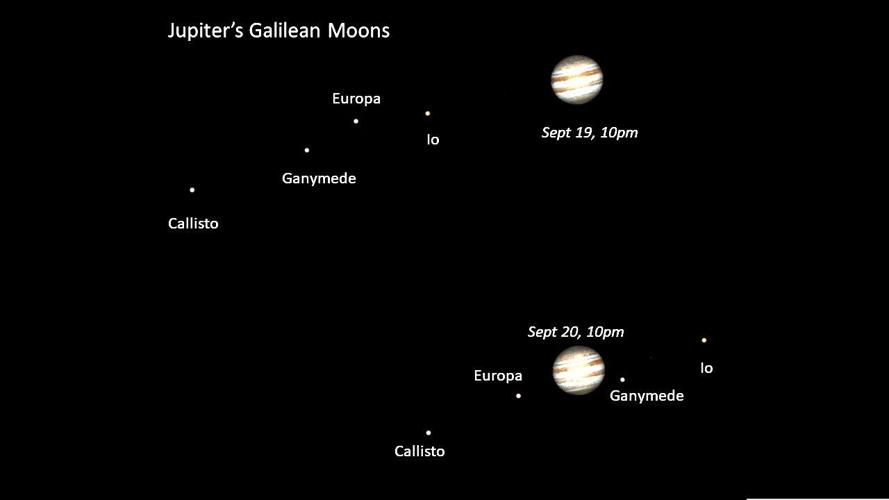
You should also be able to see four small “stars” lined up along Jupiter’s equator. They are the planet’s four largest moons, Io, Europa, Callisto and Ganymede. They are easy to see because they are large. Ganymede is the solar system’s largest moon, being even larger in diameter than the planet Mercury. Io and Callisto are larger than Earth’s moon, with Europa being slightly smaller.
A fun thing to observe is the movement of Jupiter’s moons from night to night. They orbit quite quickly, and you can see them change position from day to day. Galileo observed this with the newly-invented telescope in 1610, causing quite a stir at a time when people thought everything revolved around the Earth! You can replicate Galileo’s discovery quite easily. Take a look at the picture included with this article, showing the moon positions on Sept. 19-20.
Fall constellations are making their presence in the September sky. Pegasus, with its “great square” of equally bright stars, is right above Jupiter in the eastern evening sky. Andromeda, to the left of Pegasus, includes the Andromeda galaxy, faintly visible to the naked eye on dark, moonless nights.
In the north, Ursa major’s Big Dipper is low in the northeast. Cassiopeia lies in the northeast. Auriga the charioteer is becoming visible low in the northeast. Look for a bright star, Capella, low in the northeast after sunset. Capella is the sixth brightest star in our night sky.
Evenings in later September also provide opportunities to view the International Space Station as it zooms overhead. Go to Heavens-Above (www.heavens-above.com), enter your location information, and click on “ISS” for times when the station is visible.
A great way to view the bright planets this fall is to visit the Goldendale Observatory. The much-improved facility features great programs and wonderful views through its 24.5-inch telescope.
If you are interested in supporting the unique State Park, as well as other Klickitat County State Parks, join me with the Friends of Gorge Area Parks, more information at www.4gorgeparks.org.




Commented