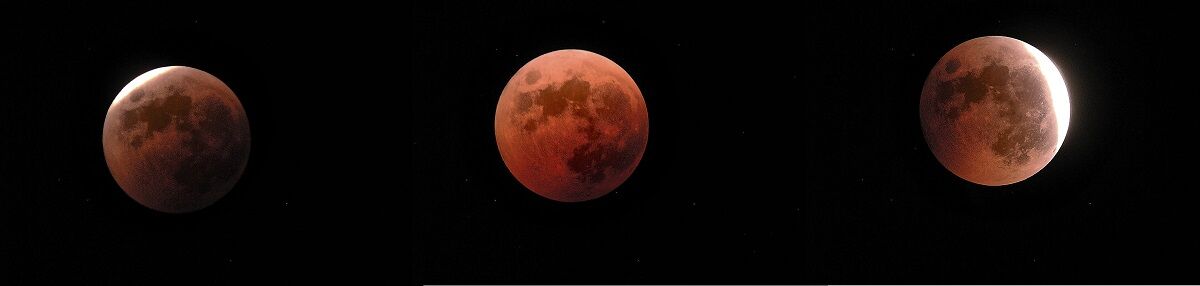
A 2004 photograph of Lunar Eclipse shows how the moon as it appears over time during the eclipse. The moon will rise May 15 fully eclipsed, at around 8:30 p.m., and the eclipse will end around 11:30 p.m.
A 2004 photograph of Lunar Eclipse shows how the moon as it appears over time during the eclipse. The moon will rise May 15 fully eclipsed, at around 8:30 p.m., and the eclipse will end around 11:30 p.m.
Welcome to May. The big event in our May night sky will occur on the 15th, when we will have a lull Lunar eclipse. Our bright planets remain mostly in the morning sky, and nights get shorter as we near the summer solstice. But nights will be warmer, and May usually presents more clear skies than earlier in spring. Get outside and take a look when skies are clear!
On May 15, our Moon will rise at about 8:30 p.m. in the southeast. It will have a distinctly reddish color, much subdued compared to the normal full Moon. It will already be fully eclipsed. The Earth will be immediately between the Sun and the Moon, blocking light from reaching our natural satellite. Some of the light passes through our atmosphere, is refracted, and bathes the Moon in a reddish glow. Long wavelength light, on the red end of the spectrum, is scattered less by our atmosphere and thus mostly reddish light illuminates the Moon, much as we encounter reddish sunsets and sunrises here on Earth. The Moon will remain fully eclipsed until about 10 p.m., and then will be in partial eclipse, slowly brightening as the Earth’s shadow creeps across the lunar surface. The eclipse will end at about 11:30 p.m.
If you watch the partial eclipse state, after 10 p.m., you may notice that the Earth’s shadow is curved as it appears on the Moon’ surface. You can see that in photos, such as the 2004 Lunar Eclipse pictures that accompany this article. The Greek astronomer Aristarchus, who lived between 310 and 230 BC, observed this and concluded that the Earth is round, at a time when many felt that the Earth was flat. He was also able to determine the relative sizes of the Earth and Moon, and that the Sun was much larger and farther away from us than the Moon.
Our bright planets remain in the morning sky in May. The one exception is Mercury, which will be visible low in the west after sunset. Look for it just to the left of the bright star cluster Pleiades on May 1.
Venus, Jupiter, Mars and Saturn will all be low in the southeastern morning sky. On May 29, look for a conjunction, a close apparent approach, between Jupiter and Mars. They will appear only about ½ degree apart in the sky. That’s about the width of the Moon in our sky, pretty close together. Look for them at 5 a.m. or a bit earlier, before the rising Sun lightens the sky too much.
In addition to the eclipse, it can be fun to follow the Moon as it marches across the sky, visiting different stars, constellations, and the planets. On May 5, you’ll find the thin crescent Moon low in the west, just below the twin stars of Gemini, Castor and Pollux. To the Moon’s right will be the bright star Capella, in the constellation Auriga. On the 9th, the first quarter Moon will lie in the constellation Leo. It will then pass through Virgo, will lie in Libra during the eclipse, Scorpius on the 17th, and in Sagittarius on the 18th and 19th, visible in early morning. It will then join the line of bright planets in the morning sky.
Summer constellations are beginning to peek over the eastern horizon in May. Look for Cygnus the Swan to be low in the east at 10 p.m. To its right, find the bright star Vega, in the small constellation Lyra. The Big Dipper, in the constellation Ursa Major, now lies high overhead. Gemini and Auriga are now low in the west, and Orion, the prominent constellation in the winter sky, has pretty much disappeared from view, to return in fall.
•••
On April 7, a celebration of the improved Goldendale Observatory was held, with Washington Gov. Jay Inslee in attendance. This summer will be a great time to visit the unique Washington State Park, located on Observatory Hill in Goldendale.
In addition, a volunteer support group has been formed, assisting the Observatory and other Washington State Parks in the Goldendale Vicinity. If the group sounds of interest to you, check out the web page at 4gorgeparks.org.




Commented
Sorry, there are no recent results for popular commented articles.