
When we first talked about taking a trip to Honduras, I must admit I was a little hesitant about it. I had read and heard that Honduras has one of the highest homicide rates in the world and I couldn’t help but wonder if this was the best destination for our annual scuba diving trip. After reassurances from members of our dive group and some additional research, I somewhat reluctantly gave in.
To be precise, we were actually traveling to Roatán, which caters more to tourists than mainland Honduras. The largest of Honduras’ Bay Islands, Roatán is an island in the Caribbean, about 35 miles off the northern coast of Honduras. It is home to the world’s second largest barrier reef system, the Mesoamerican Barrier Reef System. The island is long and narrow, 28 miles in length, with a total land mass of 49 square miles. The mountainous backbone is surrounded by extensive coral reefs, and fishing villages dot the coastline. Visitors can fly directly to the island or take a flight or boat from the mainland. The resort we were staying at was even more secluded than that and required an additional short boat ride to get there.
When we arrived, we were greeted by impeccable weather. The temperature remained consistent throughout out stay with temperatures in the 90s during the day and dropping down to the high 70s in the evenings. Although it was fairly humid, there was almost always a refreshing breeze to keep things comfortable outside. If the heat did become unbearable though, air conditioning was available in most of the indoor areas around the resort.
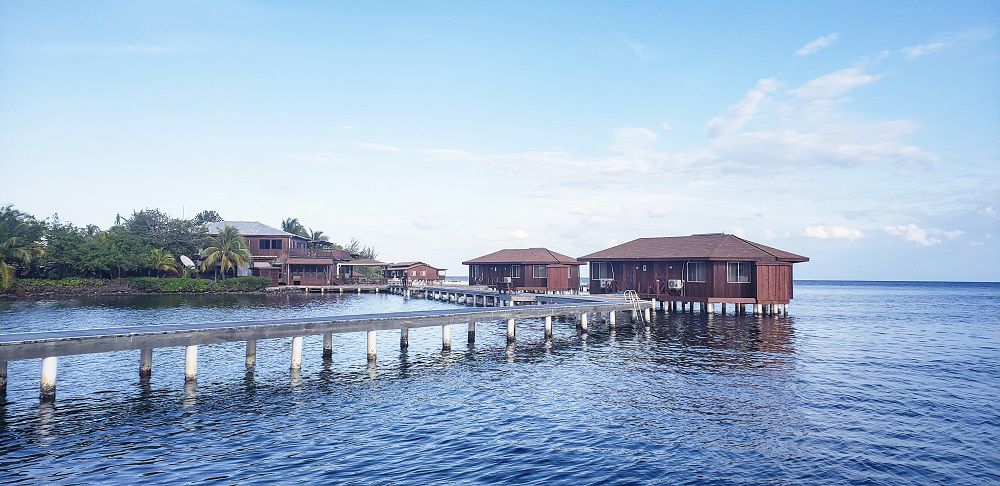
Our particular resort was geared toward scuba divers. The resort owned multiple boats and was conveniently set up with their own filling station for tanks, washing stations for gear, outside showers and pretty much anything a diver would need. The resort was its own little community with individual cabanas over the water, houses, a gift shop, a dive shop, a camera store and a large enclosure for their two pet parrots outside the restaurant. There really was no reason you had to leave for anything. The resort had it all. It was a scuba diver’s dream set up.
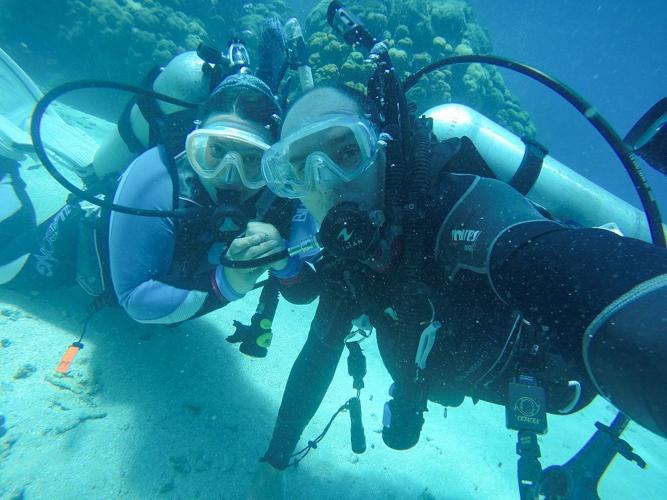
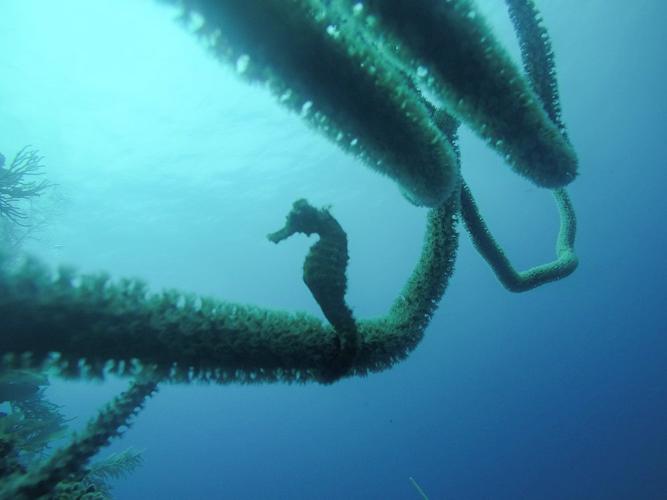
The diving in Roatán did not disappoint. Many of our dives were on massive coral walls where we saw spectacular sea sponges and swam in and out of canyons and crevices. We also had the opportunity to go on our first wreck dive and explore a sunken ship. On our dives we saw drum fish, lionfish, eel, octopus, reef sharks, huge puffer fish, too many small reef fish to count or name and, one of my personal favorites, sea horses. I saw more seahorses on this trip than all my previous dive trips combined. Although we did not see a lot of large marine life this trip, we did have some memorable encounters with some of the smaller inhabitants of the reef.
One of these encounters was when we were stalked by a green moray eel as he attempted to steal a lionfish from our dive master’s lionfish dungeon. Roatán has a program to help mitigate the effects of one of the most invasive species to the area, the lionfish. Under this program, divers are trained to safely hunt lionfish with spears and then relinquish them to the resorts for them to prepare and cook. It may seem as though everyone is ganging up the lionfish; however, if the lionfish population remains unchecked, these aggressive, non-native, prolific breeders will decimate the reef’s fish population. Interestingly, we also learned that local divers had been teaching the eels how to safely hunt the lionfish themselves by attacking them from behind, thus avoiding the poisonous spines on their fins. The lionfish in the area finally have a predator that has acquired a taste for them. Because of this, that green moray eel followed us, swam under and between our legs and rammed the canister that contained the lionfish our dive master had speared earlier. Unable to break into the dungeon, the eel was so determined that he eventually ripped a lionfish right off a spear of a diver. I’m a little squeamish about these kinds of things, so I averted my eyes through this whole encounter and chose not to participate in the program.
Although this trip was primarily a dive vacation, we had plenty of things to see and do above water as well. I particularly enjoyed going out each evening with a flashlight and searching for sea life while walking along the docks. It became a nightly ritual before we went to bed and we made sure to stay out long enough to see something new each night. We saw countless octopi, crabs, lobster and even a hermit crab the size of a football looking for a new home, who was attempting to downsize, to no avail. Remarkably, we saw all these creatures without even setting a foot in the water.
On most evenings, the resort had scheduled entertainment. My favorites were when the fire dancers and local schoolchildren came and performed. Both shows were incredible yet completely different from one another. The fire dancers showed so much grace and artistry while the children (who were a variety of ages) enthusiastically and skillfully danced in native costumes. At one point, audience participation was encouraged and several of us got to experience these dances first-hand. There were also hermit crab races and concerts from local musicians during our stay.
The highlight of the trip, however, was an event more than 12 years in the making. Each day, our diving group had the option of doing a drop-off dive after our morning boat dives. This dive is exactly how it sounds. The boat drops divers off in a specific area roughly 300 yards from the resort in what the resort refers to as its “front yard.” On day one of our trip, our dive master accompanied us on this dive and took us through how to maneuver our way safely back to the resort. The dive itself is not incredibly difficult and has an abundance of sea life in a relatively shallow depth. This time was our second drop-off and our group was comprised of only four people. My boyfriend Nick and I were “buddies,” so we stayed close to each other during the dive while the others remained slightly farther away. One of the incredible things about scuba diving is that there is so much life to see literally all around you and even two people swimming right next to each other can see different things. At one point, while I was preoccupied with some fish, Nick had swam ahead and “discovered” a shell nestled in the sand. He caught my attention and beckoned me over to see it. It was a strange shell, something I had never seen before partially obscured in the sand. Most of the time, when you see shells while diving, they are indeed living beings and are more subdued in color. This particular shell, however, was quite vibrant and almost iridescent. I swam closer to it to get a better look resisting the urge to pick it up (a diving etiquette no, no). When I looked closed closer though I saw that it had a small, gold hinge along its edge.
I suddenly was so excited. Here in the sand, I had found a treasure that someone had lost. I picked up the shell and thought to myself how amazing it would be if there was actually something in the trinket box. I gently opened it and found a diamond ring secured inside. At this point, I had mixed feelings about the treasure I had found. I was incredibly excited to have found it but couldn’t help but feel guilty for the couple who had lost their engagement ring. I looked to Nick, who had been next to me watching this all transpire. We couldn’t really speak to each other given the regulators in our mouths and the fact that we were under water, but I attempted to fill him in on what I had discovered, nonetheless. As I made gestures explaining to him what I had found, he simply watched without much of a reaction.
“He doesn’t understand,” I thought. He found this beautiful shell and didn’t realize that it was actually a trinket box with something inside. As I continued to try and educate him nonverbally, he finally opened up his arms and threw out his hands with an exasperated look.
Suddenly it dawned on me. This was indeed my treasure. After more than a decade, Nick had proposed. I could hardly contain myself and nearly choked on my regulator. I was so ecstatic and completely taken by surprise. This will definitely be one of my most memorable dive experiences.
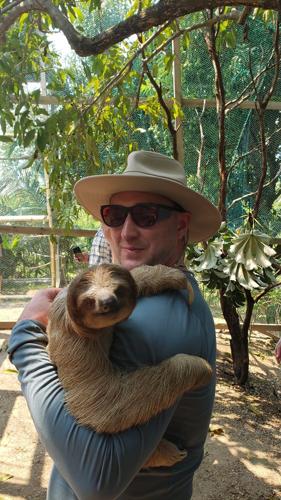
After a week of diving, we decided to venture away from the resort and spend some time on dry land. We went on a guided tour complete with a boat ride through the mangroves as well as a visit to a sloth and monkey sanctuary and an iguana reserve. We had the opportunity to hold a sloth as well as be used as a capuchin monkey’s personal jungle gym at the sanctuary. We also got to play with guinea pigs and talk to some parrots.
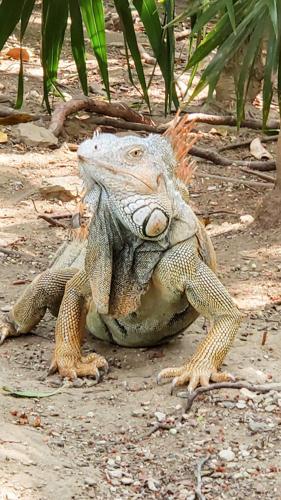
The iguana park was quite impressive. The park began as someone’s solution to the decline in the native iguana population due to locals hunting them for food. A man decided to transform his 12 acres of personal property into a place where iguanas could thrive. Today, more than 4,000 iguanas freely roam in and around the property. In this protected haven, the iguanas can grow to four feet long and can be seen everywhere. They are baby and juvenile iguanas in large pens, iguanas lying all over the ground, iguanas chasing each other through the forest and iguanas in the trees above. They are quite accustomed to visitors and many will allow you to feed them leaves and even pet them. The farm allows the iguanas a safe place to live and each year, iguanas are released into the wild, helping to maintain the native reptile’s population on the island. On the grounds there is also a marina where the owner keeps tarpon (large saltwater sports fish) that visitors can view swimming under and around the docks. You could tell by visiting this park how dedicated the owner is to the island’s wildlife.
In just over a week, we saw and experienced so much. Roatán will always have a special place in my heart. Not only because it was where Nick and I got engaged, but also for the great diving, the sea horses, the sloths, the monkeys, the iguanas, the nightly dock adventures, the fire dancers, the dancing of the local children and some of the best hospitality I have ever experienced. Honduras indeed has its share of problems, but like any place in the world, is so much more than just one bad statistic. It is a place of beauty with so much life, both on the land and in the water surrounding it. Looking back, I can’t believe I almost bowed out of this incredible adventure.


Commented