
Artist Chris Pothier has been a professional artist for about 19 years, creating fine art paintings in oil and commercial projects in a variety of media, and is now passing on his skills, techniques and passion to students in area through oil painting classes at The Dalles Art Center and Mary-hill Art Museum.
Born and raised in in suburban Boston, Mass., Pothier and his wife Kathy are relative newcomers to The Dalles, where they have a home on East Eighth Street.
He cited the weather as a primary motivator for leaving the East Coast, where they were settled in New England for many years. “People here last year were talking about all the snow. Where I’m from, we would get like eight feet of snow every winter. In spring it would warm up for a few days and melt — and then we would get yet another snow storm.”
It was the snow that drove them west to the Pacific Northwest.
Pothier frequently travels in his work and was soon focusing on the west, and eventually Oregon. “I wanted to go to the west coast, to advance my carrier, and we have a lot of friends and family in the northwest,” he said.
Their move landed them in Portland, where they set up short-term and started looking for a place to call home. “We looked at a lot of towns, Th e Dalles just had what we were looking for. We really fell in love with the house, as well. I do a lot of work all around the country, but this is my home base.”
“We really love it here. And it’s really a great community of artists,” he said.
As a commercial artist, Pothier does paintings, large murals, and even reproductions of existing paintings. “I do a lot of work for clients; individual people, businesses and restaurants. In that realm I’m a sort of hired gun, I do what they need. It’s all commissioned work.”
When he isn’t working on commission, Pothier pursues his own vision in the realm of fine art. “The commercial work funds my obsession with painting. I sell my personal paintings, but most of that work is purchased by big collectors because those pieces can be really expensive.”
In college, Pothier started out studying philosophy, but he soon found he had a unique way of exploring that discipline.
“The images in my head sort of created my philosophy, but it was hard to explain them with words,” he said. “I had to paint them to explain them.”
It was the need to communicate his philosophical ideas that started him on the road of becoming an artist.
He began to study for a fine art degree and realized he had found both his passion and his vocation.
“When I started painting, it just came easily to me. I didn’t struggle at all, it just came,” he said. “I also benefited from having some really good teachers, too.”
He earned a degree in fine art painting, but it took time to find his feet as an artist. “It was 10 years of continuously working — of just learning to control it — before I was confident I could do what I set out to do,” he said.
That confidence allowed him to successfully work as a professional artist and pursue his own vision in paint as well.
His personal work, his art, is largely focused on people and how they relate to each other.
“I’m a news junkie,” he said. “I don’t watch TV, but I follow a lot of news online. I’m also interested in history.
“I look at the larger picture of things, the larger focus. Looking at the whole scheme of things, that’s what I’m good at.”
His work is often produced on a theme. “For a few years, I did paintings on capitalism and business,” he said, pointing to a painting of many arms and hands scrambling to grab a briefcase. “They usually have a narrative and are figurative.”
“I’m really fascinated by human behavior in society, how we interact with each other. I like to explore those kinds of topics, as a sort of general idea.
“In a lot of ways, I see myself as just an observer,” he added. “I’m fascinated with groups, group mentality; that’s my next series of paintings.”
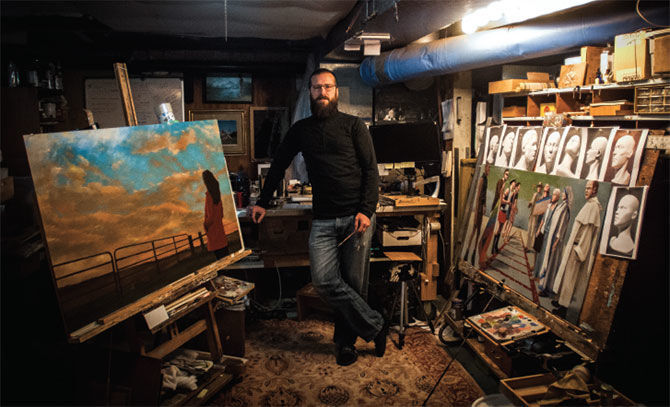
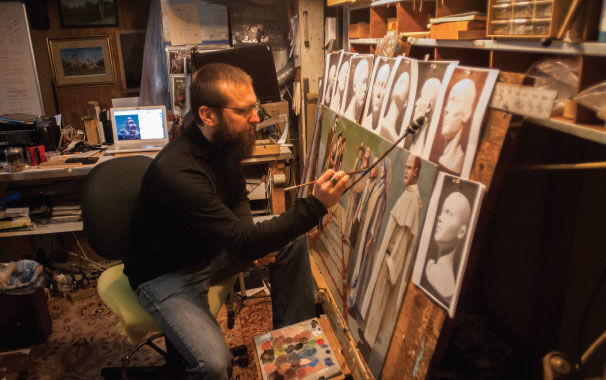
Gesturing to a work-in-progress on one easel — there is another one on a facing easel — he said he is just starting on the new series. The image is far from complete, a group of individuals still isolated on the canvas. Posted around the painting are paper prints of generic heads, one for each character on his easel, which he is using to reference the angles and light he seeks to capture.
“All my painting comes from visualizations that just hit me. It’s not exactly day dreaming, these mental images get into my head when I’m thinking. I don’t know where it comes from.
“When I’m awake, sleeping, when I’m dreaming, ever since I was a little kid, It flows through me, it just comes.”
“Oil painting is a lot like being a plumber or an electrician: you can’t just stumble into it,” Pothier said of his work teaching art classes. “You really have to be shown the craft, the too l s and technique. The knowledge gets passed from teacher to student through the generations.”
“The student learns, and eventually the student be-comes the teacher.”
Pothier will be teaching two art classes this year, one on oil painting at The Dalles Art Center and a second on art reproduction to be held at Maryhill Art Museum.
This isn’t the first time Pothier has taught painting, having taught as an adjunct for about nine years in college, but he said he enjoys teaching it his way, this time: “At college, they asked me to teach in specific ways, using specific techniques.
“Here I’m teaching it my way, teaching my own methods.” He described his techniques “pseudo-classical, with a touch of Italian Renaissance.”
The oil painting class at TDAC will start at the beginning, he said, with an empty canvas and a focus on the basics. “If you get those really basic, really important aspects down, I think anyone can pick it up,” he explained. “That’s what I’m doing at the art center; everyone starts at “0” and gets built up from there.”
The class at Maryhill will require participants to be more familiar with oil painting techniques, he said. The process he uses to paint reproductions of a paintings can be broken into three parts: The first is to work out the colors, which is done with very broad, undefined areas of paint. The second step is a small but complete reproduction, a sort of “practice painting,” and the final step is the actual reproduction.”
Copying great paintings is a very time-honored way of learning and teaching, he added.
“This is the smallest studio I’ve ever had,” Pothier said of the narrow basement room studio at his home in The Dalles. “You have to be pretty creative with the space.
He’s had giant studios in the past, but working from the home he shares with his wife and three children (Axel, Ian and Zachary) was more important than a large space, he said.
Entering his studio, the visitor arrives first at a small desk, beyond which are two large easels brightly lit with specialty lights, each easel facing the other.
This where Pothier does his painting. On the desk is his laptop. He takes a lot of photographs to serve as references in his paintings, and they can be displayed on screen.
Along one wall toward the back of the room is a counter covered with a clutter of equipment that serves as a work table. It is here he uses bright, directional lights to explore how light on a subject will cast shadows and high-lights.
“I make little models to see how the light hits,” he explained. He points to a painting on the wall behind the counter: “With that painting, I used paper for the cars. I use various objects, and some-times clay figures, to model the light.”
The opposite wall is where he dries his paintings or sets them aside while he works on something else.
The studio is not cluttered with paintings. “They go out pretty fast,” he explained. He currently has about 40 showing in three galleries on the east and west coasts.
Finding A Market
In addition to his thematic work, Pothier also creates fine art he knows will sell.
“It’s like any art. You have to sell, eventually, to make a living,” he said.
“I try to have both work that sells and work that is more meaningful but maybe doesn’t sell the same way.
What sells?
“It’s figurative, it’s land-scape, it’s not disturbing. It’s not going to make anyone sad,” he added.
Pothier ’s work will be showing at the art center, located at 220 E. 4th St., in May and he will be on hand for the opening reception Thursday, May 3, 5 p.m. to 7 p.m. The center is open Tues-day through Saturday, 11 a.m. to 5 p.m. Admission is free. His work can also be found at Steel Door Art Gallery, 1991 NW Upshur Street, Portland. He is on Facebook, and his website is www.christoher-pothier.com.


Commented
Sorry, there are no recent results for popular commented articles.