There is always a sense of excitement when you begin exploring the history of a new project. What will you uncover? What might you learn that will help you better understand why things have become what they are today and how they might change in the future. For me, the exploration never grows old. It is fascinating, as are the people I meet along the way and their personal stories.
This last year I have focused on the history of the fruit industry in Hood River Valley. My interest was piqued decades ago when I was working with Ruth Guppy, one of Hood River’s premier historians. I had uncovered a crate in the old red barn that housed hundreds of fruit labels from the 1900s through 1940. These beautiful lithographs had been collected by Masuo Yasui when he farmed in the valley during that era.
I wanted to learn more about the labels to determine whether Columbia Gorge Center could use them in fundraising for the clients they served. I was told that Dave Burkhart and Ruth Guppy could advise me on their use and historical significance. I began my research with Ruth at the urging of my father, who shared that she and my Aunt Ellen had been classmates and colleagues in crime when they were young. That certainly intrigued me. A single phone call provided entry into her home where she regaled me with stories of my aunt and their many adventures. She also opened her files and bookshelves filled with magazines, photographs and newspaper articles. A literal Pandora’s box. I have rediscovered them in a metal filing cabinet at the Hood River History Museum. Ruth was a treasure, sharing information on almost any topic related to our community, from Nathaniel Coe to Chief Tommy Thompson. Her uncanny ability to uncover the human stories that lay beneath the pictures and words brought history to life and her willingness to share made her an invaluable mentor. She has been gone for a decade but her gifts will carry on for generations.
I was reunited with Ruth’s writing through the collection of her newspaper articles, “Over the Picket Fence,” published by her daughter Macy Guppy and the work Ruth did with Dave Burkhart on the book “It All Began with Apple Seeds.” Ruth’s writing pulled you into what ever topic she might be exploring. Her personality was so engaging that I fell in love with the history of everyday events and their ability to influence us currently and in the future.
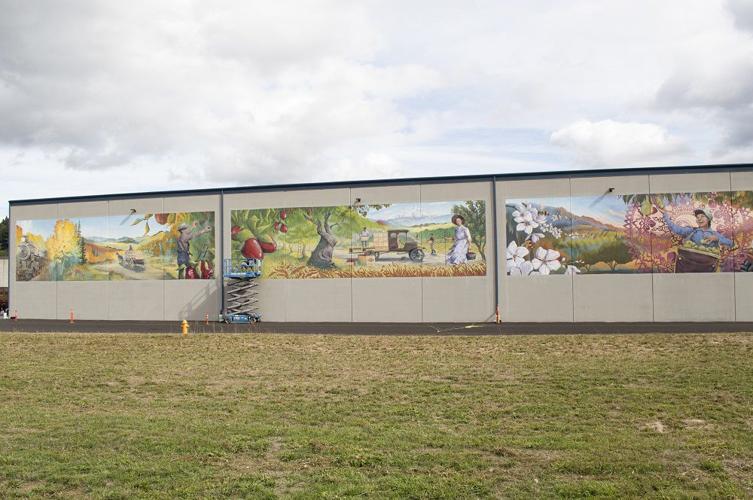
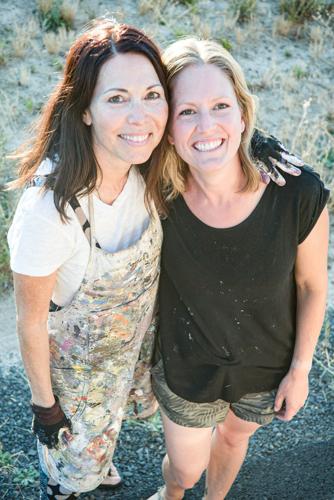
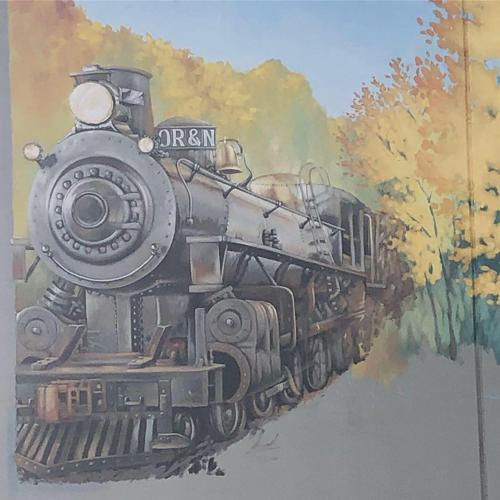
The culmination of the historic research into our fruit industry, from its infancy to current practices, is the magnanimous mural welcoming all to the little community of Odell. It celebrates the bounty of our valley, and the diversity of the people who helped create a place where the best fruit in the nation is raised. In the process these conditions have also created some of the best children who will help mold our future. True to the lessons Ruth taught me, it was the people along my historic investigation that were the greatest treasure uncovered. Working with the talented artists Allison Bell Fox and Michelle Yamamoto was truly inspiring. Day after day, through the intense heat of August and the chilling cold mornings of September, these two women exhibited the same work ethic of the farmer’s they were portraying. I visited the mural each evening to measure the progress and capture the emerging picture with my cell phone camera. I couldn’t imagine how it could be improved, and then the following day a series of intricate details would emerge. Each layer added more depth to the mural making a simple “drive by” inadequate to appreciate its creativity and potential impact. Fortunately, a professional photographer, Robin Dickinson, has captured the immensity and intricate detail that my cell phone photos lacked.
The Diamond Fruit Growers Board of Directors has been extremely supportive of the project, with much of the burden falling on the shoulders of facilities manager Nick Erickson to support the artists and ensure their safety as well as having easy access to the artist materials and Diamond machinery. Most significantly, the board did not want this to be a marketing tool for their fruit. It was meant to be a gift of the community to the community in celebration of all the efforts of workers, farmers, and industry related employees who made this such a great community in which to work and play. Individual donations and donor advised funds have paid for the artists time and materials.
Patrick Rawson and daughter Claire have worked tirelessly on the concept, friend and fundraising inspiring a broader visions of valley wide murals throughout orchards, fruit stands, markets and cideries along the fruit loop to help educate folks of the importance of the fruit industry and the value of the diversity of the people who toil in the fields and fruit plants.
Shelley Toon Lindberg, director of Arts and Education of the Gorge has been instrumental in the development of the project as well as the primary connection to students, artists, materials and inspirational concepts that have led to the enhancement of the project.
Phase 2 of the Odell Project is emerging. We will be exploring the siting of a kiosk on property directly west of the mural also owned by Diamond Fruit Growers. The current concept is that a local artist who works with reclaimed metal and wood will design a kiosk that will house portraits of fruit farmers and industry leaders researched and painted by students from the Odell area. A videographer will interview the descendants of those portrayed by the students and the short videos will be captured on QR codes that can be viewed on visitors’ cell phones. A mural of the valley designed by students will highlight the kiosk and a time-lapse video will highlight the magnitude of the process and explore the intrinsic details within the mural.
This collaboration between artists, business, students and community helps reinforce the beauty of this community and the people who make it the treasure that it is. It strengthens your spirit and belief in the good of most human beings.



Commented