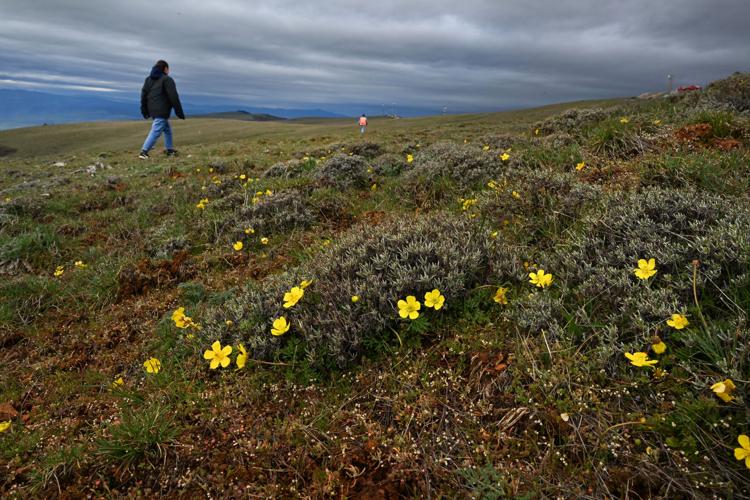
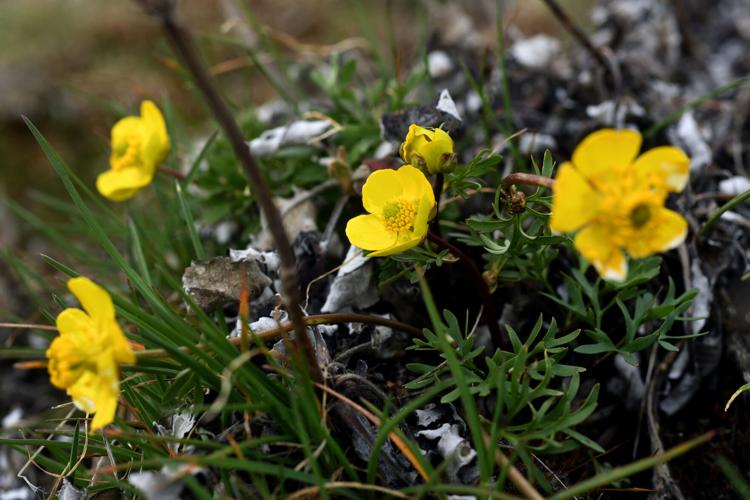
KLICKITAT COUNTY, WA- The blossoming of The Dalles Mountain buttercup can be seen on the hillsides in the Columbia Hills Natural Area Preserve and Dalles Mountain State Park in Klickitat County, Washington on March 24th, 2026. The Dalles Mountain buttercup, Ranunculus triternatus, is endemic to the Gorge, meaning it survives nowhere else on earth, said Ethan Coggins, a Natural Areas Specialist with the Washington State Department of Natural Resources. After more than 20 years of population decline, monitoring efforts are intensifying for the tiny, early-blooming endangered buttercup that grows only in the Gorge. Also called the obscure buttercup, it’s known from just four populations within a fifty-square-mile area, with an estimated 8,000-12,000 individual plants. A federal species of concern, the flower is listed as endangered in Washington. (Photo by Helen H. Richardson/Special to the Columbia Gorge News)
KLICKITAT COUNTY, WA- The blossoming of The Dalles Mountain buttercup can be seen on the hillsides in the Columbia Hills Natural Area Preserve and Dalles Mountain State Park in Klickitat County, Washington on March 24th, 2026. The Dalles Mountain buttercup, Ranunculus triternatus, is endemic to the Gorge, meaning it survives nowhere else on earth, said Ethan Coggins, a Natural Areas Specialist with the Washington State Department of Natural Resources. After more than 20 years of population decline, monitoring efforts are intensifying for the tiny, early-blooming endangered buttercup that grows only in the Gorge. Also called the obscure buttercup, it’s known from just four populations within a fifty-square-mile area, with an estimated 8,000-12,000 individual plants. A federal species of concern, the flower is listed as endangered in Washington. (Photo by Helen H. Richardson/Special to the Columbia Gorge News)
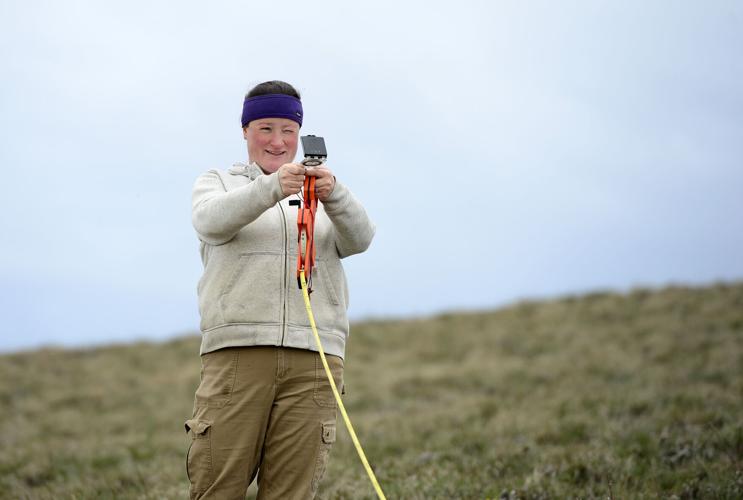
KLICKITAT COUNTY, WA- Ecologist Kim Quayle lines up survey lines while looking for The Dalles Mountain buttercup in the Columbia Hills Natural Area Preserve and Dalles Mountain State Park in Klickitat County, Washington on March 24th, 2026. The Dalles Mountain buttercup, Ranunculus triternatus, is endemic to the Gorge, meaning it survives nowhere else on earth. After more than 20 years of population decline, monitoring efforts are intensifying for the tiny, early-blooming endangered buttercup that grows only in the Gorge. Also called the obscure buttercup, it’s known from just four populations within a fifty-square-mile area, with an estimated 8,000-12,000 individual plants. A federal species of concern, the flower is listed as endangered in Washington. (Photo by Helen H. Richardson/Special to the Columbia Gorge News)
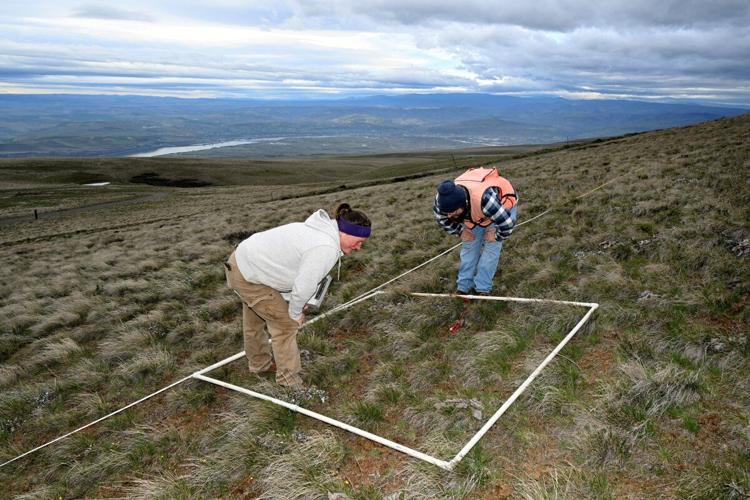
KLICKITAT COUNTY, WA- Coggins and Quayle searching for buttercups in the frame. The Dalles Mountain buttercup, Ranunculus triternatus, is endemic to the Gorge, meaning it survives nowhere else on earth, said Ethan Coggins, a Natural Areas Specialist with the Washington State Department of Natural Resources. After more than 20 years of population decline, monitoring efforts are intensifying for the tiny, early-blooming endangered buttercup that grows only in the Gorge. Also called the obscure buttercup, it’s known from just four populations within a fifty-square-mile area, with an estimated 8,000-12,000 individual plants. A federal species of concern, the flower is listed as endangered in Washington. (Photo by Helen H. Richardson/Special to the Columbia Gorge News)
KLICKITAT COUNTY, WA- The blossoming of The Dalles Mountain buttercup can be seen on the hillsides in the Columbia Hills Natural Area Preserve and Dalles Mountain State Park in Klickitat County, Washington on March 24th, 2026. The Dalles Mountain buttercup, Ranunculus triternatus, is endemic to the Gorge, meaning it survives nowhere else on earth, said Ethan Coggins, a Natural Areas Specialist with the Washington State Department of Natural Resources. After more than 20 years of population decline, monitoring efforts are intensifying for the tiny, early-blooming endangered buttercup that grows only in the Gorge. Also called the obscure buttercup, it’s known from just four populations within a fifty-square-mile area, with an estimated 8,000-12,000 individual plants. A federal species of concern, the flower is listed as endangered in Washington. (Photo by Helen H. Richardson/Special to the Columbia Gorge News)
HELEN H. RICHARDSON
KLICKITAT COUNTY, WA- The blossoming of The Dalles Mountain buttercup can be seen on the hillsides in the Columbia Hills Natural Area Preserve and Dalles Mountain State Park in Klickitat County, Washington on March 24th, 2026. The Dalles Mountain buttercup, Ranunculus triternatus, is endemic to the Gorge, meaning it survives nowhere else on earth, said Ethan Coggins, a Natural Areas Specialist with the Washington State Department of Natural Resources. After more than 20 years of population decline, monitoring efforts are intensifying for the tiny, early-blooming endangered buttercup that grows only in the Gorge. Also called the obscure buttercup, it’s known from just four populations within a fifty-square-mile area, with an estimated 8,000-12,000 individual plants. A federal species of concern, the flower is listed as endangered in Washington. (Photo by Helen H. Richardson/Special to the Columbia Gorge News)
HELEN H. RICHARDSON
KLICKITAT COUNTY, WA- Ecologist Kim Quayle lines up survey lines while looking for The Dalles Mountain buttercup in the Columbia Hills Natural Area Preserve and Dalles Mountain State Park in Klickitat County, Washington on March 24th, 2026. The Dalles Mountain buttercup, Ranunculus triternatus, is endemic to the Gorge, meaning it survives nowhere else on earth. After more than 20 years of population decline, monitoring efforts are intensifying for the tiny, early-blooming endangered buttercup that grows only in the Gorge. Also called the obscure buttercup, it’s known from just four populations within a fifty-square-mile area, with an estimated 8,000-12,000 individual plants. A federal species of concern, the flower is listed as endangered in Washington. (Photo by Helen H. Richardson/Special to the Columbia Gorge News)
KLICKITAT COUNTY, WA- Coggins and Quayle searching for buttercups in the frame. The Dalles Mountain buttercup, Ranunculus triternatus, is endemic to the Gorge, meaning it survives nowhere else on earth, said Ethan Coggins, a Natural Areas Specialist with the Washington State Department of Natural Resources. After more than 20 years of population decline, monitoring efforts are intensifying for the tiny, early-blooming endangered buttercup that grows only in the Gorge. Also called the obscure buttercup, it’s known from just four populations within a fifty-square-mile area, with an estimated 8,000-12,000 individual plants. A federal species of concern, the flower is listed as endangered in Washington. (Photo by Helen H. Richardson/Special to the Columbia Gorge News)
THE GORGE — The buttercups found on The Dalles Mountain are unique, endangered, and are being monitored and protected by the Washington State Department of Natural Resources (DNR). The fast-moving water of the Missoula Floods during the Ice Age shaped the beautiful landscape of the Gorge by scraping away rocks and sediment through the valley, and it also shaped the unique growth of The Dalles Mountain Buttercup.
The flood which scoured the rest of the valley didn’t reach the top of the ridge which means deeper soil remains there, explained DNT Natural Area Specialist Ethan Coggins. “They got cordoned off from the sage brush buttercup you find everywhere else, and they just became this rare species,” said Kim Quayle, another ecologist with DNR.
Coggins also explained that when the area was ranch land, the ranchers didn’t graze their cattle on the tops of the mountains in the early spring so the top layers weren’t taken off like they were in other areas, which kept the native environment from being damaged like it was below.
While the balsamroot and lupines are the well-known eye-catchers of the Gorge, the buttercups are important for early pollinators and early nesting birds whose chicks rely on those insects to grow. “This year they were blooming in late January,” said Coggins. “They’ll even bloom under the snow sometimes, which is very unusual.”
In recent years, the buttercup has experienced significant declines. Between 2003-2012, they declined 39-75% and have continued to decline since. Though they are not individually counted, there are estimated to be between 1,000 and 10,000 individual plants, which are only found in the Columbia Hills and the Mill Creek Drainage.
Though ecologists don’t know the exact reason for this decline, they believe an invasive bluegrass, Poa bulbosa, is spreading too quickly and making it inhospitable for the buttercups. “It’s probably making it harder for baby buttercups to germinate to start the population over again and keep the whole cycle going,” said Coggins.
To mitigate this effect, DNR teams frequently employ weed treatments to keep the grasses from overtaking places for the buttercups and the other rare ecosystems on the sites.
“Conservation is not always just like leave it in place. Unfortunately, we have done enough in the natural world that we can’t just do that anymore,” said Coggins.
The human presence also impacts the buttercup habitats, and Coggins explained that they spend a lot of time educating people about how to enjoy nature without damaging. Sayings like, “wildflowers grow by the inch and die by the foot,” and “don’t bust the crust,” Coggins explained, is how they remind people about the delicate balance of the bio-crust and ecosystems of the landscape. “In our area, the biotic crust grow a little faster, so it might recover in five to 10 years, but in the desert, it can take 50 to 100 years for that crack that you’ve made in that biotic crust to fuse and repair itself,” said Coggins.
To monitor these plants the ecologists currently do presence/absence counts using a large frame placed at randomized intervals along the site. “When they started this, they’d get 40-50% hits. Now if we get 10%, we’re like ‘woah! So many buttercups this year!” said Quayle. “It’s kind of hard to track now. Because we have that tiny percent, the stats on that aren’t as valuable.” To capture the data more finely, they began doing circular plots where the individual plants are counted within a given area in 15 minutes.
“It would be better if we could have the same person do it every single year for 15 minutes and know they were exactly as good at finding the buttercups every year,” Coggins joked.
DNR teams have limited time and resources, and have a large coverage area and many projects and they rely on local botanists and volunteers to supplement their work. Oregon Naturalists is one of the groups they work with and teach a class, but this buttercup research in particular has been done by Paul Slichter, a self-taught local botanist and retired teacher who has documented the wildflowers and plants of the Pacific Northwest for years.



Commented