
There are a total of six performances, five evenings and one matinee.
Inherit the Wind
Aug. 22, Aug. 27, Aug. 29, all 8 p.m.
The Night Thoreau Spent In Jail
Aug. 21, 8 p.m.; Aug. 23, 2 p.m.; Aug. 28, 8 p.m.
Order tickets at showtix4u.com or go to Waucoma Bookstore. Prices are $18 for adults, $15 for seniors 62 and over and students 13-17. Both plays are suitable for all ages, but content might be too complex for anyone under 13.
Proceeds from the plays go to Columbia Gorge Ecology Institute, The Next Door, Hood River County Libraries, and Start Making A Reader Today.
Cast: Inherit The Wind
Henry Drummond — Will Thayer Dougherty
Matthew Brady — Tom Burns
E.K. Hornbeck — Ray Abanto
Mrs. Brady — Carol Thayer
Rachel Brown — Maza Brady
Bertram Cates — Roman Moretti
Rev Jeremiah Brown — David Dye
Howard Blair — Connor Muhl
Edith Davenport — Jana Castanares
Judge — David Adams
Mayor/Organist — Bill Weiler
Meeker — Edward McNair
Melinda — Alea McCarty
Mrs. Blair — Barb Berry
Elijah, Jurors — Dennis Castanares
Mrs. McClain — Adrian Chaton
Mr. Goodfellow — Dell Charity
Radio Man — David Dye
Cast: The Night Thoreau Spent in Jail
Henry David Thoreau — David Dye
John Thoreau — William Thayer-Daugherty
Mrs. Thoreau (Mother) — Carole Thayer
Ellen Sewall — Maza Brady
Ralph W. Emerson —Tom Burns
Lydian Emerson — Barb Berry
Edward Emerson — Gerald Hoff
Bailey — Edward McNair
Sheriff Sam Staples — Ray Abanto
Deacon Jeremiah Ball — David Adams
Williams — Dell Charity
Aunt Louisa — Adrian Chaton
In two dramas opening together this weekend in Hood River, historical events find new life and current meaning, as Plays for Non-Profits takes the stage at Columbia Center for the Arts (CCA).
Proceeds from the productions go to four local non-profit groups, under the program started five years ago by Lynda Dallman, who directs one of the plays. (See sidebar for details.)
Jerome Lawrence and Robert E. Lee were classic Broadway playwrights who created Tony Award-nominated works that have become timeless dramas for thinking Americans. Columbia Center for the Arts and Plays for Non-Profits have partnered to present two of their plays to celebrate their unique art of protest, according to Dallman.
“The Night Thoreau Spent in Jail,” first produced in 1969, reveals the early life of the American writer, Henry David Thoreau, who was jailed for refusing to pay a poll tax. Thoreau protested on the grounds that the money might be used to pay for the Mexican-American War, which he adamantly opposed.
“Inherit the Wind,” first produced in 1955, features a courtroom battle over the legality of teaching evolution in a Tennessee public school — an educational conflict that still splits communities in 21st century America.
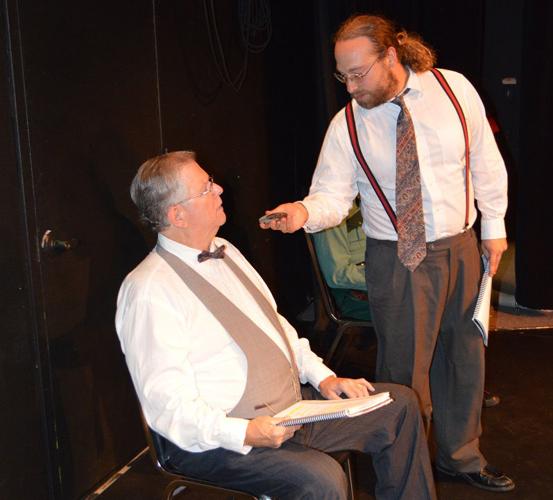
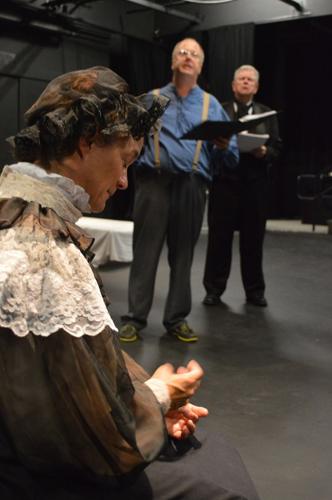
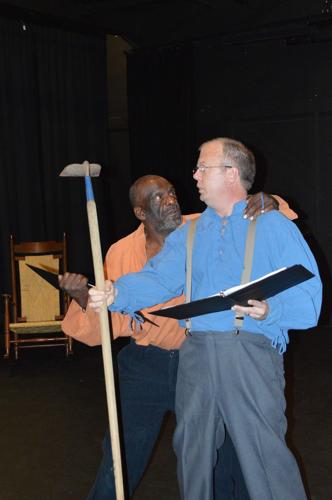
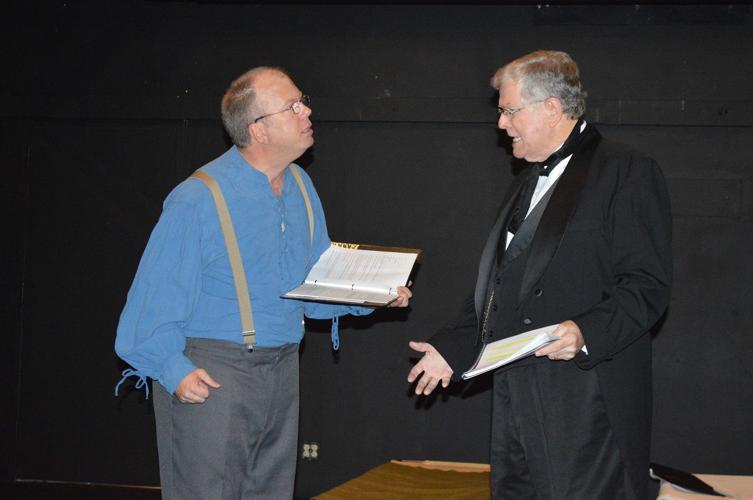
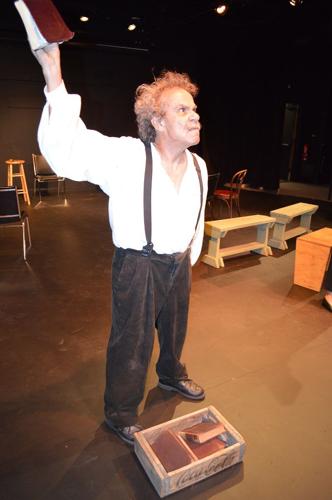
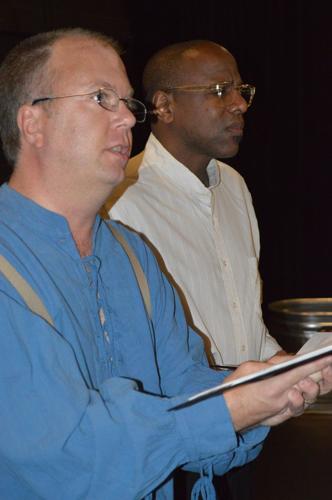
The plays happen on alternating days, and are staged readings, meaning actors carry their scripts in most scenes. But they wear period costumes and, compared to past staged readings at CCA, there is a far greater emphasis not only on sets but on stage movements, also known as blocking, as well as entrances and exits by characters.
The scripts are evident as the stories begin, but the movements and emotions employed by the performers tend to render the books invisible once the stories get going.
“As directors, we decided to present the two plays as reader’s theatre, using lighting and music to add to the audience’s enjoyment and to optimize the use of CCA’s venue. We were fortunate to find a versatile cast and crew, local actors capable of portraying a variety of roles and skilled technicians willing to bring their special talents to the productions,” said Dallman, who directs “Wind.” William Weiler directs “Thoreau.” The directors went outside CCA for help, too: stage furniture includes chairs in keeping with early-20th century stories, borrowed by the Hood River Library, one of the benefitted non-profits.
The two plays have in common the driving interplay between two men of vision and passion — in “Wind” it is the lawyers and social activists Henry Drummond and Matthew Harrison Brady (fictional stand-ins for Clarence Darrow and William Jennings Bryan, respectively) and in “Thoreau” the clash is between writers and friends Henry David Thoreau and Ralph Waldo Emerson.
The plays contain powerhouse scenes, as well as ample humor. Many of actors appear in both stories.
Tom Burns plays Brady and Emerson, David Dye plays Thoreau and William Thayer-Daugherty portrays Brady’s nemesis, Henry Drummond. Adding to the spark and fire-and-brimstone in “Wind” is Dye’s portrayal of the other passionate influence the vitriolic Rev. Jeremiah Brown, whose daughter, Rachel (Maza Brady), befriends the teacher on trial, Bertram Cates (Roman Moretti, in his first local show).
Audiences get to see plenty of Dye, Burns and Thayer-Daugherty, but the scripts provide plenty of great scenes for the likes of Ray Abanto as the newspapersman Hornbeck in “Wind.” Barb Berry as Lydia Emerson, Dell Charity as the slave Williams, as well as Edward McNair as Bailey, Thoreau’s cellmate and confidante, and David Adams as Deacon Ball, in “Thoreau.”
The drama, humor, and deep political and theological questioning of the plays come out in lines such as Thoreau’s to Bailey: “You know what the government said to me, Bailey? ‘Your money or your life.’ I don’t give it my money, and they think they have my life!”
Later, in their cell, Henry tells Bailey, “If I were God, Bailey — instead of just a speck of Him — I wouldn’t let you die away in the dark.”
Brady arrives in town in “Wind,” proclaiming, “What a challenge it is to fit on the old armor again! To test the steel of our Truth against the blasphemies of Science!”
At the trial’s climax, Drummond soundly presses Brady on where scripture and science diverge, Brady sputters, “I do not think about things that … I do not think about!”
Drummond: “Do you ever think about things that you DO think about?”
Dallman notes that “Inherit the Wind” is based on the Scopes “Monkey” Trial of July 1925; this particular conflict was waged between famed attorneys Bryant and Darrow, but the playwrights insist that “Inherit the Wind” does not pretend to be journalism. “It is theatre. It is not 1925. The stage directions set the time as ‘not too long ago.’ It might have been yesterday. It could be tomorrow,” Dallman said. “Only a handful of phrases in the play were taken from the actual transcript of the trial. The characters in the play have life and language of their own — and names of their own. The play’s theme of every human being’s right to think, and to think differently, is as relevant for modern audiences today as any throughout history.”
Dallman writes: “Writing in the New York Times in December of 1970, Howard Taubman described the ideological relevance of the play to contemporary audiences — some of whom were protesting the Vietnam War and others who were decrying the environmental crisis portrayed in ‘A Silent Spring.’ He stated that ‘this play and its protagonist, though they are of the 19th century, are speaking to today’s concerns: an unwanted war in another land, civil disobedience, the interdependence of man and nature, education, the role of government and the governed.’ Taubman’s observations, along with Thoreau’s protests, should sound very familiar to 21st century audiences.”
Weiler, long-time musical director for CAST productions as well as actor in many shows, is directing for the first time — and it’s the drama he has burned to do since he was a young man.
“It was more than 40 years ago when I first saw a riveting performance of ‘The Night Thoreau Spent in Jail’ on a stage in Santa Monica, Calif. I made a promise that night to bring ‘The Night Thoreau Spent in Jail’ back to life sometime in the future. Thanks to Lynda Dallman, a phenomenal cast and crew, Thoreau lives again.
“We know Thoreau best as a Walden Pond naturalist and writer, but it was his book, ‘On Civil Disobedience,’ that inspired Gandhi and Martin Luther King, among others. Gandhi credited Thoreau’s essay for being the ‘chief cause of the abolition of slavery in America,’ while saluting Thoreau as ‘one of the greatest and most moral men America has produced.’
“For a while, Thoreau worshipped Ralph Waldo Emerson for his strong stands on individualism and non-violence. This Emerson quote may be where Thoreau’s views on protest and Walden Pond living met: ‘Do not go where the path may lead; go instead where there is no path and leave a trail.’
“It was the Manifest Destiny doctrine of his government which drove the mystic Thoreau to the shores of Walden. His outrage is closely akin to the many young people today who protest injustice, environmental degradation, and war. Young Thoreau was disgusted by the lies and confusion which clouded the bloody undeclared conflict with Mexico. The text of the play contains a denunciation of the war actually made by a young Whig Congressman from Illinois, who was not re-elected because of his stand, but who later became the first Republican President of the United States: Abraham Lincoln.
“Time is awash in Thoreau’s jail cell. We are not trapped in happenings past. The explosive spirit of Thoreau leaps across the years, addressing with power and clarity the perils of his own time and, prophetically, ours as well.”
The increased emphasis on stage movement and casting strategies come together in one humorous scene in “Wind” involving Jana Castanares and her husband, Dennis Castanares. Jana portrays a prosecutor, questioning jury candidates who exit and enter through a stage door; the three different men are all played by Dennis Castanares, who leaves and then comes back, varying his accent, expression and posture to clearly distinguish the three people he is playing in the three-minute span.
In another family tie, Carol Thayer makes her stage debut, appearing with her son, William Thayer-Daugherty, a veteran of shows at CCA. Mother and son have don’t directly interact, but Carol has a key scene as wife of Matthew Harrison Brady, comforting her husband after Drummond has defeated him in court.
Burns, Thayer-Daugherty, Dye, and others are familiar faces at CAST but both productions feature new faces in addition to Carol Thayer: Alea McCarty, Gerald Hoff, Roman Moretti, and David Adams.
Then there is the increased stage time by Dell Charity and Adrian Chaton, who have both had small roles in past productions but are best known as backstage crew, aka “ninjas.”


Commented