
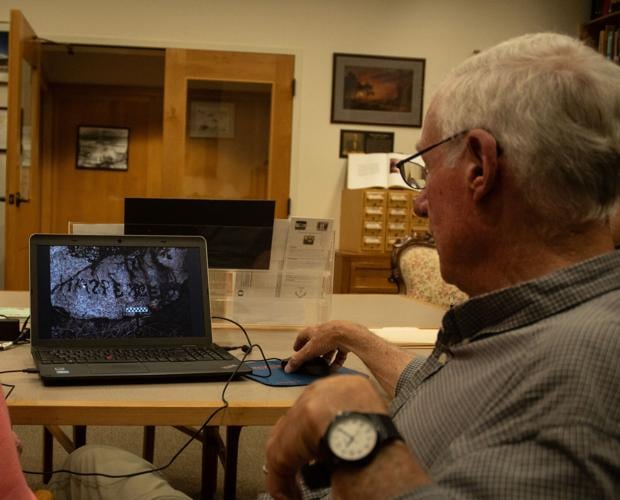
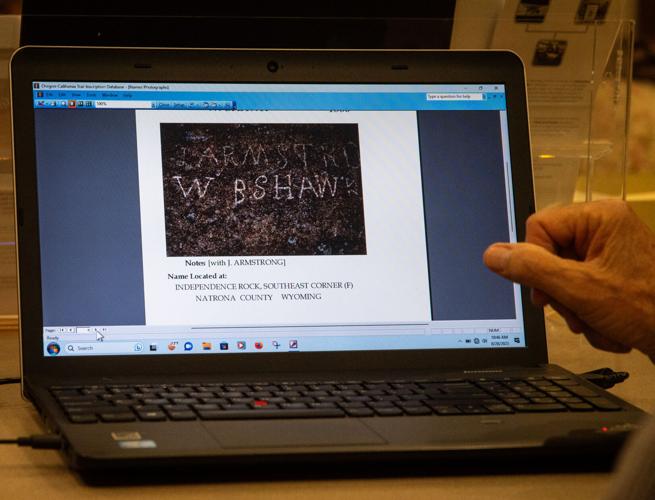
A searchable database of immigrants’ names, scratched or painted on rocks along the Oregon Trail, arrived at Columbia Gorge Discovery Center and Museum on Aug. 28. The collection is donated by photographer Jim Henderson, who spent years along the Trail photographing rocks with cross-pollarized light to reveal many hidden names.
The collection comprises a Microsoft Access database of the digitized photos of names. Museum staff can search for any name, and print copies of the photos. Henderson also donated photographic prints for 5,135 names.
“This is unique,” said collections registrar Susan Buce. It’s a new genealogical resource no other museum has. Soon, anyone search for images of their ancestors’ names inscribed along the trail.
Henderson and his wife and partner, Alice, spent roughly eight years documenting every name they could find along the trail between Kansas and Southern Oregon and California. Cows, weather and vandalism have worn the rock surfaces at many sites, making some names illegible. A special technique was needed to “see” the fading marks.
The project started after Jim Henderson, one of just three registered biological photographers in Oregon, was inspired by a dermatologist’s photograph of a melanoma in cross-pollarized light. Henderson photographed subjects for medical researchers, but often the details of such things as melanomas lacked contrast or were hidden beneath the skin. Cross-pollarized light enabled the camera to see beneath the surfaced and capture images.
“I thought, ‘Well, that’s a cool technique,’” said Henderson, who also does fine art photography using infrared light.
So Henderson started renting strobes to photograph pictographs, revealing scratched or damaged images in something like their former glory. To photograph obscured rock art, Henderson placed pollarizing filters over both his camera lens and his lights, a technique first used by R. Rox Anderson in 1992 to “see” malignant melanomas beneath human skin.
He remembers an image on a canyon wall, invisible except for some red paint. Cross-pollarized light revealed the complete figure.
But the technique didn’t work in daylight. “We started going later and later,” Henderson said.
So how does it work? Light, Henderson wrote in a study detailing his techniques, is everything. During the day, color shifts as different wavelengths are scattered at dusk and dawn. Shadows tilt and change. The pitted, painted outer surfaced of a name or pictograph reflects light in all directions, creating “visual noise.”
Night photography with cross-pollarized light solved these problems. “You bring consistent light with you,” Henderson explained. “Cross-pollarized light eliminates most of the light scattered at the rock surface.” Meanwhile, about 10% of the polarized light enters the rock and is de-polarized, revealing internal reflections from objects a couple of millimeters in, such as melanomas or hidden layers of pigment. Thus the camera can “see” names written in pigment or axle grease which has been covered by silica, or scratched up at the outer surface.
In 1996, Henderson started photographing pictographs with this technique at Horse Thief Lake State Park. Three years later, he undertook to photograph surviving pictographs on ceded lands for Warm Springs Museum, with a grant from Meyer Memorial Trust.
In about 2003, the U.S. National Park Service asked him to record immigrant names marked on stone at City of Rocks in Idaho. Officials knew about just a few hundred names; Henderson’s technique revealed hundreds more. Over the next eight years, Henderson and his wife would follow the Oregon trail and its offshoots from Kansas to Southern Oregon and California.
“I got every grant that was available for an individual,” Henderson remarked. “The Park Service started putting out these little diddly contracts to get this stuff recorded.”
The Hendersons divided each site into a grid, then recorded and photographed every name. Some immigrants stood atop wagons to inscribe names 12 feet high; to avoid rubbing the names with a ladder, Jim Henderson stood atop his own vehicle. The thousands of names were written in block letters or cursive, engraved or painted in axle grease, many damaged. Sometimes, illiterate travelers had others inscribe their names.
“I was the help. You can’t do it all yourself,” said Alison Henderson.
The whole endeavor was a partnership, with Jim doing the photography and Alison taking down the details. “She was the one that kept all the good details and records,” Jim Henderson added. But night-time photography had its dangers for the pair. “We did run into black widows,” Henderson remembered.
On that early grant for Warm Springs, Henderson went to Horsethief Lake State Park at night to experiment on a large scale. “One night we were there ... one of the barges went by,” he recalled. It focused spotlights on Henderson, who set off brilliant flashes as he worked. It must have looked like someone blowing up petroglyphs: Shortly after, a SWAT team descended on him. “And I’m sitting there with a snub-nosed digital flash meter,” said Henderson, who was about to fire off some tests with a blindingly bright strobe. “And I’m pretty sure if I had, they would have opened up.” The situation got sorted out, but remains one of his most exciting trips.
Working with private landowners, on whose property most of the sites were found, was one challenge. Some of them ran cattle near the marked rocks. Sometimes the owner lived in distant cities, leaving a hand in charge of land-management tasks — like wandering photographers. “He doesn’t want a bunch of jokers comin’ through and leaving his gate open,” Henderson explained. But he was rarely refused permission.
He found many deteriorating and damaged sites, though. Even names written in stone aren’t forever: Granite decays from within. Siltstone and sandstone, over time, lose layers of their surface, and with them the names of immigrants. “Cattle will always stand by rock faces,” Henderson said. “Every time a cow hits it, or someone shoots it,” bits come off. At some sites, modern names scratched into the rock in layers obliterate historical ones.
Henderson recalled a collapsed, fragmented cliff face in Quivira State Park in Nebraska, where Kit Carson and John Freemont’s names were recorded in the 1920s. “All those names are now gone,” he noted. “Most of these sites are gone.” Fragments were scattered at the cliff’s foot, unreadable.
If Henderson couldn’t find a previously-recorded a name, he added it to the database, sans picture.
Of all the places Henderson’s been, Immigrant Springs stands out. In the little Wyoming valley, containing a cow pond which once provided immigrants with spring water, Henderson photographed the remains of a centuries-old campfire and admired the still-intact words scratched into the stone. “There’s DNA in that name,” he said.
The physical prints are stored in the Discovery Center’s overflowing archives, and the digital database will be available by appointment in the William G. Dick Research Library after Oct. 1. Those interested in looking up a name can email library@gorgediscovery.org. Include your name, phone number, the name(s) you want to look up in the database, and any other relevant information.
More of Jim Henderson’s work can be found online at www.jhendersonphotographer.com/technical-recording.html.


Commented
Sorry, there are no recent results for popular commented articles.