Welcome to March, the month when spring begins and when we “spring” forward to daylight savings time. Change to Daylight Standard Time (DST) occurs first, on March 8. Set your clocks ahead one hour. Spring officially begins March 19, when the Sun is directly above Earth’s equator, and the length of day and night are approximately equal.
Even though our winter rains are important, providing us with snowpack and water for the dry summer months, it does not make for much in the way of stargazing opportunities. Maybe some of you were able to take a peek at Betelgeuse, the star in Orion that was last month’s binocular suggestion. If you missed it, March may provide you with the opportunity. The March binocular object is also in the constellation Orion, so you can pick them both up at the same time.
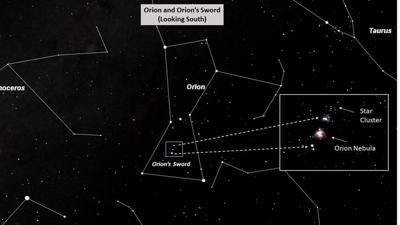
The March object is the sword in Orion. Look for Orion in the southwestern sky after sunset. Orion’s “belt” is easy to pick out, with a line of three almost equally bright stars. Below the belt, a fainter collection of stars make up the sword, also fairly easy to spot. Point your binoculars toward those stars in the sword—you should be able to see the entire sword in standard binoculars, thanks to their wide field of view. You’ll get a dazzling display of many stars! Look closely at the center of the view, where the bright stars of the sword are. You should be able to pick out a fuzzy area—the gas and dust clouds of the Orion Nebula. You are looking at a stellar nursery, an area where stars are being born, about 1,400 light-years distant. Just above the nebula is a nice open star cluster that may stand out.
As March begins, we’ll have a nice first-quarter Moon sitting between the Pleiades star cluster, to the right of the Moon, and the Hyades star cluster to the left. The Hyades cluster makes up the “face” of Taurus the Bull, along with the bright star Aldebaran. Aldebaran is much closer than the fainter stars of the Hyades cluster, lying along our line of sight with the cluster.
Full Moon follows on March 9, with new Moon March 24. On March 18, the waning crescent Moon will join the planets Jupiter, Saturn, and Mars low in the southeast before sunrise.
The full Moon on March 9 will be a “Supermoon.” The Moon circles the Earth in an elliptical orbit, and thus is sometimes slightly closer or farther away than average. Although not really defined, the Moon is generally considered a Supermoon when it is near its closest approach to Earth, at the time it is either full or new. You may be able to detect that it is slightly brighter.
The only planet visible in our evening skies in March is Venus. The planet is very bright, and can even be seen during the day under clear skies. Venus is growing closer to us during March as it orbits the Sun. At the start of the month, it will be over 80 million miles from us, and will close in to about 60 million miles by the end of the month. As it grows closer to us, its appearance changes from mostly-illuminated, like the Moon past its first quarter, to slightly less illuminated, like the first-quarter Moon. Even a small telescope will allow you to see the shape. Venus is shrouded in thick clouds, which help to make it shine very brightly in our sky, but do not allow us to see any detail on the planet.



Commented