
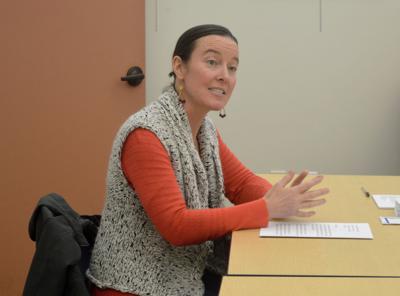
Deli sandwiches were set out in the Hood River Library Conference Room during the lunch hour on Thursday, Dec. 12, in preparation for the library’s first Lunch and Learn event: Homelessness in the Gorge.
“We just wanted to open our doors to have a conversation about how it (homelessness in the community) has changed,” said Arwen Ungar, assistant director of the Hood River County Library District.
The lunchtime discussion was the first of five scheduled through January (see sidebar for details), with hopefully more to come, intended to help engage the public in topics that aren’t always easy to talk about.
“Talking with staff, we were trying to find a way to get a little more engagement with the public,” Ungar said. “… The broader idea is to talk about ideas that are difficult for people and to open up that space for people to ask questions and learn vital information about our community."
Because of the wide variety of evening events that are generally planned throughout the community, the library thought to try and schedule the event so people could attend during their lunch breaks, Ungar said.
About 30 interested citizens and representatives from different community organizations, including FISH, The Next Door, Helping Hands Against Violence, Columbia Gorge Climate Action Group and Riverside Community Church, attended the 1 p.m. discussion on homelessness within the community. Most of the sandwiches were gone by the end of the hour.
“I think the fact that so many people want to come here says something positive about our community,” said presenter Sarah Kellems, the director of Hood River Shelter Services, on the size of the group.
“Many of us experience strong reactions to the reality of increasing homelessness in our community. We may have opinions and we may have questions, and often our questions are multi-layered and difficult to answer,” said Kellems.
Shelter Services’ primary operation is the Hood River Warming Shelter: An overnight shelter that operates 6 p.m. to 7 a.m. nightly from mid-November through mid-March. The shelter also provides warm clothing and sleeping bags, toiletries, shower passes and access to laundry, as well as hot meals provided in collaboration with 16 local restaurants.
Kellems spoke about the shelter’s services and provided some background on the changing homelessness situation in Oregon.
She also took a moment to talk about language, and her own preference to use terms such “people experiencing homelessness” or “unhoused people” instead of “the homeless.”
“I ask you to remember that we are talking about people, and that is why we put people first in the language that we use,” she said. “I believe there is great value in working from a place of shared humanity and acknowledging each other first.”
A recent statewide shelter study issued by Oregon Housing and Community Services called Oregon’s current homelessness situation “a crisis of catastrophic proportions,” Kellems said. According to the study, an additional 6,000 shelter beds would be needed statewide to accommodate all of the people currently experiencing homelessness in Oregon. (The full study is available online at www.oregon.gov/ohcs).
Contrary to some common conceptions, Kellems said, very few of the people who stay at the Warming Shelter for extended periods of time are from outside the Gorge.
On average, the Warming Shelter has 17 guests per night: Some are long-term local guests who stay for most or all of the shelter’s season, some are out-of-towners staying one or two nights before moving on, and others are folks experiencing temporary hardships, such as having their power shut-off, sudden job-loss, family separation, health challenges or other crises.
The number of people utilizing the Warming Shelter has been increasing winter to winter: The 2012-2013 season saw 48 individual guests, the 2014-15 season had 62, 2016-2017 had 86 and there were 107 in the 2018-2019 season. The Warming Shelter has been open now for approximately one month and Kellems said that, so far, they have had more than 30 guests. Guests are typically adult men and women, but the shelter had a family with two children stay last year, and two single mothers with two children in the 2012-2013 season.
The Hood River Warming Shelter is the only warming shelter currently operating between Gresham and Pendleton, and while Kellems said there are efforts on both sides of the river to change that, the lack of emergency overnight shelters is just one part of the problem: There is also a critical lack of daytime shelters and daytime programming, as well as services and resources meant to help people out of a situation of homelessness, she said, such as affordable housing.
“The goal would be that the people in our community would be less likely to need emergency shelters,” Kellems said, adding that Shelter Services is not in a position to take the lead in those efforts.
Shelter Services’ most immediate long term goal is finding a permanent facility. The Warming Shelter started as a service that rotated weekly between different locations before it found a home in Riverside Community Church, where it has been every winter for the last three years. The space works well for the Warming Shelter, but it has some limits, such as a lack of on-site showers, office space and laundry facilities; on especially busy nights, Kellems said, beds have to be set up in the hallways for guests.
The shelter hopes to be ready to apply for some legislative funding when it becomes available in the spring, and Kellems said the shelter would ideally like to partner with an agency or group of individuals to rent a dedicated space.
In the meantime, the shelter is actively looking for volunteers, donations, and providers for services such as insurance and dental care. One attendee, who stated that he is a current long-term guest this season at the Warming Shelter, said that many shelter guests are looking for work and are often gathered outside Riverside from 6-7 a.m. and 6-8 p.m. daily if anyone needs workers for odd jobs.
For more information on the Warming Shelter and how to help, visit hoodrivercares.org or email info@hoodrivercares.org.


Commented