Ted Beckley, Larry Hughes, Lucile Stephens and Gary Conley contributed to this report.
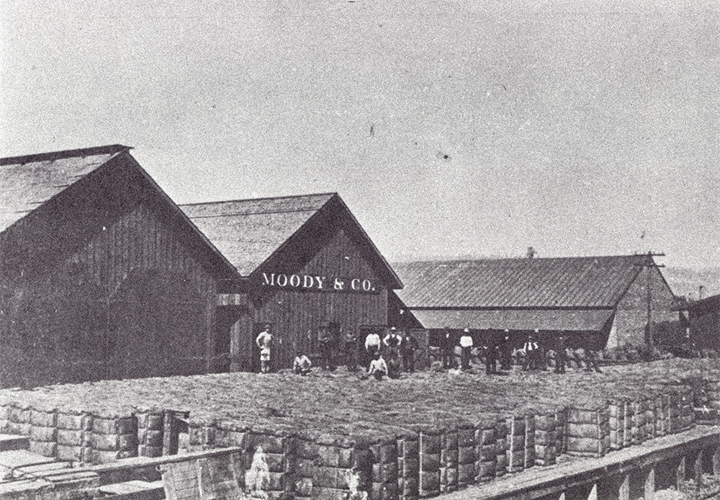
Last week’s History Mystery, above, was scanned from a photograph in a 1996 calendar published by the Wasco County Historical Society.
The caption reads, “Moody Warehouse, pictured with many tons of baled wool on platform beside railroad, was originally a 250-foot-long facility where locomotives were cleaned and washed. Building was cut in two and both sections were moved almost a mile to Second and Monroe Streets in The Dalles. Warehouse was used for storage when Shaniko was a flourishing wool shipping center and then by Pacific Fruit and Produce Co. and by a cooperative wheat storage until 1943 when acquired by R.W. Hughes Feed and Grain. Site was cleared of old structures in spring of 1985.”
Ted Beckley said the warehouse was built in 1892 by J.R. Moody, who later became governor of Oregon. “This picture is taken from the back of the building, from the railroad tracks, looking south,” he added.
Larry Hughes wrote that the wool pictured had been cleaned, baled, and was ready for loading into boxcars. The buildings were originally used for cleaning steam locomotives — at the left of the picture, the outline of huge doors where the trains entered are visible. In 1985, the Hughes family gave the buildings to Dr. Terry McDuffee, who removed, restored, and relocated them to his upper Mill Creek farm.
Lucile Stephens noted that the Moody Warehouse Company also had warehouses in Shaniko. In 1903, during the second of three wool sales, W.A. Rees deposited over a million dollars in the bank, she said.
Gary Conley noted that Tum-a-lum Lumber also used the location.
Ted Beckley, Larry Hughes, Lucile Stephens and Gary Conley contributed to this report.
Last week’s History Mystery, above, was scanned from a photograph in a 1996 calendar published by the Wasco County Historical Society.
The caption reads, “Moody Warehouse, pictured with many tons of baled wool on platform beside railroad, was originally a 250-foot-long facility where locomotives were cleaned and washed. Building was cut in two and both sections were moved almost a mile to Second and Monroe Streets in The Dalles. Warehouse was used for storage when Shaniko was a flourishing wool shipping center and then by Pacific Fruit and Produce Co. and by a cooperative wheat storage until 1943 when acquired by R.W. Hughes Feed and Grain. Site was cleared of old structures in spring of 1985.”
Ted Beckley said the warehouse was built in 1892 by J.R. Moody, who later became governor of Oregon. “This picture is taken from the back of the building, from the railroad tracks, looking south,” he added.
Larry Hughes wrote that the wool pictured had been cleaned, baled, and was ready for loading into boxcars. The buildings were originally used for cleaning steam locomotives — at the left of the picture, the outline of huge doors where the trains entered are visible. In 1985, the Hughes family gave the buildings to Dr. Terry McDuffee, who removed, restored, and relocated them to his upper Mill Creek farm.
Lucile Stephens noted that the Moody Warehouse Company also had warehouses in Shaniko. In 1903, during the second of three wool sales, W.A. Rees deposited over a million dollars in the bank, she said.
Gary Conley noted that Tum-a-lum Lumber also used the location.
20 years ago – 1999
A 70-year-old local woman was injured when her car ran off Old Highway 30 Tuesday at 3:40 p.m. and went over a steep embankment. Dep. Randall Hooper of the Wasco County Sheriff’s office said she was westbound and headed home when the car went off the road to the right and went 128 feet down an 85 degree embankment near what is known as the “Onion Patch.”
A proposed new city water rate is simpler than the current system, and puts the steepest hikes on commercial users.
The reelection of Wasco County Judge John Mabrey is again being challenged by Mosier councilor Bill Ward. Already the issue of a circuit court case, Ward opened a new complaint to the Oregon Secretary of State alleging Mabrey made misrepresentations in his Voter’s Pamphlet statements.
City police recently apprehended three juveniles in connection with some local car prowls, but in the process recovered some items that have not been reported stolen.
CARILLO, Calif. (AP) — Gasoline prices dropped below $1 for yet another new all-time low, but prices may finally be bottoming out, an industry analyst said Sunday.
WASHINGTON (AP) — Broadcasters are considering suing the nation’s largest satellite TV company over its plans to continue providing CBS and Fox programs beyond a court-ordered Sunday cutoff date.
40 years ago – 1979
Having sunshine for Monday’s eclipse appears to be dim, the weatherman says, but there’s plenty of special activity. And even with clouds, you can expect things to get quite dark and there may be rather spectacular flutters of shadow across the landscape and in the skies.
Don Hall, a five-year member of the Wasco County Fair Board, has delivered a letter of resignation to the Wasco County Court. County Judge Rick Cantrell said a sealed letter from Hall is on his desk, but he can only make assumptions about what the letter contains. He said if the letter is not retrieved, it will be opened at Wednesday’s court meeting. “I didn’t like the treatment the present court has handed us the last 90 days,” Hall said Friday of his resignation. He said among the reasons for his resignation letter, dated Feb. 20, are the court’s actions in setting fees for the use of the new fairground exhibition building and in the court’s expansion of the fair board from three to five members.
Remember that fancy fireworks show at The Dalles Dam last July 4? It’s still in the red about $500 and Jaycees need help if there is to be one this year.
WASHINGTON (UPI) — Led by rocketing food, housing and medical bils, the cost of living in America began 1979 with a whopping 11.2 percent annual rate — well over President Carter’s inflation forecast — the government said Friday.
60 years ago – 1959
Griffith E. Williams, a native of The Dalles who achieved national fame as an orchestra leader, died early Monday at his Evanston, Ill., home. He was 50 year of age. Griff Williams and his orchestra gained popularity across the land for their “dream music.”
“Wings of the Motherland,” a color film produced by the Soviet government to show the extent of Russian air power, will be shown during tonight’s aviation program at The Dalles Junior High School.
Dalles area basketball fans will have an opportunity this Friday to see Portland University’s basketball team, ranked 19th in the nation, in action at a local court.
“The Russian language isn’t as hard as people think,” according to Dalles High School Russian teacher John Bennett. And to prove it he cites the 13 students, from an original class of 22, who have stayed with the school’s lone first year Russian course he teaches, since it was introduced last September.
A proposal which would raise the top monthly pay bracket of all classes of city employes roughly five per cent over salary ranges set up in the city’s 1956 pay plan was passed unanimously by the Dalles City Budget Committee at a special meeting last night.
MOSCOW (UPI)—Soviet Premier Nikita S. Khrushchev turned down today the West’s proposals on Berlin and nuclear test suspension.
80 years ago – 1939
Two Yakima girls, having hitchhiked from Dufur to The Dalles this morning, related a lurid tale to local officers of being abducted from Yakima city streets at the threat of a gun and of being taken to Dufur last night.
Three men, picked off a Union Pacific train several nights ago, were sentenced to 10 days in Wasco county jail when they pleaded guilty to the charge of train riding, before Judge Glenn O. Allen in justice court yesterday. Railroad agents told the court they would like to learn if articles were stolen from a box-car, the seal of which had been broken.
First industrial visit of high school and junior high instructors to local institutions was made yesterday after school, when 27 teachers toured the Wasco Warehous Milling company plant.
Adam Kaufman, a resident of Wasco county for 58 years and a member of the Wasco County Pioneers’ association, died last night at a local hospital at the age of 78 years.
SALEM, Feb. 24. (UP)—The senate committee on railroads and utilities today began to work out a people’s utility district bill of its own. By its action the committee indicated it would throw out a bill already introduced by Senator Lyman Ross, democrat, Washington, and follow ideas advanced by the office of Governor Charles A. Sprague.
100 years ago – 1919
Wasco county men whose names appear on the records of the local draft board as slackers will be prosecuted according to a message received Saturday by Sheriff Levi Chrisman. The telegram directed Sheriff Chrisman to appear before the military authorities in Portland today with the complete records of the local draft board regarding men listed as draft evaders or deserters. Sheriff Chrisman was also directed to take with him the complete docket of all registrants, in order that certain corrections might be made.
With the tentative organization of a county development league in this city Saturday, Wasco county made a big stride forward.
Two men giving their names as James Walden and James McCormick were arrested yesterday by Chief-of-Police Gibons. McCormick was charged with drunkenness and a bottle of Jamaica ginger extract was taken from him. Chief Gibons says he found papers on the two men showing that they are I. W. W.’s.
For some time citizens of this community have been greatly interested in doing this thing and that thing for the good of the state. This spirit is most commendable. For some time various propositions have been put up to the community which while helping the state help some other city primarily. This spirit is all right too. But it seems to The Chronicle that with all our boosting it might be a very fine thing to boost our own city primarily and the rest of the state secondly.
NEW YORK, Feb. 24.—In the arrest of 14 Spaniards, police today assert they have frustrated a plot to assassinate President Wilson at Boston.



Commented