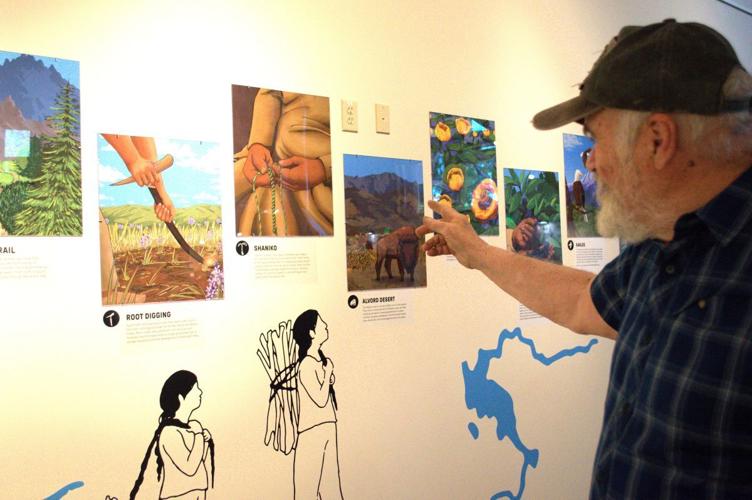
Chuck Rollins, president of Crown Point Historical Society, shows artwork created by undergraduate students at the Pacific Northwest School of Art in collaboration with the museum’s indigenous committee, led by Ken Katchia Smith.
Chuck Rollins, president of Crown Point Historical Society, shows artwork created by undergraduate students at the Pacific Northwest School of Art in collaboration with the museum’s indigenous committee, led by Ken Katchia Smith.
CORBETT — The Crown Point Country Museum opened its doors this March to a rural community of only a few thousand. The log cabin-inspired building is 3,500 square feet, tucked away not far from the Portland Women’s Forums and the Crown Point Vista House.
The museum is a project of the Crown Point Historical Society (CPHS), which was established in 1970. For years, the group has tried to establish a hub to showcase their town’s unique, rich history with community members and visitors alike.
Then, the CPHS received a portion of the Multnomah County tax levy from the Oregon Historical Society. One of their longtime members also passed away and left them a large donation. It was these gifts, and the support of the community, that made their dream possible.
They wanted to spotlight as much of Corbett’s history as they could, paying respect to the pioneers and communities that built the town into what it is today. Chuck Rollins, president of the Crown Point Historical Society, doesn’t take full credit for the museum’s success. He joined the CPHS in 1973, shortly after leaving the military, and became a board member the following year. That’s when he began to meet some of Corbett’s original pioneers, several of whom were more than 100 years old and had dozens of untapped stories to tell.
The museum came together piece by piece, with each small detail carrying a century of history with it. Most of the items on display, including early photographs and a veteran’s World War II medals, were donated by community members. The space showcases iconic local history as well, including a case dedicated to the accolades of champion cowgirl, Corbett-born Lorena Trickey.
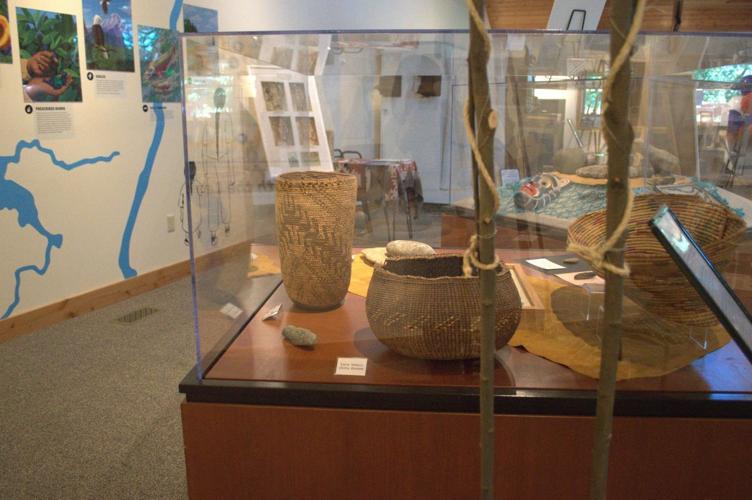
The museum itself includes several displays, one of which is dedicated to the history of the Wasco tribe and their life alongside “Nch’i-Wana” (The Big River).
The exhibit includes a map of trails alongside woven baskets, arrowheads, and other handcrafted items. It is surrounded by artwork created by undergraduate students in the graphic design program at the Pacific Northwest School of Art in collaboration with the museum’s indigenous committee, led by Ken Katchia Smith (Tuck’ush Winch Katchia).
Local Wasco elder Smith is CPHS’s “point of reference” regarding Indigenous pieces and history throughout the museum. He is one of the last fluent speaker of several Indigenous dialects, and serves as the area’s oral tradition historian, sharing the culture of the Wasco people.
One of the museum’s displays dedicated to the history of the Wasco tribe and their life alongside The Big River.
Amelia Fiore photo
The railings that line the walkway and exterior of the museum are made from pieces of actual railroad tracks from Larch Mountain, which used to shuttle logs and timber in the early 1900s. Builders discarded the leftover tracks, which would eventually be picked up by a few locals who worked with CPHS to take it out of the woods and bring it to the museum. When the Oregon Historical Society visited, they commended the use of the artifact in a practical sense and how it allowed visitors to actually interact with a piece of history.
Even the conference table that hosts the CPHS marketing meetings has its own story, spanning over 120 years. “This was some of the last lumber that came down the flume at Bridal Veil,” Rollins said, pointing to the intricate pattern in the wood. “An elderly gentleman made a table out of it for his bed and breakfast, and we were able to get it, and now we’re using it as a conference table.”
Outside the museum stands a memorial wall dedicated to local rockhounder, “Klondike Kate” Rockwell.
The wall was built over the course of two years, and includes some of her own stones embedded alongside colorful rocks native to the area. When the museum team found a portion of Rockwell’s collection on Craigslist, they jumped on the opportunity to purchase them.
Luckily for them, Sean Hietpas stepped in and offered his time, working to construct it alongside members of the Columbia Gorge Rockhounds. “The slowest day was only five rocks that we put in place, but he wanted it to be right,” Rollins said. “Things have fallen into place like this. Every time we needed something, it happened.”
The gift shop is filled with local art and donations. Even a handful of local electricians provided labor and materials for free. The museum team is entirely volunteer-based, and school kids raised $5,000 through a walk-a-thon fundraiser.
Rollins describes the relationship the Crown Point Country Museum has with the community is “more like a family connection than a business connection,” and that he values the unique skills that each person brings.
“I like someone that says, ‘Hey, why don’t we try this? And I’m willing to take it on.’ So they’re the doers. We have a lot of doers out here,” he said. “I think one of the reasons it has gone so well was due to the community coming together and focusing on this project.”
That is what the Crown Point Country Museum is made of — the work of dozens of hands coming together to create something that has captured and will last lifetimes.
The museum hosted its first history presentation on Aug. 2, and is planning to host two each month through October. Historian Gunnar Abramson presented “A Man and His Mountain,” a lecture about Mount Saint Helens and Harry Truman, the man who stayed behind during its eruption.
The museum hopes to host more presentations on the history and the foundations of Corbett, including the logging and fishing industries that shaped the town’s infrastructure.
In the coming months, the museum is looking to expand. They are in the planning stage of building a 32-foot-long longhouse on the other side of the current parking lot, as well as a veterans memorial site closer to the main road. The longhouse will mirror the traditional Wasco gathering spot, and is going to be built “the traditional way, no nails.”
They hope to continue to connect with and schedule visits from local schools and retirement communities, sharing the rich history of the town with people of all ages.
From now through November, the Crown Point Country Museum will be open on Fridays, Saturdays and Sundays from 10 a.m. to 4 p.m., admission free of charge.



Commented