As the holiday season draws near, The History Museum of Hood River County is getting ready for end-of-year gifts from donors who wish to take advantage of any tax benefits that their giving to charitable non-profit organizations can provide. Monetary donations are cherished by all groups doing specialized work in the cultural, environmental, and humanitarian fields. And the tax-deductible donation of money to an IRS designated 501(c)(3) organization helps fund crucial activities performed by dedicated people working to improve the human experience and protect the natural world.
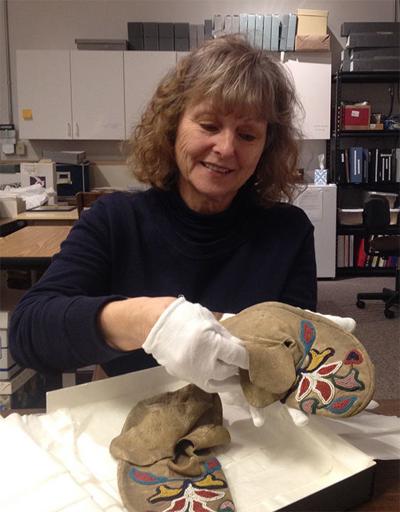
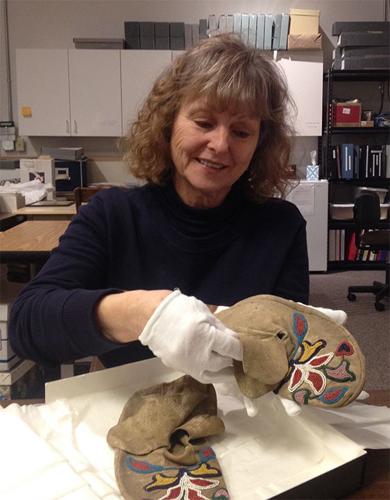
Museum staff, however, also tingle with anticipation whenever a donor walks in the door not just with much needed funds, but with a potential gift to the collection cradled in their arms. Whether carefully wrapped or tossed into an old cardboard box, artifacts of all types are delivered to museums across the country, especially at year-end. The same is true at The History Museum, repository of our local heritage. With a rush of excitement, we peer into the wrappings to see what family treasure has found its way to us. Such gifts are almost always brought to the museum simply with a sense of generosity and a desire to safeguard the history of a family, an event, or a local structure. Unfortunately, not all items offered up are true treasures. But many are, even if in rough condition. And it is the job of specialized museum staff to analyze each potential gift to the collection for its individual historic worth and relevance to the museum’s mission and holdings.
‘Unfortunately, not all items offered up are true treasures. But many are, even if in rough condition. And it is the job of specialized museum staff to analyze each potential gift …’
Museums are fascinating places. Because beyond the permanent displays that greet the visitor and walk the curious through other times and the experiences of other people, there are numerous storage areas behind closed workroom doors. Especially in a history museum, objects of all types are stored out of sight — objects to be displayed occasionally in thematic exhibitions. This is true in part because there is simply not enough gallery space to display everything at once. And surprisingly, many museum artifacts are too fragile (or susceptible to damage from extensive exposure to light) to be on display for long periods of time. This does not diminish their historic worth, but simply requires particular care.
Given pre-determined collecting guidelines and restricted storage capacity, all museums are selective in what they accept as donations to their holdings. At The History Museum, we assess the appropriateness of each item and what it adds to our understanding of local history. Other considerations include whether it duplicates another object in the collection: how many tractors is/are enough? In those cases, we will suggest a more suitable home at another specialized institution, such as WAAAM. Sometimes we do not mind if there is some overlap—such as with Native American baskets, early photographs of Hood River and its residents, vintage fruit labels, quilts, etc. — as long as the object is in reasonable condition. Frequently it is the condition of an object that precludes its acceptance.
The procedure for making the gift of an object or document to The History Museum follows standard museum practice: 1) the owner brings the item to the museum; 2) the owner completes a form declaring legal ownership, which is signed by both owner and museum representative, who each retain a copy of this document; 3) the item is immediately assessed by the Collections Committee or the owner leaves the item temporarily in the museum’s care to be assessed by the Collections Committee; 4) the owner stipulates disposition of the item if the museum decides not to accept the gift.
Donors thus have the ability to determine what happens to a potential gift that is not accepted for the museum’s collection. The donor may want to take the object back. In some cases, the donor requests that the museum dispose of the object. Alternatively, the donor may give the museum permission to sell the object for the benefit of the museum.
If the museum accepts the object, it is usually as an unrestricted gift, which gives the museum the legal right to keep, lend, or otherwise dispose of the donated material. Sometimes if a better example of a particular object is subsequently given to the museum, the museum will “deaccession” the lesser example. If an item is deaccessioned any proceeds from its sale are reinvested in the collection itself, no deaccessioned funds can be used for non-collection purposes. All in all, it seems like a complicated process, but The History Museum follows the standard museum practices that guide all American public museums.
So we look forward to welcoming you. Your year-end gift(s) can be transformative for The History Museum, and we never know what treasures will walk in the door!
To ease year-end congestion, we have identified the following times for receiving object donations: Tuesday and Thursday, 11 a.m. to 1 p.m., or by appointment at 541-386-6772.
•
Dr. Lynn Federle Orr is executive director of The History Museum of Hood River County.



Commented
Sorry, there are no recent results for popular commented articles.