
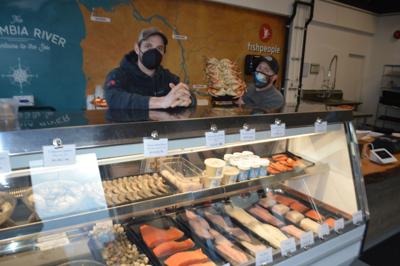
Fishpeople is the answer to the question, “What do you get when you cross a finance geek, an artist, and a couple of commercial fishermen?”
That’s how the “finance geek” of the group, CEO Kipp Baratoff of Hood River, sums up the four-person partnership that makes up the leadership of Fishpeople.
The 10-year-old company’s first inland seafood market opened in February at First and Oak, bringing a taste of the ocean to downtown Hood River. Fishpeople owns off-loading, production and retail operations at its facilities at the coast, but this is the company’s first retail outlet outside of Ilwaco, Wash., and Garibaldi, Ore.
“Everyone has had to find a new market and new ways to survive, frankly. So it’s been a lot of fun to be in town,” Baratoff said.
Four sets of hands hauled in the Fishpeople brand.
Mike Shirley and Scott Kastengren are both commercial fisherman “who started the landing part of the business,” Baratoff said. “We brought their supply chain with our sales and marketing together into one company,” he said. Duncan Berry and Baratoff were selling soups and jerky and other products in groceries around the United States. Baratoff is the “number’s geek,” though he is open to changing that to “guru.” Berry’s art work is on the Fishpeople swag, and on the walls of the market.
“As 21st-century fishmongers we seek to be stewards of ocean and river, and our job is to help the consumer that loves this product,” Baratoff said,
“It’s a four-founder story but for me being in Hood River and being able to bring some of the coast home, and this quality product home, is really a dream come true,” Baratoff said. “I didn’t know fish when I started the company. My partners did.”
A look at the cases in the Hood River market last week showed Coho salmon, King salmon, ling cod, rock fish, and petrale sole, three or four varieties of oyster in the shell (and oysters in jars), whole cooked Dungeness, Mexican white shrimp, and scallops, and (now or in the future) prepared foods including crabcakes, clam chowder, bouillabaise, poke bowls or crab salad, and some fresh, crisp white wine or beer to go with it.
You’re likely to encounter Baratoff in the Hood River shop, and among those greeting customers in Hood River is store manager Joe Sheahan of Hood River, long a familiar face at local establishments, most recently Everybody’s Brewing.
“It does feel good to be settled into downtown Hood River. It’s a dream come true for me,” Baratoff said. “We started this company the same year that my wife and I moved to the Gorge, but after nine years of working at the coast or Portland, to have work at home is a wonderful thing.” He added, “It changes my identify, I was anonymous in this town, just a resident but now I get to be an active member of town and figure out how to contribute as a business.”
One close association is just across the street at Celilo Restaurant. Baratoff has provided seafood for Chef Ben Stenn and his crew as they have continued to provide meals throughout the pandemic for groups and communities hurt economically by the pandemic. “Before we even opened here, we sold quite a bit of salmon to Ben.
“We have a good relationship with those guys, they help us with product development. We have an off-site prep kitchen at Celilo. We’re fully licensed there and we work with them and look forward to building that relationship.” Fishpeople is making its chowder at Celilo, with an eye to expand to other products, and is open to other local partnerships.
“We have friends in the family in the restaurant industry and if they’re interested in doing a special or something we’ll partner with those restaurants,” he said.
Connections to other local businesses have given Fishpeople’s owners renewed insight to the economic impact of the pandemic.
“Food service can use jobs right now,” Baratoff said. “And seafood was equally hit. Seventy percent of seafood in America is sold into the food service channel, so when casinos and hotels went down, restaurants went down, the colleges and universities, all went down, we lost a lot of our markets. The whole industry has had to revamp. Everyone was focused on retail or grocery or direct to consumer, everyone has had to find new markets, and new ways to survive, quite frankly.”
Baratoff said that Fishpeople helps support 400 families between its fishery and on-shore facilities. Fishpeople works with a “fleet” of about 200 boats, depending on the season.
Fishpeople hauls in fish, crab or bivalves at its facilities in Ilwaco and Garibaldi. “Ilwaco is at the mouth of the river, the front door to the Pacific. Its the first port in after we cross the (Columbia) bar. A lot of Oregon boats drop at our facility, too. Our approach to service makes it work well, and a lot of it is relationship driven.” Fish are filleted, albacore tuna canned, and crab cakes are made in Garibaldi. Anything not done in those facilities is prepared in co-packaging agreements at other locations. In Ilwaco, the fleet can find bait, a lounge, a hot meal and help with groceries sometimes. We’re like a truck stop.
“That’s what they come for and that’s what we compete on,” Baratoff said. “You must pay a good price and pay on time. It’s always an interesting relationship between processor and fleet. Other folks might provide working capital to a boat, but we do not. We’re not bankers and we don’t want boats to be in debt to us. We buy fish, plain and simple.
“We don’t own the boats. When we say ‘our’ boats or fleet, it’s who we contract with. It’s an open market. We complete with services and prices,” he said.
“If it didn’t come across our docks it’s coming from partners who have similar values as us,” Baratoff said. “We fish for tomorrow in mind.”
Tuna is caught one fish at a time, one example of how Fishpeople adheres to standards and practices recommended by groups such as Marine Stewardship Council.
“We have a deep appreciation for what the ocean and rivers deliver and our goal at Fishpeople is that the natural food movement, which is really well connected to land, can cross over to include the ocean and rivers. We want to help seafood lovers take care of the supply chain the same way others take care of the land,” Baratoff said. “The industry needs to be good for the oceans and rivers and good for the essential workforce — crews on boats and in processing houses.
“Seafood has many of the same issues as farming does, with labor and with the weather and with worrying about arable soil and taking care of it for future generations,” Baratoff said. “Yet, our industry has much to learn; 90 percent of what we eat in terms of seafood is imported, and 90 percent of what we catch is exported. That’s not good math. We have such great bounty here.”
Baratoff said Fishpeople seeks to expand consumers’ understanding of the seasonality of ocean and river bounty, and he draws a comparison between what residents already understand about bounty, whether they are in Pacific City or Parkdale.
“The coastal citizens understand what’s happening when the fleet is out, just as here in the Gorge we understand that ‘the strawberries are coming on,’ or ‘it’s pear season.’ We understand the seasonality of fruit, and what Joe and I and the company want to do is help people understand the seasonality of the ocean.”
Ground fish is year-round, as are clams and oysters, Baratoff pointed out.
“July is early tuna season, that’s our next big season, and in between we’ll have shrimp, black cod and others,” he said. Spring months also mean cold water pink shrimp, and some of the fleet “peels off to Alaska for the early salmon and black cod season,” he said.
Look for black Cod in April and early tuna season arrives in July. Copper River season will be in May.
“In June we start thinking about tuna, and halibut season is the summer. A lot of things that come out in the summer aren’t out now.”
Right now it’s crab, and will be for at least another month.
“Lingcod and groundfish are coming off the boats, but what the fleet is focused on now is Dungeness,” Baratoff said.


Commented