
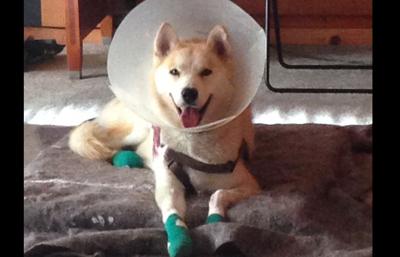
A dog that was seriously injured falling from the back of his owner’s truck illustrates the danger of transporting dogs in unsecured ways.
On Aug. 18, a local man jogging along The Dalles Bridge noticed a dog riding atop a fully loaded truck bed covered over with a tarp. The next time he looked up, the dog was gone.
Three year-old Bishop, a sweet-natured golden Husky, had somehow fallen out of the bed of his owner’s truck. Bound to the vehicle by the lead attached to his collar, he was dragged partway across the bridge before the tie snapped and he came to rest somewhere on the Washington side.
Chelsee Hudson, dog control officer at The Dalles City Police, said that while the incident remained under investigation, she’d recognized Bishop as a dog she’d picked up multiple times as a stray over the last year.
“He’d been drug from where the arch starts on the Oregon side, all the way to the Washington side until his collar snapped,” she said. “While this particular dog was trained to ride in the back, putting him on top of a pile of stuff left him with nothing to keep him from falling off.”
According to recent estimates from the Humane Society of Utah, around 10,000 dogs die each year in the United States from injuries sustained riding unsecured in the back of their well-intentioned owner’s pickup trucks.
Because transporting unrestrained dogs in truck beds has been banned in a number of other states, Oregon lies in a legal grey area in terms of what barriers need to be in place to prevent an animal from getting hurt.
All four of Bishop’s paws were worn down to the bone and his soft underbelly was so badly damaged in the accident that he had to be neutered. No toenails were left on any of his paws, and a long gash runs along one of his legs with spots of road rash all over his body.
Every other day, Bishop needs to be put under anesthesia to allow veterinarians to monitor his healing progress, treat his injuries and re-bandage his paws. While Kristy Long, community outreach and volunteer coordinator for Home At Last, said it’s too soon to tell what the course of Bishop’s entire treatment and recovery process will be, despite everything, he has appeared in good spirits overall.
“After all he’s been through, he’s such a sweet dog,” Long said. “He’s so happy and he’s such a love bug. Everybody who’s known him prior to this said he’s known in the community for being a real sweetheart. We just want to help Bishop, focus on his care and prevent other people from having the same horrific tragedy happen to their animals. It was a terrible accident and we never, ever want to see it repeated.”
Pet safety information provided by Home at Last states that improperly tethered animals can be strangled by their own leashes if they tumble over the side of a vehicle, and that pets riding in the back of pickup trucks should be secured in a crate.
“The way [Bishop] was tied up, he had way too much room to move about the back of the pickup. If you go around a corner really fast, dogs can just roll right out,” Hudson said.
If owners plan on securing their dogs in the back of a truck, Hudson recommended they be put on a shorter lead that is attached to the front of the cab, not the back. And while Home At Last workers maintain tethering an animal to a vehicle is never ideal, they advised owners to measure the length of the leash so that animals are not in danger of sliding out or over the sides of the bed.
“I personally don’t recommend dogs being kept in the back versus up front if there’s room,” Hudson said. “If people are willing to take the time and effort to make it safe for the dog — okay. But just throwing them in the back and hoping they stay in is not the way to go. I’ve seen way too many fall out or be drug. So if you have any doubts that your dog might jump out or not be stable enough to keep from falling out, tie them with a short enough lead, and tight enough so that it doesn’t come undone.”
Hudson encouraged owners to make sure their dogs have enough room in the back of the pickup to lie down and to never carry dogs on top of a loaded bed. Bishop’s case, she said, is the worst she’s seen so far due to the extent of his injuries, with a recovery time estimated at about two and a half months.
Home At Last has begun a GoFundMe campaign to raise money for Bishop’s surgical needs, with the total estimated need set at around $7,000. As of Wednesday press deadlines, Home At Last had raised $1,950 for the cause.
Long said the total cost for Bishop’s medical care has neared the $3,000 mark and will only continue to grow with the ongoing treatment necessary to ensure his full recovery, so she encourages interested citizens to visit http://www.gofundme.com/Saving-Bishop to donate any amount they can spare.
“He has a good prognosis and he will survive, so we at least know that much,” Long said.
The man identified as Bishop’s owner, David Damon McConville, 22, was arrested Aug. 29 at Home at Last when he appeared to claim his dog. He was jailed on charges of first-degree animal neglect and animal abandonment at the NORCOR regional jail the same day.
Updates on Bishop’s recovery status can be found at Home At Last’s Facebook page at https://www.facebook.com/HomeAtLastHS.


Commented