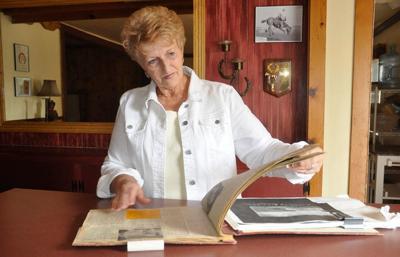
LINDA MILLER Wilson looks through scrapbooks compiled about “colorful” early members of the Fort Dalles Riders Association, of which her family has long been a member. She has found a passion in researching colorful characters from Wasco County’s past, including Blanche McGaughey Sammis, one of the first women to ride the rodeo circuit. Wilson will be speaking about Sammis and early fairs and rodeos on Sunday from 2 to 4 p.m. at Riverenza Café in The Dalles.
LINDA MILLER Wilson looks through scrapbooks compiled about “colorful” early members of the Fort Dalles Riders Association, of which her family has long been a member. She has found a passion in researching colorful characters from Wasco County’s past, including Blanche McGaughey Sammis, one of the first women to ride the rodeo circuit. Wilson will be speaking about Sammis and early fairs and rodeos on Sunday from 2 to 4 p.m. at Riverenza Café in The Dalles.
Linda Miller Wilson’s passion for Wasco County history was sparked a little more than seven years ago when she was given three dilapidated scrapbooks that were filled with clippings and photos of notable community members. Pictures of the 1947 founders of the Fort Dalles Riders Association included some of Wilson’s family members. And some were “colorful” characters, including Blanche McGaughey Sammis, one of the first women to ride bucking horses, wrestle steers and compete in rodeo relay races.
While “proper” women were wearing corsets and ankle-length dresses, and settling into the life of a homemaker, Sammis was outfitted in pants and bulldogging steers for prize money.
“She was a woman who refused to be confined to the dictates of society,” said Wilson.
She remembers spending time as a child with Sammis, who was a family member by marriage. That connection sparked an interest in creating a documentary about the woman who was small in stature but mighty in spirit.
“It’s been a very big learning curve,” said Wilson of her research.
On Sunday, she will not only share information about Sammis but also the history of fairs and rodeos in Wasco County from 1869 to 2015. Her presentation takes place from 2 to 4 p.m. July 19 at Riverenza Café, 401 East 10th Street.
In 1912, Sammis, who was then 27, rode broncs in the first Calgary Stampede and won the Northwest Ladies Bronc Riding Championship of the Northwest at the Pendleton Roundup.
“She and the other fearless young women who were living their dreams were treated like rock stars and earned lots of money,” said Wilson.
While women were fighting for the right to vote and gain independent status, Wilson said Sammis and other female rodeo riders were already calling the shots for their own lives.
Wilson searched online and travelled to several museums to obtain information on Sammis, and then pieced together the rare newspaper clippings that she came across.
She also reviewed “Traces,” a book written by Rick Steber that was published in 1980 and based, in part, on an interview with Sammis.
Some of the facts in the book did not match up with what she knew, such as when Sammis had broken her ankle in competitions. Her claims of some victories did not match up with reports she had found.
Since Sammis died a couple of years later at the age of 96, Wilson is not sure whether the exaggerations were intentional or the byproduct of an aging memory.
“Growing up, I knew that Blanche liked to embellish a lot so it’s difficult to know if that was what she was doing with the book interview or if she was just getting forgetful,” she said.
During her exploration, Wilson found the answers to some of her questions. For example, she wondered how Sammis, as a woman who was only 5-feet 2-inches tall, had the upper body strength to ride broncs.
She learned that a family member had owned a stage line and Sammis regularly drove coaches with a four-horse team from Pilot Rock to Pendleton.
“That would have built up her arm, leg and core strength,” she said.
But Sammis’ story isn’t just one of adventure, it is a love story, said Wilson.
When Sammis was 30 years old, an age considered a spinster in that era, she had an opportunity to travel to Hollywood and appear in a film about rodeo women.
She was waiting to catch a train in The Dalles when Ted Sammis, a successful businessman/rancher, asked her to marry him. She accepted and never boarded the train, ending her rodeo career.
“Her mother had passed away at an early age and Blanche had raised her brothers and worked as a teenager before coming to Oregon at the age of 16,” said Wilson.
“I think Ted offered her stablility, as well as prestige and stature in the community, and that was something she was looking for.”
Ted and Blanche married on Valentine’s Day in 1915 and lived on a 3,000 acre ranch on Skyline Road, where Blanche enjoyed a magnificent view of both Mount Hood and Mount Adams.
The couple never had children but seemed to have been very happy in their marriage.
“Blanche loved to work in her yard and garden,” said Wilson.
“One day a neighbor’s horse showed up in her yard, destroying her hard work.
“That enraged her and she got her rifle out and shot from the hip. She said that she only wanted to scare the horse off, but she shot him dead. She came running out to the field where my Uncle Joe and Uncle Ted were working and shouted at them to ‘do something about the horse.’
“They buried the horse and a couple of days later the neighbor came by and asked Blanche if she had seen his horse. She said, ‘Well, I saw him a couple days ago but haven’t seen him since.’”
Wilson is also researching the historical accounts of other Wasco County pioneers.
“I would like to do a series,” she said. “I feel that if I don’t tell these stories, I’m afraid they will be lost.”



Commented