
In the flower fields of the Columbia Gorge, a blue-haired, spiny-looking cuckoo bee patrols, searching for other bees’ pollen-laden nests so that it can steal them for itself.
In the volcanic mountains of Oregon, a rare bee, unseen for 50 years, gathers pollen from one of four penstemons and stuffs it into a bubble in a lava field to feed its eggs.
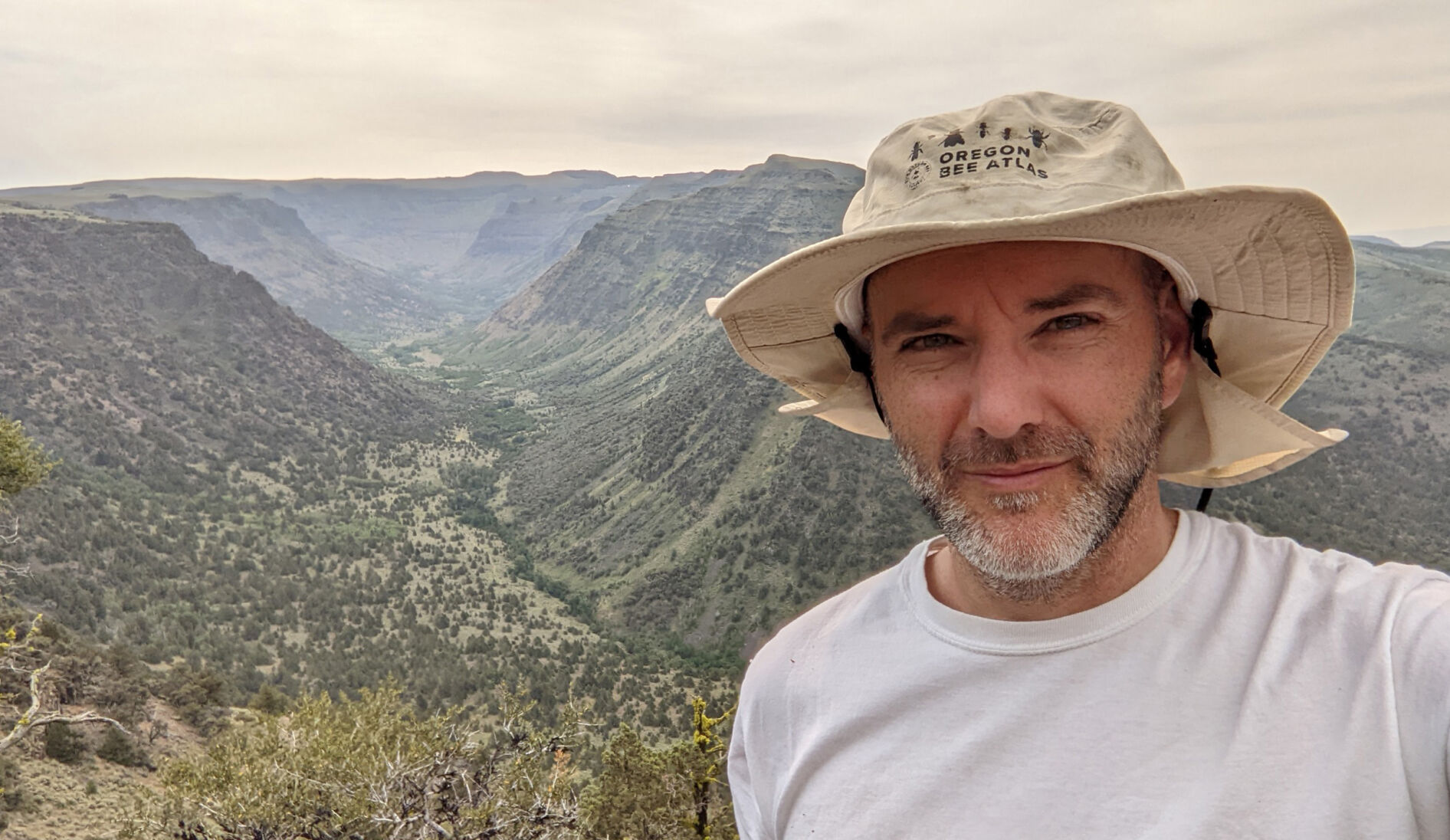
As one of the “largest ecological projects ever” works with trained volunteers to document the state’s wildly diverse and little-surveyed native bee populations, discoveries like this are becoming more and more common, according to Oregon Bee Project taxonomist Lincoln Best.
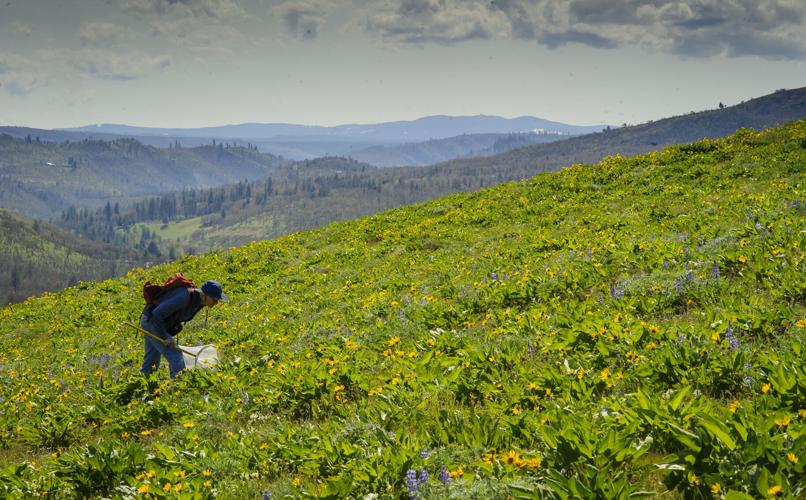
“We used trained citizen scientist volunteers to go out all over the state, into the desert, into the alpine and to swing a butterfly net, document the plants, and of course, lethally sample bees, which would then come back here to our lab, where we could look at these many tens of thousands of museum bee specimens,” Best explained.
The project began in 2018, when of thousands of bumblebees died after a blooming tree in Wilsonville was sprayed with insecticide. The subsequent public outcry led to the creation of a pollinator health professorship at OSU, through which was created the umbrella Oregon Bee Project. This program oversees commercially managed pollination and pesticide training, among other things.
This umbrella also includes the Oregon Bee Atlas, which trains volunteers in bee sampling and identification through the online Master Melittologist program. There, volunteers learn how to sample bees, create good data, and “ultimately, how to discover weird or rare or otherwise unknown bees all around the state,” Best says.
To accomplish this, the OBA depends on many partners, including the Department of Forestry, OSU, University of Oregon, multiple labs, and others. “We’re fortunate to get support from the state,” Best noted.
White boxes of specimens line the walls of the lab where Best works, like a strange honeycomb. Best estimates they contain 100,000 specimens of bees so far.
Some of these specimens represent species that are new to Oregon, or very poorly known. Moreover, perhaps 10-15% of Oregon’s bees remain without names, Best said, representing potentially 70-100 new species. His enthusiasm for this diversity of bees comes through clearly.
About half of those 100,000 specimens are common, widespread bees. “The last third is all of the diversity,” Best explained. Several thousand are specimens of much rarer bees, “things that may only visit sunflowers, or mountain bluebell.” Some are so specialized they visit just one, or a handful, of flower species, or survive in a limited habitat. Often these are only represented in collections by one to ten individual specimens.
The volunteers make a record of every flower they sample from as well as every bee they catch in the act of pollination. From this information, conservationists get a sense of how much habitat is available to Oregon’s specialist bees.
First, a volunteer photographs a flowering plant and uploads the record to iNaturalist, an online database of nature observations. Then they catch the bees that visit the plant. So far, a grand total of 18,492 plant records from more than 1,400 species of flowering plants have been uploaded, with an average seven bees collected for each observation. With more than 600 species of bees documented so far, this is one of largest ecological projects ever, Best claims.
The model has been used in the creation of the Washington Bee Atlas and the Idaho Bee Atlas, and a New Mexico Bee Atlas is planned for 2023.
Lab work necessary
More than 750 bee species are thought to inhabit the Beaver State, “some of which look very similar to one another, and all of which are really small,” Best commented. Most are impossible to identify on the wing, and only about 200 can be identified from photos. So OBA volunteers have to kill and pin bees, then examine them in a lab, with a microscope. A DNA database for solitary bees is in the works, which Best hopes will help differentiate the many lookalikes.
A few genera found are new to Oregon: Squash bees, which have followed their domesticated food plants — squashes — from their native habitat to Oregon; fairy cuckoo bees, and a bee which specializes in California poppy. They’ve also found new species, including new longhorn bees and the Eastern bumblebee, Bombus impatiens, which is spreading into Oregon from Seattle and British Columbia. Many of these have no common names — “It’s just weird scientific names,” Best said. More than 50 species have been added to Oregon’s records so far.
Data collection is not evenly distributed; there are three hubs of activity, in southwest Oregon, Portland, and the Bend area.
The annual data release contains a dataset for each annual collection cycle, free for anyone to use (the next release is anticipated by 2024).
The next step is to create an efficient “pipeline” that goes from bee and data collection and input to the generation of automated reports. This could eventually allow a land manager to select their property on a map and see an automatically generated report on the bee species present, including notes on conservation concerns, habitat specialists, plants and some general recommendations for management.
While the current datasets are available, they are not nearly that easy to go through. “They’re just a huge spreadsheet,” Best explained. “It’s hard to extract land management solutions.”
When that difficulty is surmounted, the discoveries of OBA volunteers could become a highly practical resource for landowners — and through them, bees — throughout Oregon.
The Master Melittologist program can be found the online at extension.oregonstate.edu/master-melittologist/how-register.


Commented