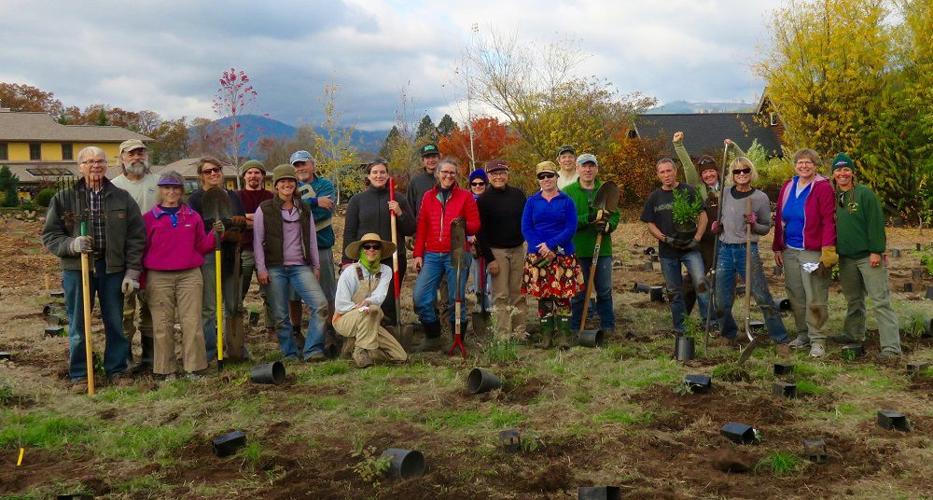
WETLANDS SQUAD, 25-strong (about four crew members weren’t shown in this picture), poses at the scene of their restoration project in Willow Ponds housing subdivision in west Hood River.
Equipped with shovels and wheelbarrows, volunteers joined together last week to plant the first portion — 5,000 square feet — of their venture, which will turn a former field of noxious weeds within their neighborhood into a self-sustaining habitat for wildlife.
WETLANDS SQUAD, 25-strong (about four crew members weren’t shown in this picture), poses at the scene of their restoration project in Willow Ponds housing subdivision in west Hood River.
Equipped with shovels and wheelbarrows, volunteers joined together last week to plant the first portion — 5,000 square feet — of their venture, which will turn a former field of noxious weeds within their neighborhood into a self-sustaining habitat for wildlife.
Where once there was a bristling tangle of bramble and noxious weeds, the Friends of Willow Ponds are shaping a patch of healthy wetlands for native creatures to enjoy.
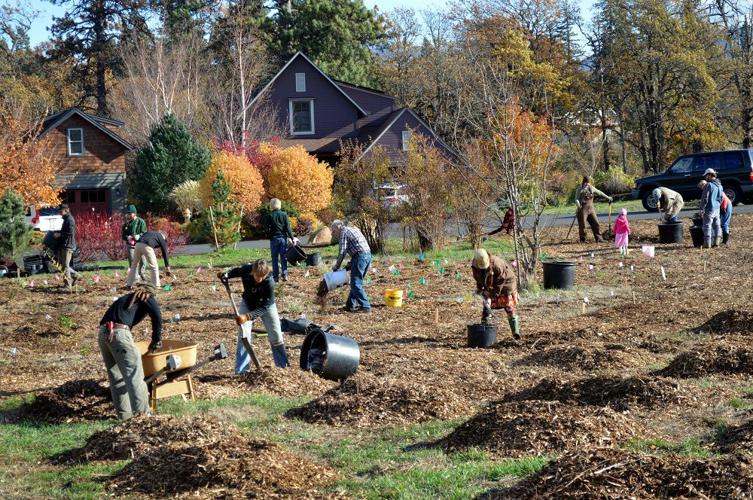
Neighbors in the Willow Ponds subdivision south of May Street in west Hood River toiled together last Tuesday to dig up a 5,000-square-foot patch of land on Nina Lane and start planting sustainable flora for a shared wildlife habitat. Their weekday session brought in about 25 workers, including nearby residents, volunteers and ecological experts. Some traveled from as far as Portland.
“It takes a village,” said Jacque Barone of Willow Ponds, describing the group effort as locals paced about with shovels and wheel barrows.
After a short break for warm chili and cookies, the workers regrouped and started spreading earth and woodchips across the field.
Even for the Willow Ponds community, with its ecological vision and shared green spaces, the restoration venture is adventurous —the project has been given a wetlands delineation by the Oregon Department of Land Conservation and Development.
Sheila Ford-Richmond, who lives a stone’s throw away on Kesta Court, spearheaded the project. The goal, she said, was to provide a healthy habitat for wildlife in the vicinity.
“It just broke my heart to see the invasives,” said Ford-Richmond.
Formerly, the site was a rundown cattle farm. What remained in 2015 was a field of thistle, knapweed and blackberry bushes, which nearby residents described as an “unhealthy habitat.” The mound of weeds was “taller than us,” Ford-Richmond said.
In its place, volunteers tore out the weeds and laid down a bed of woodchips. Little colored flags marked the spots where new plants were rooted. So far, the restoration squad has planted 5,000 square feet out of the 20,000 in the total wetlands area.
Humble Roots Farm & Nursery out of Mosier provided the plant expertise. Co-owners Andrew Merritt and Kristin Currin helped steer workers in the process.
“They’re highly regarded for their dedication and their incredible knowledge,” said Ford-Richmond, who had worked with the duo over the past few years on different projects.
Merritt and Currin hope frogs, birds, bees and monarch butterflies will enjoy the new habitat, which includes plants that support “true natives,” such as milkweed, perennial flowers and shrubs. While some birds (especially quail) enjoy lurking in blackberry brambles, many Pacific Northwest pollinators can’t survive in that habitat.
Merritt said the goal wasn’t simply for a pretty garden, but for a livable spot for wetlands creatures.
The transformation to sustainability won’t take place over night, Ford-Richmond indicated. Next summer, the piece of land will get a “deep soak” once a month, but following the kick-off process, the habitat will be able to sustain itself without human care.



Commented