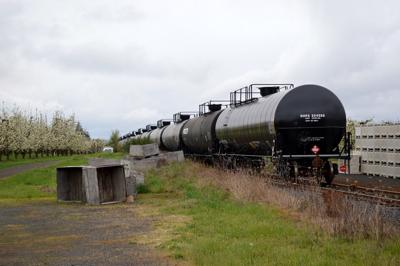
RAILCARS near Parkdale, as seen along Woodworth Road, are mostly empty except for chemical residue, such as propane. Mt. Hood Railroad has been storing at least 150 of the excess cars, which aren’t being used due to the nationwide oil downturn.
RAILCARS near Parkdale, as seen along Woodworth Road, are mostly empty except for chemical residue, such as propane. Mt. Hood Railroad has been storing at least 150 of the excess cars, which aren’t being used due to the nationwide oil downturn.
Black railcars stowed on the tracks from Hood River to Mount Hood may resemble oil trains, but fire officials say they’re actually storage cars that formerly held propane and other raw chemicals. Some residue still remains.
Since March, Mt. Hood Railroad has been storing at least 150 of the semi-empty railcars on the tracks in Hood River County. Each “residual tanker” contains less than 250 gallons worth of various chemicals, mostly propane, Hood River Fire Chief Devon Wells said.
“They raise a little bit of a risk, but at the same time they’re legal on the tracks,” Wells said. The railcars don’t violate fire code, and they aren’t as flammable or dangerous as loaded oil tankers, he said.Amid slumping gas prices nationwide, the railroad has been receiving a storage fee from shipping companies to park the
excess railcars on the tracks along the Hood River, mostly tucked out of site and shepherded away from populated areas. The cars get shuffled between different spots in the valley on a regular basis.
Ron Kaufman, railroad general manager, said it was a “business decision” to cut short the company’s usual summer excursion trips to make way for the vacant railcars. Most likely, the tour route that usually extends to Parkdale will stop in Odell this summer, he said this week.
“Due to extremely low gas prices there is an influx of rail cars in need of temporary storage nationwide,” Kaufman said in a March press release.
Kaufman said Mt. Hood Railroad began as a freight operation and has always kept that role, but he acknowledged the switch from summer tours in the Parkdale area to storing cars is a noticeable “change.”
Some upper valley residents were caught off guard by the influx of trains. A handful of people from Parkdale and Dee called the Hood River News office, reporting more than a hundred black railcars on the tracks, and voicing concerns of a potential fire danger.
Mike McCarthy, of Parkdale, was asked about the cars and said he learned the railcars were mostly empty, but the visual impact of the line of cars near Woodworth Road was still unsettlingly “eerie.”
Local environmental watchdog group Columbia Riverkeeper took the stance that the tankers pose an element of risk, but the danger’s not as extreme as an oil shipment.
“Storing these tankers along the Hood River is not ideal. Even so-called empty oil and chemical railcars continue to (give off gas) due to residual chemicals,” said Brett VandenHeuvel, Columbia Riverkeeper executive director. “A bigger concern, of course, would be full railcars.”
As oil transport declines around the United States, full crude bearing unit trains haven’t been spotted recently on the Oregon side of the Gorge, said Michael Lang, Friends of the Columbia Gorge conservation director.
However, many oil trains are still visible from Washington. A proposed oil-by-rail terminal in Vancouver has drawn fiery opposition from elected leaders and citizen groups around the region (see related story).
Lang said crude oil unit trains can be spotted by the red Department of Transportation (DOT) placard with the number “1267.” A standard DOT-111 oil tanker holds upwards of 34,500 gallons of crude oil.
Some railcars in the Hood River Valley have a red flame icon, but the number is “1075” — Class 2 flammable gas — the same placard on propane tanks.



Commented