
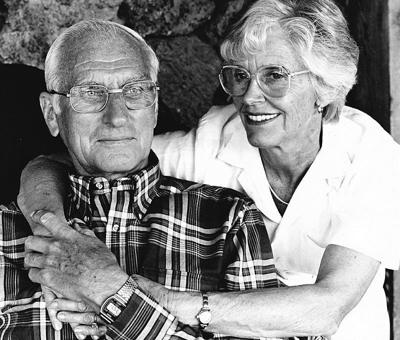
(Editor’s note: The following was penned by Jim Tindall for the Gorge Heritage Museum Newsletter in 2009. The review is based on the book commissioned by the late Wally and Priscilla Stevenson, “The Stevenson Chronicles,” as a gift to their descendants. A limited number of books were printed but copies are available for review at both the Gorge Heritage Museum in Bingen and the Columbia Gorge Interpretive Center in Stevenson. Following the publication of the newsletter, Wally sent Tindall a thank you note for the review. The original review has been edited with updates. Mr. and Mrs. Stevenson passed away one day apart in the last week of August.)
One can learn a lot about life from reading history and biography. Every personage of the past, with scrutiny, evolves into a paradox. Take a fellow like Wally Stevenson, who on first glance was a hard-nosed businessman. Yet, he was also the loving partner of wife Priscilla (they would have celebrated their 73rd wedding anniversary on Aug. 30, 2014). He was, also, the generous, helpful pool boy for his White Salmon relatives. While he may have been the demanding chief principal of SDS Lumber Company, he was also a gifted, caring provider for his extended family. Perhaps his hardest business decisions have as their basis determining their eventual good for the entire family.
Like the mature Ponderosa pine, Wally Stevenson had deep roots. His sense of place, ancestrally in Scotland, and personally, in Willard, stand clear in “The Stevenson Chronicles,” a book commissioned by Wally and Priscilla Stevenson as a loving gift to their descendants.
Several taproot themes shape this 10-inch by 13-inch, 100-page, forest- green monograph. These include devotion to family, dedication to post secondary education, service to country, the importance of recreation and sports, and fortitude. The last of these, of course, is fostered in other attributes.
This book is also a celebration of partnerships: matrimonial, business, fraternal, and social.
The Stevensons, in the publication of this book, honored family and business associates and the various communities through which their lives had taken them.
It is hard to hold a candle to the men and women who matured in an era of the Great Depression. Their values of reliability, to selfless national service, frugality, and avoidance of public showiness are all inspirational. They set high standards with which later generations have struggled. The Stevensons emulated this ideal American Citizen. They are quick to rebound from adversity. Like the rodeo cowboy, they get up and shake it off.
Priscilla wrote a poem to Wally for their 61st anniversary, summing up his life’s philosophy. Several of the couplets read, “Whether it’s freezing weather or 100 degrees/-you say the temperature is ‘Just Fine.’/When I think it’s time to re-carpet, after 25 years of wear and grime,/You question my eyesight – to you the rugs still look ‘Just fine.’”
While younger readers know war in some form through Iraq, Afghanistan, Vietnam, and other recent conflicts, World War II somehow seemed to coalesce our regionalisms and other diversities into a near single-minded national character. For our nation, Pearl Harbor changed everything.
Wally Stevenson’s graduate school was the U.S. Navy and the European Theater. In many ways he epitomized his generation.
Wally received the Bronze Star in 1944 for his meritorious service during D-Day, when he commanded a submarine chaser with a crew of 65. On June 8 and again on June 11, PC-1232 assisted ships struck by mines. It was his leadership role, made possible by Wally’s NROTC studies while he worked toward his degree in civil engineering, that helped to shape his business management skills.
Wally wrote, “I was only about 24 years old at that time, so I learned about being responsible for many men at an early age.”
While the Stevenson family business interests are regional in scope, the Stevensons remained politically and socially committed to the Mid-Columbia and especially to White Salmon. Wally served on the White Salmon Valley School Board and on the White Salmon City Council.
The family’s charitable giving is well known and wide spread and reflects keen interests including the school district, the library and the arts.
Sport and recreation release steam and show mettle, prowess, and agility. “The Stevenson Chronicles” tell of brother Rees’ legendary skiing abilities and how he and high school sweetheart and later wife, Eloise, were inducted in 2008 into the Northwest Skiers Hall of Fame. Also included in the book, are Priscilla’s and her siblings’ love of all things athletic. Son Bruce Richard Stevenson was something of a daredevil, enjoying football and basketball and skiing. He took risks, enjoying the exhilaration. As a teenager he actually dove off the Hood River Bridge. The impact of the 60-foot drop, going head-first, knocked him out. Luckily, Wally, was there with a boat and fished him out.
Wally and Priscilla kept trim and fit with skiing, tennis, and as aging slowed them down just a bit, golf. Competitive sports were a passion for many in the Stevenson family in their youth; active recreation remains an important part of many of their lives.
In gathering my thoughts for this review, several initial themes suggested themselves, but the recurring one that kept gaining my attention was that of higher education.
“The Stevenson Chronicles,” researched by Doug Levin and designed by Keith Carlson, tells the story of Wally Stevenson’s business and family. Throughout the book in the numerous family biographies, great value is placed upon the importance of higher education. From Priscilla Brown Stevenson’s parents Dick Brown who attended the Biltmore Forest School, and Dorothy Davies Brown who attended Smith College, and Wally’s parents, Don and Angeline Williams Stevenson, both graduates of the University of Oregon, down to the grandchildren of Wally and Priscilla, attending and succeeding in college is essential. Wally and Priscilla remained proud Husky alumni.
Jason Spadaro, current president of SDS Lumber Company, and the first non-family member to run the family business (he was elevated to the position after the sudden death of Bruce R. Stevenson in 1997), told The Enterprise earlier this week that “our community has been lucky to have Wally and Priscilla Stevenson as leaders. They loved this area and said many times that there’s no better place in the world. They were quietly, incredibly generous people and done so much to help our community for everyone to enjoy.”
Spadaro also had high praise for the company’s founding fathers. “We had three incredible founders in Wally Stevenson, Bruce M. Stevenson, and Frank Daubenspeck. At SDS, Wally provided incredible leadership and taught us, like he did his own family, about leadership, business, and community. We’re going to miss Wally’s leadership, but we look forwad to continuing his legacy.”
On a more personal note, Spadaro talked about the relationship he had with Wally Stevenson for nearly a quarter century.
“I’ve never met a greater leader, or a businessman with greater integrity, than Wally Stevenson,” Spadaro said. “No one could be more grateful than I am for having Wally as a mentor the past 24 years. I’ll carry the values I’ve learned from his with me forever.”
Wally and Priscilla Stevenson commissioned “The Stevenson Chronicles” as a gift to their descendants, to celebrate family. Wally writes, “We have had our share of tragedies, problems, and disappointments along the way, but we never gave up. We have always looked to the blessings of our family and have gone positively forward from there.” This tenacity and fortitude is inspirational, for no hard work or great wealth can protect us from the pain of being human, of loving those around us, regardless of their quirks or flaws.
While the book focused on the immediate family of Wally and Priscilla, the reader also learns about the immediate ancestors and about their siblings. You may know Wally as the partner of brother Bruce and Frank Daubenspeck and their phenomenal success in SDS Lumber Company (founded in December 1945 with the purchase of bankrupt Norby Lumber and Box Company in Bingen), but Wally sees and lives by the bigger partnership.
While he continued to operate as a shrewd and prudent businessman, much of his drive stemmed from his devotion to family, to guaranteeing prosperity for those he loves. He managed his resources with that goal ever present in mind.
“The Stevenson Chronicles” reads well and is entertaining history. For you history buffs you may enjoy reading about Don’s founding of the Broughton Lumber Company in the early 1920s with partner Harold Broughton, and how Willard became a formative place of home for Wally and his siblings Don, Eleanor, Jean, Bruce and Rees. Prior to the Broughton partnership, Don was a general contractor of highways, dams and bridges. It was these experiences that led to extended family campouts at the work site. This roughing it built fond memories.
As Wally writes, “I look back and wonder how my mother seemed to handle a family living in the wilderness so well. It helped that all the kids got along really well, and the older ones took care of the younger ones.”
Every youngster dreams of sailing off to new lands in search of adventure. The freedom of travel, the sport of mastering the vessel, the challenges of nature all come into play. In the late 1940s Don and Angie Stevenson purchased what would be christened the Black Prince, a 104-foot, trip-screw ship boasting three 500 hp engines, and was a surplus high-speed aircraft rescue ship. These engines were replaced with 180hp diesels, reducing the running speed from 27 to 11 knots. With much refurbishing the old Navy ship became a sleek yacht that was host to many a family member and friend. While The Black Prince was Don’s rig, sons Bruce and Wally, for their experience in navigation in the Navy, were the skippers with often five or six trips a year. During the warmer seasons it was moored in Puget Sound; Drano Lake was its winter home.
The Stevenson family is fortunate to have had several sanctuaries from the hectic, competitive business world. While The Black Prince was sold in 1960, other getaways have blessed the family. In addition to the Stevenson’s lovely White Salmon home, they wintered for a decade or so at Indian Wells, Calif. Also, daughter Bernice Stevenson Bean’s retreat at Nimpo Lake, British Columbia, “Walker’s Cabin,” was “an isolated and idyllic place to relax and reflect.” The Stevensons enjoyed travel and that special freedom that comes with escaping the routine.
Like most individuals successful in business, Wally Stevenson sailed with a course true to his ambition, possessing a keen faith in his vision for progress, with the welfare of his large, extended family as the rudder.


Commented