
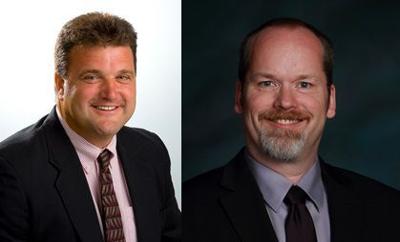
The two-man race for Klickitat County Commissioner District 2 is heading into the home stretch. After going head-to-head as the only candidates in the Primary Election, two-term incumbent David Sauter of Lyle and first-time challenger Michael Richard of High Prairie will go at it one final time in the Nov. 4 General Election.
The partisan position of Com-missioner carries a 4-year term in office. The current salary is $55,965.
Why are you running for re-election/election to the County Board? DAVID SAUTER: I decided to run again for this position because I care deeply about the citizens and well-being of Klickitat County. We are facing several challenges right now that I feel I am uniquely qualified to meet.
MICHAEL RICHARDS: I am running as a more fiscally responsible candidate. The county budget has exploded without a comparable benefit to the citizens of Klickitat County. As I have illustrated during recent candidate meet-and-greet events, in the past eight years, the budgets under the commissioners’ control have averaged increases of 120%, and commissioner travel expenses have in-creased by 230%. The citizens of Klickitat County have to ask themselves if they are receiving a reasonable return for their tax dollars.
Why do you want to be a county commissioner?
RICHARDS: I believe that many of the problems and issues that we face today will ultimately be resolved at the local level. Local politics provides the best opportunity for one-to-one communication between constituents and their representatives in government. This is key to providing accurate representation of the will of the majority of the population while preserving the rights of the minority.
SAUTER: When I ran for this office originally, I pledged to bring energy, enthusiasm and new ideas to this position. I pledged to govern fairly and with integrity, listen to all sides of the issues and to act in the best interest of the citizens. I believe I have fulfilled the promises I made, and I would like to continue my commitment for another term.
What is your personal background, education, professional experience, current employment, that helped you prepare for the position of county commissioner?
SAUTER: I was born and raised in Klickitat County. I attended Lyle School District and later Clackamas Community College, studying agriculture and business. I worked in the wine and salmon industries before starting my own construction business, building custom homes and managing employees. I also served on the Klickitat County Planning Commission and as a liaison for Klickitat County to the Columbia River Gorge Commission during the first Management Plan review. Since becoming Klickitat County District 2 Commissioner, I have worked hard to serve all of our county citizens. I am, by nature, a problem solver. I actively stay engaged both locally, and keep a close eye on statewide issues that impact my constituents. I have been elected to serve on the Washington State Association of Counties (WSAC) Board of Directors, Legislative Steering Committee, and now the Executive Board. Locally I also serve on the Columbia Gorge Housing Authority and the Columbia Gorge Regional Airport Board. All of these responsibilities have left me uniquely qualified to continue as a Klickitat County Commissioner.
RICHARDS: In addition to a four-year degree in electronics engineering and a successful twenty year career at high-tech companies such as Intel and Linear Technology, I spent the past several years in a leadership role. I was responsible for coordinating the activities of a ten member team working across all six departments of a fast-paced manufacturing facility. Our team was responsible for resolving many issues that came up between production, equipment engineering, process engineering, quality assurance and outside vendors. It is a challenging environment that requires exceptional people skills.
What is right or wrong with the way the County Commission is currently conducting the county’s business, and what improvements are you proposing to make the conduct the business more transparently to the taxpayers of the county?
RICHARDS: One of the biggest improvements that I would like to address is the county’s accounting procedures. Klickitat County currently uses two different and incompatible systems: cash and accrual. The county had to contract with an outside CPA in order to gain approval for this arrangement from the State Auditor. I believe we need to expend the effort necessary to bring the accounting system up to generally accepted standards. I have spoken with several current and former county employees that say this would provide the most benefit and increase the effectiveness and transparency of our county government. As president of the High Prairie Community Council, the first thing I did was create a new website on which the meeting agendas, minutes, bylaws and other information are all readily available. This was something completely new to our community council. Additionally, we began making complete video records of each meeting and posting them on the internet so that people who could not attend due to mobility issues, illness, scheduling conflicts, etc., would not miss any of the council goings-on. These improvements have generated positive feedback from the community and cost nothing to implement. I believe we should investigate the possibility of incorporating a change such as this for the county commission. If nothing else, it may inspire more citizens to actively participate in their local government.
SAUTER: I like to focus on the positive. Regarding transparency, one way we have improved service and public input is by conducting public hearings on issues that are specific to west-end taxpayers at the Pioneer Center. This saves people from having to travel to Goldendale to voice their concerns. As for an area of improvement, I would like to re-establish the permit intake position at the Pioneer Center to allow citizens to submit and pick up building permits without traveling to Goldendale. I would also like to improve how we serve the public using technology. We are exploring ways that we can provide better access to county records online.
What has the County Board accomplished during your time in office and why have those accomplishments been good for the citizens of Klickitat County? In the alternative, what things has the current County Board done in terms of policy matters and management of public funds that you disagree with?
SAUTER: We have been very active as a board. One of our biggest accomplishments has to do with the Port of Klickitat and our role in retaining Insitu, which led to their decision to build the Eagle Point Campus here in our county. We also hired a Veteran’s Service Officer to help our veterans better access services. We invested in a 911 radio system upgrade which included the building of a new dispatch center. We formed the Klickitat County EMS district. We created the Columbia Gorge Regional Airport Business Park. We actively pursued state and federal funding, as well as provided county matching funds, to improve infrastructure county-wide. Specifically, we helped fund the White Salmon slow-sand filter, which allowed new water hook-ups in their service area. We also provided matching funds for Dallesport and Bickleton water system upgrades. We gave numerous grants to fire and school districts and improved roads throughout the county. All of this was accomplished while maintaining a balanced budget.
RICHARDS: Every January since 2001, the county commissioners have received an automatic 2.5% cost of living adjustment, while other county employees must wait to find out how stable the budget is to see if they will be awarded a pay increase by the board. This continued during the 2008 recession. I believe that the matter of compensation should be turned over to an independent salary review board as suggested by RCW. As I mentioned earlier, budgets under the commissioner’s control have more than doubled in the past eight years. During the same timeframe, budgets under other elected official's control have increased an average of only 10%. I have attended numerous BOCC meetings this year and have witnessed other officials request, and be denied, more or better resources to effectively do their jobs for the citizens. I believe that the needs of citizens should come first and all reasonable requests for resources from other departments must be seriously considered prior to undertaking large infrastructure projects or economic development projects such as the expansion at the Columbia Gorge Regional (CGR) Airport.
What is the current state of the county’s finances? How much debt is the county holding on behalf of taxpayers? What projects has the county invested in to acquire that debt? How secure is the county’s ability to maintain its debt/service schedule?
RICHARDS: The county budget is a challenge to understand. Some of the debts are hidden, For example, the CGR Airport budget is not listed in the county records. Many problems at the CGR Airport could have been avoided had the county not mismanaged the original paperwork for the SEPA reviews, project descriptions and the like, which has been covered by the media. Environmental concerns raised by citizens in the area and were found to have merit but were ignored by the county, resulting in delays and cost increases. I believe the results of the radio system installation speak for themselves. This is what we should expect when one government agency mandates that another government agency undertake a large and complex project such as this. In my opinion, the players involved were simply doing the best they could on a project that was far outside the scope of their knowledge and experience.
SAUTER: Klickitat County is in great shape fiscally. Currently, our county liabilities total $5.7 million, of which $1.5 million is a bond on the construction of the Pioneer Center, $3.9 million is a bond on the Dallesport Wastewater Treatment Plant, and $250,000 is the county’s share of the $500,000 Community Economic Revitalization Board loan for the Columbia Gorge Airport Business Park. Our total reserves are around 19 million dollars. During my term we instituted a reserve policy that requires all debt to be backed by cash. While we are easily able to meet our debt service with current revenue, this ensures that should something happen to our revenue sources, all of the debts of the County could be cleared and we would still have a significant amount of money left in reserves. For all practical purposes, the County has no debt. We keep a reserve for future capital infrastructure needs and investment opportunities.
Why has the County Board gone “all in” on the development of the Columbia Gorge Regional Airport? How are project costs being split between the county and the City of The Dalles?
SAUTER: The Columbia Gorge Regional Airport represents one of our best opportunities for economic development in the central part of our county. The location has access to transportation, public infrastructure, reasonable housing costs, and availability of buildable land. We are trying to expand the aerospace business development area to include citizens living on the east side of our county, providing much needed employment. All costs for projects are split 50/50 with our partners in the City of The Dalles. We are thrilled to have recently received another grant for our new “Flex Space” building, the first to be built in our new business park. We have already secured our first tenant, Life Flight. We are very confident that we will soon be able to add manufacturing jobs as well.
RICHARDS: The reason for the airport infrastructure is to allow private companies to build on government land. Why does the county desire to build a building twice the size needed for Life Flight? The airport sponsors, Aeronautical Management Inc., a private entity, receive 10% of the lease to Life Flight. The ultimate results of the investment at CGR Airport are yet to be realized. However, it is my belief that government should not be the investor of first resort for projects such as this. Government does not have the same incentives as the private sector to proceed carefully or keep investment costs low. If a private venture suffers delays and cost overruns, the consequences of those decisions are confined to that entity. As we saw in the years 2007-2008, failures on behalf of government investment are distributed to the taxpayers at large. From my perspective, government should limit its own participation and allow free market enterprise to identify opportunities, evaluate the profit potential, and proceed on projects such as this.
What are the key issues facing Klickitat County in the next 4 years, and what is your thinking on how the county ought to meet the challenges those issues present?
RICHARDS: One of the biggest challenges for our local government is how to manage the increasing environmental regulations coming from state and federal government. For example, the county is required to uphold the rules and regulations of the state Shoreline Management Act and the Gorge Commission. However, landowner’s property rights must also factor in to the county’s actions. In cases of conflict between property owners and the rule of law, the county must advocate on behalf of county residents in whatever way possible, while simultaneously ensuring that no lawsuits result from the actions of the board.
SAUTER: One issue that concerns me deeply is our housing situation. I believe access to affordable, work-force housing continues to be a key limiting factor for economic growth. We are working to solve this problem. As a board member on the Columbia Gorge Housing Authority, we are actively bringing people together to collaborate and find solutions. We are working with groups of bankers, land developers, builders and municipalities to get affordable housing built and on-line. Another key issue is high-speed internet availability. We still have many areas in our county that are on “dial up” internet. Businesses require high-speed internet. Without it, many of our citizens are being left behind. When we constructed towers for our new radio system, we considered those locations to be used as future access points to provide broadband internet services. If re-elected, I will work to bring affordable high-speed internet throughout the county.


Commented
Sorry, there are no recent results for popular commented articles.