
This past Friday at the White Salmon Public Library, nature enthusiasts came together to listen to Jay McLaughlin and Ken Bevis deliver talks for “A Natural History Series” coordinated by Joy Markgraf.
The lecture is part of a series during the entire month of April, occurring every Friday at the White Salmon Public Library starting at 6:30 p.m. Topics rotate weekly depending on guest speakers.
The first night of the series began with a full house. White Salmon locals as well as outside residents gathered in the library’s Baker Gallery to listen in on presentations ranging from forest management to how to engage younger generations with nature.
The night began with introductions by Caitlin Cray, then moved into Jay McLaughlin opening the floor with an informational talk titled “Forest Health and Fire in the Mt. Adams Region: Advancing Our Understanding in Pursuit of More Resilient Forest and Human Communities.”
McLaughlin has worked with communities and natural resource issues since 1995; his background entails a master’s degree in forestry from the Yale School of Forestry and Environmental Studies, and a bachelor’s degree from Whitman College.
Currently McLaughlin is the founder and executive director of the Mt. Adams Resource Stewards (MARS), a nonprofit organization founded in 2013 with the mission to “support the health, productivity, and sustainability of the communities, economy, and landscape of the Mt. Adams region.”
In McLaughlin’s lecture he brought up the role of fire in management and maintaining a forest and its communities. McLaughlin stressed the importance of addressing forests as multifaceted ecologic communities that can’t be summed up in one explanation, “there’s a lot of complexity in forests in the Mt. Hood, Mt. Adams region,” said McLaughlin. The role of fire as a management tool for forests in the Mt. Adams region is slowly being transitioned to prescribed burning.
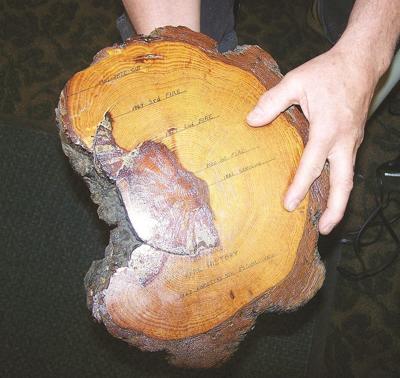
When looking at forest ecology and fire, an automatic assumption is the devastation it brings to the environment, McLaughlin addressed this as a natural process saying that “disturbance, in our case fire, is woven through the narrative here,” here being the Mt. Adams region and its history with naturally occurring wild fires. Depending on the region, Mt. Adams forests vary greatly by elevation, there’s no “one site fits all theory when talking about fire,” said McLaughlin. The method of prescribed burning is controversial because different forest ecosystems need different levels of burns which creates debate among forestry professionals. Some forests have higher precipitation, resulting in a moister ecosystem. These forests are more controversial in what foresters think should be done when using fire to maintain them. Historically moist forests tend to burn less frequently but more severely with species of flora that have adapted to such conditions. On the other end of the spectrum are forests that are drier, with more frequent fires that don’t burn as severely and act more like standard maintenance. The ponderosa pine was used as an example of a successfully adapted resister species because of its thick bark which protects its core from the fire’s damaging heat.
The forests McLaughlin discussed in the lecture were south of Mt. Adams and lumped into the moist end of forest ecology, meaning that said forests often had fewer but more severe burns when fires took place. Now, the forests are overcrowded and competing for resources, so trees don’t grow as large as their predecessors once did. McLaughlin explained this happening because regular fires weren’t burning the underbrush and eliminating weaker trees. But there is some hope for prescribed burning, says McLaughlin, after the Cold Springs Fire in July 2008 a charred ecosystem was left behind but this allowed for researchers to gather observations and data about how the area regenerated.
With a better understanding of fire from researching the Cold Springs fire McLaughlin hopes he and the MARS organization can make progress in pushing the acceptance of prescribed fires as a way to manage forests. McLaughlin carefully laid out the goals of a prescribed fire as: reducing fuel that could build up and create a more severe fire than one would naturally occur, restoration of ecological processes, seed bed preparation, and increase forage.
The talk came to a close with McLaughlin discussing prescribed burnings’ slow start as a well-accepted form of forest control since federal and state law overlap in regulating it, which makes it difficult, says McLaughlin. Although forests benefit from the chemical change that fire brings to the soil there’s constant tension on whether a prescribed fire can be contained while still being effective. McLaughlin brought up the challenge of keeping prescribed burning alive as a positive subject that has positive returns. But the possibility for things to go wrong is high, which makes people hesitant.
The evening then transitioned to Ken Bevis’s “The Saga of Washington’s Fish and Wildlife” power point presentation which entailed him singing and playing guitar. Bevis is a wildlife biologist who works in various communities to teach people about forest ecosystems. Bill Weiler, from Hood River, accompanied him on his keyboard singing along to songs about native animals in Washington, ranging from the Black Bear and hummingbird to the Chinook salmon.


Commented