
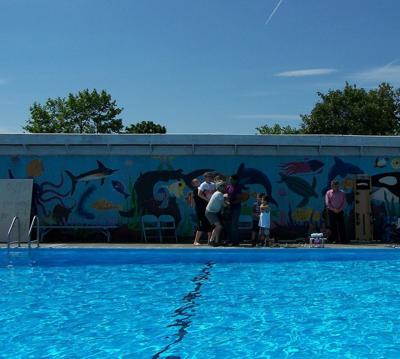
The northeast corner of the Whitson Elementary School carpark has been designated as “the site” for the next White Salmon swimming pool.
By consensus, the City Council gave the city’s pool consultants the go-ahead on Feb. 3 to prepare a final site plan that focuses exclusively on the carpark location.
The decision came with some urgency. With a final, approved site plan, City Administrator Pat Munyan Jr. can start writing an application for a $500,000 grant from the state Recreation and Conservation Office. The deadline is May 2; state funding from the Land and Water Conservation Fund would become available in 2017.
Mayor David Poucher told The Enterprise on Monday that the council will be asked at the Feb. 17 meeting to cap the project budget at $1,350,000. He said that sum represents the amounts the city expects to receive from grants, private donations, and community fund-raisers.
“That’s the figure [the city’s consultants] will have to work with to develop a final site plan that we can take to potential donors,” Poucher said. “And we have to move fairly quickly if we want to meet the grant deadline.”
If all goes to form with the financing, Poucher added, construction would begin in 2018 and the pool would open in 2019.
Consultant Brooks Heard, of Trout Lake, told the City Council last Wednesday the project “started out as a feasibility study and has evolved into a design phase.”
He said the estimated construction budget for the proposed pool came in at around $1.5 million. In response to a question from Councilor Jason Sabourin, Heard said the budget includes demolition of the existing pool and turning the site into playground for the school.
The council and consultants Heard and Dick Spies took their cue from Paul Mosbrucker, a member of the White Salmon Valley School Board.
Mosbrucker stated the School Board is “adamant” the pool must be located in the northeast corner of the carpark (the corner of Hood and Church). He also noted there is strong support in the community for retaining the large Douglas Fir on the lot’s southern boundary as a heritage tree, in tribute to the community’s deep roots in the timber industry.
Whitson Elementary School Principal Todd McAuley added that parking congestion should not be an issue since the school year and the pool season don’t overlap.
Heard and Spies presented multiple site plans for the pool that also included locating the pool in the northwest corner of the lot. Each plan outlined by the consultants maximized the number of parking spaces to address the issue of parking congestion.
A decision to move forward came when Poucher summarized what he had heard and, hearing no objection from the council, told the consultants to get started on a final site plan that will include a construction budget and recommendations for financing pool maintenance and operational costs.
As a final note, Heard reiterated the consultants’ recommendation to council to appoint a steering committee of stakeholders to guide the project through the final design phase and construction. The council, however, did not take up his request.
The Recreation and Conservation Office (RCO) administers the state’s Land and Water Conservation Fund, which provides funding to preserve and develop outdoor recreation resources, including parks, trails, and wildlife lands.
Congress established the fund in 1965 with the passage of the Land and Water Conservation Fund Act that authorizes the Secretary of the Interior to provide financial assistance to the states for the acquisition and development of public outdoor recreation areas.
According to the RCO’s Web site, typical projects include:
•Renovating community parks,
•Building new skate parks, tennis courts, swimming pools, and trails,
•Protecting wildlife habitat,
•Building athletic fields.
Funding comes from a portion of federal revenue from selling and leasing off-shore oil and gas resources. The grant cap per project is $500,000.
The match requirements is 50%. For local agencies and special purpose districts, at least 10% of the total project cost must be from a non-state, non-federal contribution. Examples of match are:
•Appropriations or cash,
•Bonds,
•Donations of cash, land, labor, equipment, and materials,
•State, local, and private grants;
•Applicant’s labor, equipment, and materials.


Commented