
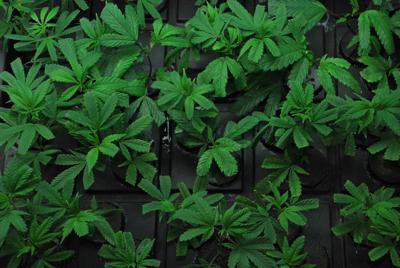
A little less than a year after allowing a prior moratorium to lapse, recreational marijuana businesses in Klickitat County’s unincorporated areas have been put on hold.
At the Oct. 21 meeting of the Klickitat County Board of Commissioners, the panel opted to reinstate the moratorium in the county’s unincorporated areas “to protect the health, safety and welfare of the public from the potential expansion of existing marijuana facilities and new facilities,” according to a press release provided by the county.
Klickitat County’s three incorporated cities include Goldendale, which has a city-specific moratorium in place currently, White Salmon, and Bingen.
While the moratorium is in effect, the Board of Commissioners will consider the adoption of policies that could include a requirement to provide notice to owners of property surrounding a proposed site, determination of factors that might decide if a marijuana facility is incompatible with other uses in certain areas, or restrictions to “protect the public’s health and safety.”
If the commissioners decide to carry on with the moratorium after a public hearing slotted for Nov. 12 at 6:30 pm at the Klickitat Public Utility District in Goldendale, the Klickitat County Planning Commission will be tasked with developing recommendations for amendments to county zoning regulations and policies.
Carrying up to an ounce of recreational marijuana was legalized by the electorate in Washington State in 2012. The resulting law, Initiative 502, places heavy restrictions on those who apply to grow, process, or sell marijuana, but does not prohibit counties from instituting moratoriums on such businesses.
As of Dec. 17, 2013, Klickitat County lifted a previous moratorium on I-502 businesses after hearing comments during public hearings regarding the legality of recreational marijuana in Washington and how the state Liquor Control Board (LCB) processes licenses and monitors I-502 businesses.
After seeing the law in action for the past 10 months, the commissioners felt another moratorium was needed before further I-502 businesses attempt to locate in the county. The LCB capped the number of retailers in Klickitat County at four, with one set for Goldendale and three throughout the rest of the county, but there is no cap on how many growers and processors can locate here.
At the time of the first moratorium, the Klickitat County Planning Department had recommended allowing licensed marijuana growers and processors to operate in General Rural and Extensive Agriculture zoning districts, or on a minimum of five acres, and to direct the planning commission to develop recommendations for the regulation growing and processing in other zones and of retail sales in unincorporated areas, but the board chose not to act on that recommendation, according to the Dec. 26, 2013 edition of The Enterprise.
“It wasn’t that (land use) wasn’t considered, we had three hearings to address any issues and they were really well attended, but they were almost exclusively attended by those who were in favor of the moratorium being lifted or had a vested interest in these facilities, so we received almost no negative comments or concerns whatsoever from the public about zoning,” said Klickitat County Commissioner David Sauter. “We are supposed to respond to our constituency, so when 40, 50, 60 commenters say we need to lift the moratorium we felt we had misjudged the situation and we lifted it. It wasn’t until after these businesses started coming in that people started seeing the impact.”
So far, the LCB has licensed Stonehenge Cannabis, in Murdock, as the lone recreation marijuana retailer in an unincorporated area in Klickitat County. The LCB has also licensed Margie’s Pot Shop, in Bingen, and Golden Dispensaries in Goldendale, though the City of Goldendale recently enacted a six-month moratorium on I-502 businesses of its own.
There are four additional retail licenses listed as “pending” in Klickitat County, according to a list of applicants by the LCB, though only one more can locate here due to the LCB’s cap.
Additionally, the LCB lists 26 businesses as applicants for a license to process marijuana in Klickitat County, of which nine are listed as “active.” There are 37 applicants wishing to grow marijuana within the county with 11 of those granted licensure to do so.
“…The Board of County Commissioners adopted the moratorium to halt the establishment of new marijuana production, processing, and retail facilities in unincorporated areas of Klickitat County, in order to allow time to determine how to address the local impacts from such facilities,” the county’s press release reads.
The county has made it clear that those who have already received a license through the LCB and filed a complete building permit application with the Klickitat County Building Department for a building permit for their facility will not be impacted by the moratorium.
“Marijuana licensees who have not yet received a license from the LCB or have received LCB licenses but not submitted a complete application to the County Building Department for a building permit are prohibited from operating while the moratorium is in effect,” the press release reads.
The commissioners’ decision to reinstate the moratorium stemmed from the locations some I-502 businesses wish to locate within the county. I-502 prohibits all recreational marijuana businesses from locating within 1,000 feet of schools, parks, arcades, or other certain areas young people might congregate.
The problem the county found with I-502 is that it does not go far enough to keep marijuana businesses away from young people or from those who do not do wish to have such a business close to their home.
“The current LCB rules restrict facilities from locating near schools and certain other types of uses, but do not consider other important factors, such as proximity to residences, school bus stops, and other locations where children and under-age young adults may be present,” the press release reads.
According to Brian Smith, a spokesperson with the LCB, the entity does not notify surrounding property owners of a pending license application, but all addresses of applicants have been listed on the LCB website’s “Frequently Requested Lists” page for the last eight months. The page is updated every Tuesday with any new information regarding the status of license applications.
The list of all applicants, including information on location and licensure status, can be found at http://www.liq.wa.gov/records/frequently-requested-lists.
“It’s the appropriate responsibility for local governments to zone their jurisdictions for where they want to channel certain commercial activity. Many local governments will post a land-use permit,” Smith wrote in an email to The Enterprise.
Smith added that the LCB will continue to issue licenses despite a moratorium in one area or another. It’s the locality’s job when it comes to enforcement, but Smith said a business cannot operate if it is not in compliance with local regulations.
“We had to face this issue some time ago and nothing in the law allows us to deny a license for someone who has applied and met all of the criteria. Moratoriums are supposed to be temporary. They come and go, they change all around the state,” Smith said.
Then there is also a concern being raised about how much marijuana the state will allow growers to produce throughout Washington. Under the initial law, a maximum of 2 million square feet of marijuana canopy could be grown in Washington, but now the state is considering upping that to 8.5 million square feet, which had led the county to fear an “expansion of operating marijuana facilities and/or a round of new applications to the LCB for additional facilities.”
The LCB allowed applications to be submitted for a short time in 2013, but no applications have been accepted since that window closed last December.
According to Smith, it isn’t going to reopen in the near future.
“We won’t be accepting any new applications anytime soon,” Smith said.
Smith also said the LCB chose to consider changing the overall square footage throughout the state to 8.5 million square feet because with the number of growers licensed currently, the canopy statewide has already expanded to 3 million square feet to feed a market that has already faced product shortages and high prices.
“The average person won’t see any difference,” Smith said.
A public hearing regarding the moratorium is scheduled for Nov. 12 at 6:30 pm in the meeting room of the Klickitat Public Utility District at 1313 S. Columbus Ave. in Goldendale.


Commented