
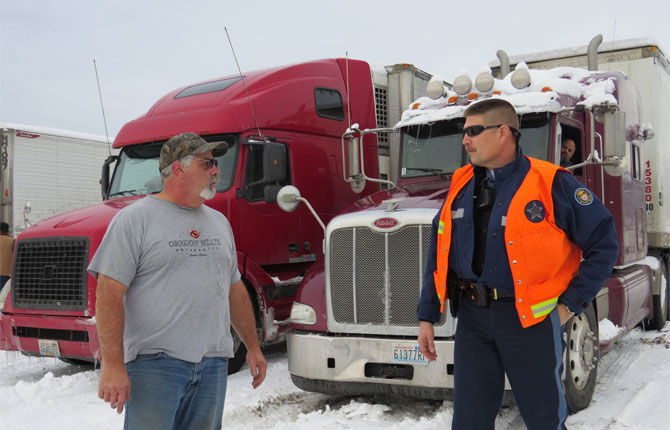
Since Christmas Eve, The Dalles Area Command of the Oregon State Police has assisted 202 stranded motorists and handled 184 reported crashes — 41 of which occurred within the past week.
Those numbers are just the ones Lt. Pat Shortt has on hand, there are others for earlier in December, when the first of a series of storms pounded the area.
“When we know we are going to have a big [weather] event, we check with the troops who are not scheduled to work and find out who’s going to be available for a call out,” said Shortt, who runs the gorge office that serves five counties.
“We’ve supplemented our patrols quite regularly over the past month and sometimes the troops have put in 14 hour days -- you can’t be dealing with a multiple-crash scene and then say, ‘Oh it’s time to go.’ We are there until the job gets done.”
On Wednesday afternoon, Shortt joined four other troopers in cruising snow-packed roadways in Wasco, Hood River, Sherman, Wheeler and Gilliam counties.
“We patrol from Bonneville to Arlington, it’s easy to put on more than 300 miles a shift,” said Shortt. “We want to make sure we are out there because we don’t want someone whose car has slid off the road sitting there and no one coming by.”
Of particular concern to Shortt on Jan. 11 was the re-opening of Interstate 84 to east and west traffic between Hood River and Troutdale.
He was concerned about the hundreds of truckers who would be back on the road after being stranded. Travel became so dangerous on Tuesday night that the Oregon Department of Transportation made the call to shut down that section of I-84 the freeway.
“That was a hairy mess,” said Shortt of having troopers on the road in an almost blinding snowstorm. Stranded trucks had been routed to a large lot at the Hood River waterfront and along Sixth Street in The Dalles.
“I can’t give ODOT enough kudos,” he said while surveying the highway that had been well plowed after the storm.
“The most important thing is to keep it smooth, eliminate the bumps that cause crashes,” he said.
His car has all-wheel drive and studded tires and he has decades of experience behind the wheel, but Shortt still keeps his speed down to 40-45 miles per hour to reduce the potential for an accident if he has to brake suddenly or make a defensive maneuver. “The worse the conditions are, the more I slow down,” he said. “People think that because the posted speed limit is 65, they can go that fast — but that’s not the way it works. Oregon is a basic rule state, which means that you can’t drive faster than it’s prudent for the conditions.”
He points to a vehicle headed in the opposite direction that is doing at least 60.
“Today, if I have someone driving 65 on this, they might well be getting a ticket,” said Shortt.
“If they blow past me, I’m not going to chase them because it doesn’t do anyone any good if I end up in a ditch or worse. I just call those ones in and we get them at the other end.”
Shortt said one of the best ways to ensure motorists keep speeds down is to have patrol cars on the road. He admits that he and other law enforcement officers also check their speedometers and automatically reduce their speed when they see a patrol care while off-duty.
“I think that’s just a natural reaction,” he said.
Shortt was headed to Hood River to check in with truckers and make sure they understand that they could not continue westbound if they are not chained up.
Overall, there was not much traffic in either direction, something that he expected would change as people learn that travel lanes are once again open.
“Bad weather is just part of living here,” he said. “Troopers who don’t like to work in these kinds of conditions don’t end up staying at The Dalles Area Command very long.”
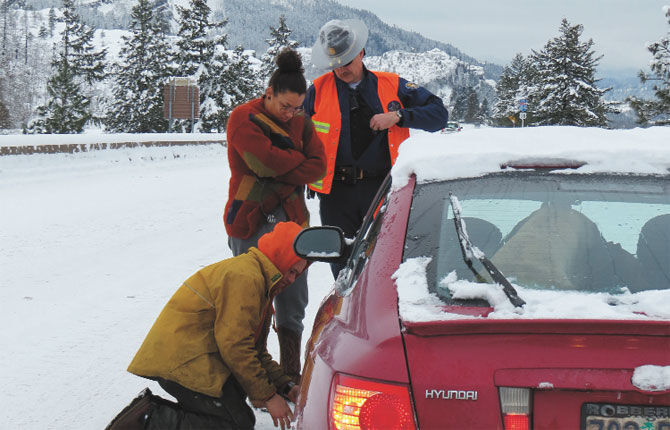
While enroute, Shortt spotted two vehicles with flashers pulled over on the westbound shoulder.
He pulled in behind and carefully made his way over on the passenger side to the couple. He was told that she had the wrong-size chains on her car and one broke so she called her husband to come fix the problem.
“What they are doing right now is kind of freaking me out,” said Shortt of the fact that the man was kneeling beside the left front tire, putting him only a short distance away from the slick roadway.
The couple seemed to have things under control so Shortt moved on.
Traffic stops along the freeway are dangerous and Shortt said those are the times when he most worries about his 16 patrol troopers.
There is always a chance, especially in bad weather, that someone will hit the patrol car or slide into the law enforcement official.
“When I get out of my car, I’m always looking for a place to run,” said Shortt. “Your head’s always swiveling — it has to be.”
He said troopers used to assign traffic stops to two categories — high risk or low risk, but times have changed and now they are defined as high risk or unknown risk.
Three years ago, Trooper Matt Zistel was shot and injured by a Portland man he pulled over along the freeway for speeding.
Those are always the situations you fear when you approach a vehicle, said Shortt. “You are hyperviligant, tuned up when you walk up to the vehicle because you don’t know what’s going to happen,” he said.
Winding down after a shift can be problematic, said Shortt, and the healthy way of doing that is for a trooper to exercise, coach a sports team or otherwise channel energy in a proactive manner.
Shortt arrived in Hood River to find that some semis had sunk into the ice below the snow layer and gotten stuck. These rigs were being pulled out of their ruts by other truckers.
Ray Hazzard of Leavenworth was one of the truckers who spent the night there. He picked up a load of grape juice in Sunnyside, Wash., and was headed to California for delivery.
“We had no place to go so we pulled over and then they moved us off the highway and down here, which was really decent,” he said.“Most places don’t get hit like this, this is really the worst.”
Back in the car, Shortt explained that it was important to get trucks off the side of the freeway because ODOT cannot plow evenly when they are there. He said the berms of snow around the truck end up creating bumps that are hazardous.
In addition, he said the risk of an accident increases when there is no shoulder room — and once there is one accident on a slippery roadway, more quickly follow.
On March 1, Shortt will have completed 30 years with the state police, plus one as a cadet.
“It’s been a really great career, I think the closer you get to the end of it, the more you realize what a privilege it’s been,” he said.
Shortt never planned to enter the field of law enforcement; his plan after high school was to go to college and become a dentist.
“My first chemistry class changed my mind,” he said.
Put off by science, he turned toward history as a major but two weeks of “boot camp” to become an OSP cadet, and time spent patrolling state parks, hooked him into the profession.
“I thought, ‘This is a noble career to be in,’” he said of the ability to help keep citizens safer.


Commented
Sorry, there are no recent results for popular commented articles.